IN BRIEF
- In Kakheti, Georgia’s main wine region, the 2026 harvest is proceeding with an exceptional delay compared to last year.
- Vladimer Kublashvili, a winemaker for over twenty years and recently appointed General Manager of Winery Khareba, tells Winemag that he has never witnessed such a late harvest.
- The underlying causes are delayed flowering, heavy rains, and an insufficient number of sunny days, leading to difficulties in sugar accumulation.
- It is a situation almost mirror-opposite to that observed in 2026 in Champagne, Germany, Italy, and Spain, where heat and accelerated ripening led to very early harvests.
- The Georgian case does not contradict climate change: rather, it demonstrates how much vintage variability has increased and how temperature, rain, solar radiation, and phenological phases must be read together.
While a large part of wine-producing Europe spent the summer of 2026 chasing grapes that were ripening too quickly, almost the opposite is happening in Georgia. In Kakheti, the production heart of the Caucasian country, many vineyards are still to be harvested in early October. Not simply because Georgia has, by nature, a later calendar than the Mediterranean. The anomaly is internal to the region itself and becomes evident when comparing 2026 with the previous vintage.
Vladimer Kublashvili, the long-time winemaker of Winery Khareba who was recently appointed General Manager of the company after twenty years with the group, tells Winemag: “In Kakheti, we are experiencing a very late harvest. Personally, I have never seen such a delayed harvest, and I have worked in the wine sector for more than twenty years.”
The comparison with 2025 is stark. “Last year, at our winery, we had finished all harvest operations in Kakheti around September 20. This year, we still have about 75% of the grapes to pick.” Winery Khareba, which owns over 1,500 hectares of vineyards in Georgia, concentrates about 1,125 hectares in Kakheti: 75% of the total. The figures cited by Kublashvili, therefore, hold value for the entire region, well beyond the mere company scale.
KAKHETI: WHY THE 2026 HARVEST IS SO LATE
The explanation for Kakheti’s extraordinary late harvest starts long before the grapes ripen. “We had a late flowering,” emphasizes the General Manager of Winery Khareba, “and, as a result, all subsequent phases were pushed forward.”
Added to this initial phenological delay was a weather pattern unfavorable to sugar accumulation. According to winemaker Kublashvili, during the season there were not enough sunny days useful for the different varieties to reach the desired maturity.
A reading also confirmed by the Georgian authorities. The Ministry of Agriculture pointed to heavy rainfall as one of the reasons why, in many vineyards, grapes struggled to reach the required sugar content, forcing producers to wait. The ministry itself explicitly defined the start of the 2026 harvest as “relatively late,” observing ripening delays in other agricultural crops as well.
The most evident case cited by Kublashvili is that of Rkatsiteli, Kakheti’s main white variety. “As of today, October 7, 2026,” he tells Winemag, “we still do not have a sufficient sugar level. We are around 19-20 Brix, but at a certain point, we must proceed with the harvest anyway to avoid drastic drops in acidity, which would further complicate the 2026 harvest.”
This is not a minor detail. During the same harvest, the Georgian public system also linked grape purchase prices to specific sugar concentration thresholds. For Rkatsiteli and other wine varieties, at the end of September, the highest bracket started from a sugar content of 19% Brix, equal to a potential alcohol content of approximately 10.7% – 11% by volume.
GEORGIA 2026 HARVEST: LATE, BUT NOT SCARCE
The delay, however, does not mean a quantitatively poor harvest. On the contrary, Georgia forecasts about 320,000 tons of grapes for 2026, a crop that could be among the most abundant since the country’s independence.
As of October 6, 182,210 tons had been processed in Kakheti, of which 92,100 were Saperavi and about 77,400 were Rkatsiteli. 99% of the grapes delivered were classified by the National Wine Agency in the high or medium quality brackets. The harvest is still indicated as being in its “peak phase,” with 13,000-14,000 tons processed daily.
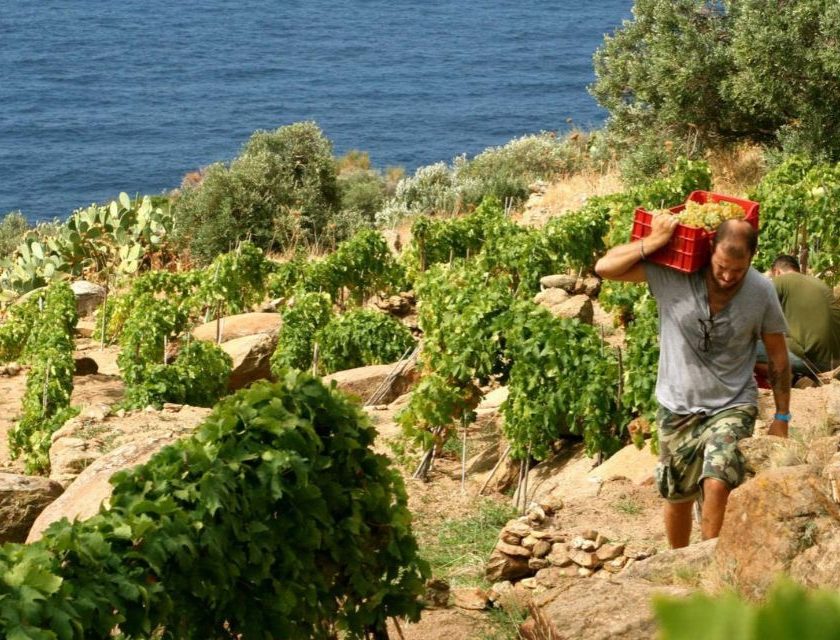
An unusual picture for the beginning of October, confirming the significant delay of the 2026 harvest in Kakheti compared to the previous year. The Rtveli, as the traditional harvest season is called in Georgia, is lasting in Kakheti well beyond the timeframe of the previous year in 2026.
For Winery Khareba, Kublashvili still expects substantially normal yields. The discussion regarding the profile of the wines is more delicate. The whites could present lower alcohol levels, while for some reds, the vintage could even yield interesting results. “The challenge,” he explains, “will be above all to maintain the typicality of the different varieties in such an unconventional vintage.”
THE WINE WORLD IN 2026 WENT IN THE OPPOSITE DIRECTION
This is where Kakheti becomes particularly interesting. Its 2026 calendar seems almost the mirror image of that observed in many of the main European wine regions.
In Champagne, 2026 was defined by the Comité Champagne as the year of the earliest harvest ever observed. The first grapes were picked on August 6, after a very early flowering and five summer heatwaves. By August 17, the harvest was widespread, about two weeks earlier than in 2025.
In Germany, the Deutsches Weininstitut described the start of the main harvest as exceptionally early—and, for many wineries, the earliest ever recorded. The summer heat simultaneously accelerated the ripening of numerous varieties, forcing producers to monitor sugars and acidity with particular care.
In Spain, Winemag had already reported the case of Juvé & Camps, which on July 27 had started the earliest harvest in its history in Penedès. In Mallorca, however, the 2026 season started about two weeks early.
A similar dynamic affected numerous Italian areas, from Asolo Montello onwards, where heat and drought brought forward harvest decisions.
FROM “BOILING NIGHTS” TO THE RAIN OF KAKHETI
The Georgian paradox becomes even more evident when re-reading what Winemag highlighted on August 10 in the article “The boiling nights… of the grapes. The early harvest, explained well“. Indeed, it is not only maximum temperatures that determine the acceleration of ripening.
When even the nights remain warm, grape respiration continues at high rates, the consumption of malic acid increases, and the window for harvesting balanced clusters narrows. Sugars go up, acidity goes down. And, in some cases, aromatic and phenological maturity struggles to keep pace.
The 2026 harvest in Kakheti shows the other side of the same complexity. Here, the problem described by producers is not that of grapes running too fast, but of a cycle that started late and sugars that struggle to advance, partly due to rainfall and the lower availability of sunny days.
GEORGIA’S LATE HARVEST DOES NOT DISPROVE CLIMATE CHANGE
It would therefore be simplistic to read the 2026 harvest in Georgia as a sort of exception capable of disproving the trend toward earlier harvests. The OIV, in its guidelines for studying the effects of climate change on viticulture, specifically invites consideration of maximum and minimum temperatures, precipitation, solar radiation, dates of flowering, veraison, and ripening, in addition to the harvest date.
It also emphasizes that to identify true climatic trends, long time series are needed, generally at least thirty years. A late harvest in a single region and in a single vintage can therefore perfectly coexist with a long-term climatic trend toward higher temperatures.
In fact, the comparison between Kakheti and the rest of wine-producing Europe in 2026 perhaps tells the contemporary problem even better: not a simple calendar that moves forward everywhere at the same pace, but a viticulture increasingly exposed to extreme vintages—divergent and difficult to interpret through old averages.
In Champagne, the grapes were already running in August. In Germany, producers were back in the vineyards early. In Penedès, clusters were being cut in July. In Kakheti, in late October, they are still waiting for part of the Rkatsiteli to accumulate enough sugar.
The 2026 harvest thus serves as a reminder that the wine climate does not have a single clock. And that, sometimes, while almost everyone is forced to anticipate it, someone still has to wait. One above all, Vladimer Kublashvili.