At the central market in the old town, on Shota Rustaveli Ave, the colors of women’s headscarves blend with those of spices, cheeses, and strips of Churchkhela, a traditional Georgian sweet made from grape juice, dried fruit, and flour. There are also a few bottles of Imereti wine, preserved who knows how. Walking through Kutaisi, the country’s third-largest city, 220 kilometers west of the capital Tbilisi, is like immersing yourself in a paint can. You emerge colorful, happy. Dazed. Intoxicated by aromas and snapshots of history, culture. Pride. Myth. This is the land of the Argonauts, of the quest for the Golden Fleece. Of the Rioni River and the White Bridge. Of Motsameta Monastery, immersed in the silence of untamed, wild nature in a wine region that wants to make its mark on the international scene. Shaking off the heavy shadow of the better-known Kakheti, with approximately 5 million bottles produced across a surface area of about 2,350 hectares.
IMERETI WINES: GREAT FRESHNESS AND MODERATE ALCOHOL
The wines of Imereti somewhat resemble that central market. The chaotically orderly city that hosts it. Intense colors, almost fluorescent. Just like those of the spices. Every bottle, a surprise. You move from straw yellow to luminous amber, or from ruby red to impenetrable violet, with the same ease with which the phrase “I love you” appears on a wall in Kutaisi, reproduced a hundred times in the three languages spoken by the locals. Different expressions, conveying the same concept. Just as the conjugations of grapes in winemaking are different: with or without the use of qvevri or wood, and resorting, or not, to more or less prolonged skin maceration.
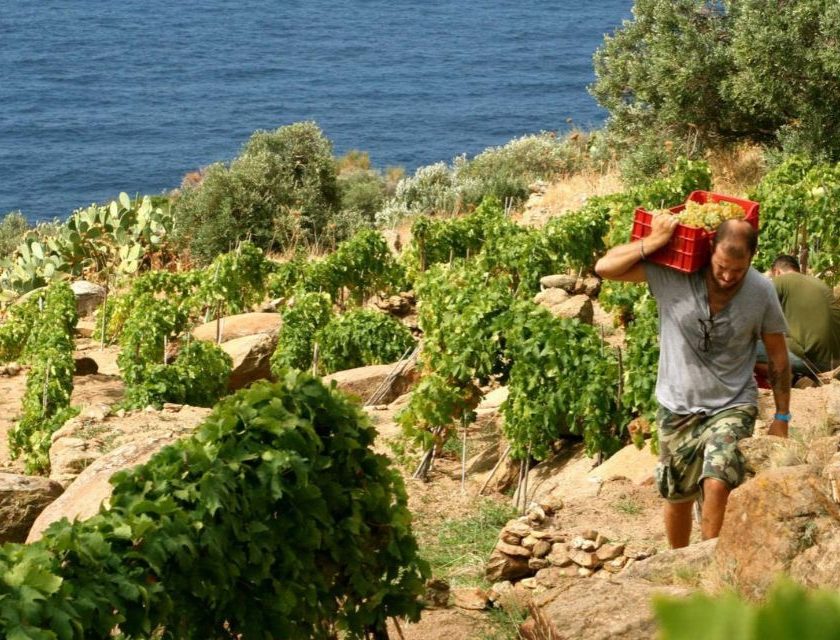
But to understand Imereti wines, one must first start with the territory’s conformation. Imereti has a milder, more humid climate, influenced by its proximity to the Black Sea and by viticulture that develops up to over 500 meters above sea level, in high hill environments. The soils are predominantly clayey-stony and white, calcareous; rich in calcium carbonate and endowed with good moisture retention capacity. It’s right, therefore, to expect fresher wines with greater acidity compared to those of Kakheti. There, the warmer, drier climate yields more powerful and, above all, more alcoholic wines. The soil in Kakheti is much more varied than that of Imereti, with the presence of clays, rocks, and alluvial terrains that contribute to producing complex, structured, broad-shouldered wines.
[modula id=”83443″]
IMERETI GRAPE VARIETIES AND THEIR INTERNATIONAL PROSPECTS
Substantial differences, which are also confirmed in the region’s ampelographic base. The grape varieties of Imereti, in fact, are different from those of Kakheti. In this corner of Georgia, you’ll find little-known indigenous varieties, such as Tsolikouri, Krakhuna, Tsitska, and Kvishkhuri (white grapes) and Otskhanuri Sapere, Aladasturi, and Ojaleshi (red grapes). What to expect from wines produced with these varieties? Great acidity, and therefore freshness, especially from “single-varietal” white wines, that is, from individual grapes. A characteristic that is more subdued in blends, with the Tsolikouri-Krakhuna-Tsitska trio that can indeed boast Imereti’s only DOC: Sviri PDO (Protected Denomination of Origin).
Each grape brings benefits to the blend: Tsolikouri and Tsitska for vibrant acidity; Krakhuna for the aromatic component and body. Also interesting from an agronomic standpoint is Kvishkhuri: with its thick skin and excellent resistance to colder temperatures, it plays a leading role in Upper Imereti, the region’s northernmost area. The white wines of Imereti, generally, recall citrus fruits like orange and mandarin on the nose and palate, loquats. They show hints of tropical fruit, white fruit like pear, and herbaceous and talc-like notes, especially in the presence of the Krakhuna variety. Curious, however, how Tsitska often brings to mind Sauvignon Blanc, especially if not subjected to maceration.
IMERETI: WHITE WINES (BETTER) IN BLENDS. REDS SINGLE-VARIETAL
As for red wines, Otskhanuri Sapere can be considered the alter ego of Kakhetian Saperavi. The “Colored One of Otskhana,” this is the literal translation of the name, in honor of the variety’s city of origin, has generally high acidity, harmonious structure, and more than respectable body: characteristics that allow the wines to age well over time, moving toward tertiary notes from the primary ones of cherry, red and black forest berries, and ripe plum.
Aladasturi impresses with its ability to read the soils, sometimes recalling certain rare expressions of Syrah on granite. It generally yields fresh, easy-drinking wines with a light body, in which tannin maturity plays a fundamental role in the glass’s balance. The real surprise is Ojaleshi, which brings to mind much of the mature profile of Refosco dal Peduncolo Rosso and the youthful expressions of Schioppettino di Prepotto. A variety increasingly rediscovered and vinified by the seventy or so wineries in Imereti.
THE USE OF TERRACOTTA AMPHORAE (QVEVRI / CHURI) IN IMERETI
While it’s now very easy to find a Georgian wine abroad, Italy included, it’s more complicated to taste a wine produced in Imereti. Kakheti dominates buyers’ choices, also because it’s now synonymous with the traditional method of vinification in qvevri, large buried terracotta amphorae that fascinate consumers worldwide with their millennia-old tradition. The “Kakhetian Method” is, in itself, synonymous with “Georgian wines.” And it’s what the vast majority of national marketing focuses on, under the claim promoting Georgia as “The cradle of wine“: “The Cradle of wine” internationally, where viticulture originated (a primacy, to be fair, disputed by neighboring Armenia).
In Imereti too, qvevri are used, locally called churi. But the traditional vinification method differs from that of Kakheti. In Imereti, only a portion of the skins—much more rarely the stems—are used during fermentation. A more delicate approach, which suits the characteristics of the grapes well and the desire to produce lighter, fresher wines, perfect for lovers of varieties like Riesling. The “Imeretian Method” tends to better preserve the wines’ natural acidity and give life to fresher wines. But above all, less tannic compared to those of Kakheti, where instead the must ferments and matures at length in qvevri with all the solid parts of the grape (skin, seeds, stems), yielding pronounced tannins, structure, and complexity.
[modula id=”83445″]
IMERETIAN WINE CHALLENGE: THE FUTURE OF GEORGIAN WINES PASSES THROUGH HERE
Precisely to help give a precise identity to Imereti wines, rewarding the highest production standards and promoting the area’s uniqueness internationally, the Imeretian Wine Challenge (IMT) was born. A wine competition conceived by Ketie Jurkhadze, director of the Imeretian Wine Association, which brings together about seventy wineries in the area and was founded in 2022, with the support of DMO Imereti (Destination Management Organisation Imereti). In early October 2024, the competition reached its second edition, hosted right in Kutaisi, Georgia’s third-largest city by population and capital of the Imereti wine region. The competition results, not yet official, confirm the absolute validity of the path undertaken by winegrowers, who in western Georgia can also count on important entrepreneurial initiatives. This is the case with Labara Winery which stands in Vartsikhe, a hamlet in the municipality of Baghdati.
Twelve hectares of vineyards nestled between the Black Sea and the Caucasus, in a plain rich in clay and limestone at the exact confluence of the Rioni and Khanitskali rivers. Krakhuna, Otskhanuri Sapere, Tsolikouri, Tsitska, Ojaleshi, and Aladasturi have found two great interpreters in Dato Gagua and Shalva Sikharulidze. Both professionally engaged in the United States, they decided to return to Georgia and establish the winery in 2017, “to help the country exploit and develop its 8,000 years of wine history.” Also from a wine tourism perspective. The word “Labara,” which gives the winery its name, in fact means “Sunny place full of life.” A tribute to Vartsikhe, a village with an ancient winemaking tradition that Dato Gagua and Shalva Sikharulidze want to transform into a tourist destination, as well as a production area for the best wines of Imereti.
The sun present on all labels symbolizes the two entrepreneurs’ dream. About 20,000 bottles currently produced, with the 2024 harvest to be considered the true debut, with the fruits of the young estate vineyards. The style and imprint of the small Labara Winery is nonetheless already clear: great care in grape selection, vinification and aging in qvevri (or, better, churi) and in used oak barrels; and a desire to express the primary characteristics of each individual variety in the glass. A beacon not only for Imereti but for all of wine-producing Georgia, especially with the 2020 orange wine (macerated) “Circum Solem” from Tsolikouri grapes, the Otskhanuri Sapere Reserve 2022, and the Ojaleshi 2023.
LABARA WINERY, THE NEWCOMER. WINERY KHAREBA, A SURE BET
For every artisanal Georgian winery that’s born and will certainly establish itself internationally, there’s one that’s already a symbol of Georgian wines worldwide. Winery Khareba is a giant producing 17 million bottles that, under the technical and oenological direction of winemaker Vladimer Kublashvili, has set itself the goal of embracing the entire national territory with its vineyard holdings (1,500 hectares currently available). Already well established in the pantheon of Kakheti’s big players, Khareba has been investing more and more energy in recent years in the growth of Imereti and its indigenous varieties. Oenologist Vladimer Kublashvili’s approach is tailored. Precise.
Proof of this is the winery’s latest project, called K’Avshiri, კავშირი, which in Georgian means “alliance,” “union.” It is in fact the joint project of Winery Khareba’s winemaker and British consultant and wine critic Robert Joseph. A white wine and a red wine obtained—as it happens—from a blend. K’Avshiri White is a blend of eight Georgian varieties with Muscat and Aligoté. K’Avshiri Red instead contains nine varieties, including two Georgian white grapes co-fermented with Saperavi and Aladasturi, left to dry for 10 days before fermentation. Both wines are obtained from partial vinification in qvevri and steel, with the use of wood for the red blend only.
K’AVSHIRI: MUCH MORE THAN JUST A WINE
“While wanting to create a decidedly ‘Georgian’ wine,” Kublashvili and Joseph explain, “we make no apologies for including a little Aligoté and Muscat in the white blend. Producing the best possible wine was far more important than adhering to any kind of rule imposing regional ‘purity’. Similarly, the 2022 and 2023 red blends brazenly contain a bit of Merlot (5%). Many producers in countries with interesting indigenous varieties today have a similar vision, but prefer not to mention their use of small amounts of ‘international’ varieties, burying them in the legally permitted 15% of ‘other grapes.’ We preferred to be open about what exactly happens in K’Avshiri.”
A vision, that of this unusual duo, which suits the climate of a country searching for identity and which, indeed, inserts itself into that search on tiptoe, with two wines of great oenological depth and great intellectual provocation. And it doesn’t happen by chance in Georgia, a nation that amuses—and that seems itself, perhaps unconsciously, to enjoy—the display of contrasting logics and interpretations, capable of coexisting in a climate of orderly chaos, on the exact geographical border with paradox and oxymoron. Like the headscarves of those women, blending with the thousand colors of spices, at the central market in Kutaisi’s old town. Or that “I love you” inscription, in three different languages on a wall, not far from the stalls. Imereti, Georgia, world. All things considered, a border.