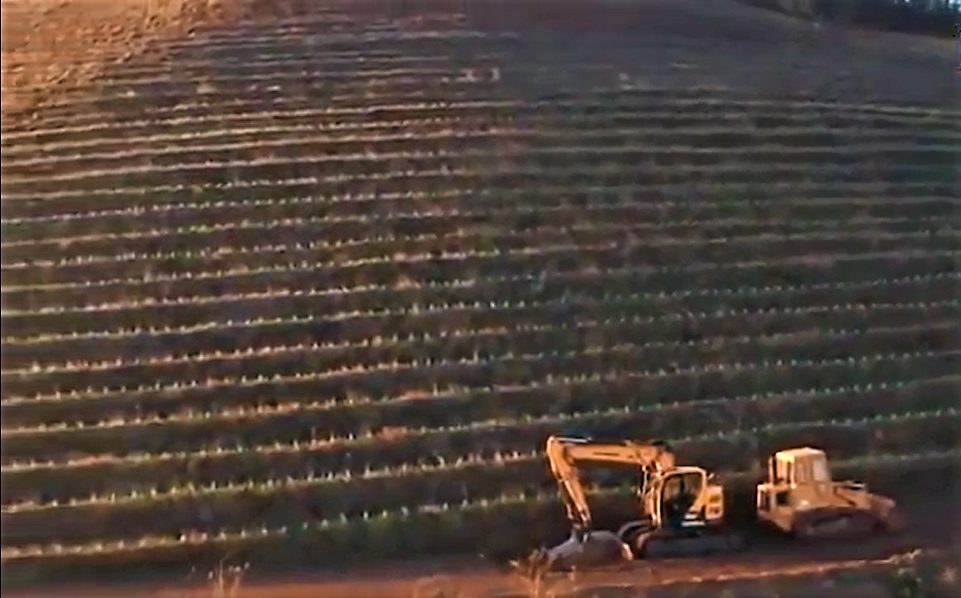
Apocalypse wine is the video filmed by the students of class IV Am at Isiss Luciano Dal Cero in San Bonifacio (VR) regarding viticulture in Soave. A “civil discourse on the ‘incongruous’ landscape,” as described by the students coordinated by Prof. Simone Gianesini, in which alleged scenes of landscape devastation carried out by some local winegrowers to the detriment of biodiversity are shown.
In addition to the title, which evokes the Apocalypse, it is the soundtrack that communicates pathos and pushes viewers to indignation. Among others, works such as Camille Saint-Saëns’ Danse Macabre, Wolfgang Amadeus Mozart’s Confutatis Maledictis, and Johannes Brahms’ Symphony No. 4 in E minor were chosen.
No names of wineries or public institutions appear in the video. From the images of Apocalypse wine, filmed between November 2021 and January 2022, what emerges instead is a generalized attack on the wine system spanning the Soave Classico area and the extended Valpolicella area in the province of Verona.
To be precise, the corridor—once wooded, now affected by what is described as “industrial viticulture”—between Val Tramigna and Val d’Alpone is cited. Among mentions and images, the hamlets of Castelcerino di Soave and Terrossa di Roncà appear.
VITICULTURE IN SOAVE: CERVIM IN THE STUDENTS’ CROSSHAIRS
The entity that is named, however, is Cervim, the “Center for Research, Environmental Sustainability and Advancement of Mountain Viticulture”. The organization, based in Aosta, is pointed out by the students as the body that rewards wines produced in the vineyards subject to the alleged landscape devastation among the Soave hills.
“In reality, we didn’t want to call out anyone specific,” Prof. Simone Gianesini comments to winemag.it, “but rather to highlight how the senseless exploitation of the landscape has its own apparent institutionalization, even with an Award.”
The point that perhaps escaped many viewers is that Apocalypse Wine is a civil, political discourse, not a technical one. We are not going into the merits of a crime, but we are pointing out moral responsibilities.
The attack on Cervim, which organizes the Mondial des Vins Extrêmes competition every year, focused on wines from “heroic viticulture,” is fierce. The barbs from two students follow one another from minute 6:50 to minute 9:24: “Self-destruction perceived as well-being.” “Seven Veronese medals? What luck.” “As long as the falsehood finds a fox or a donkey to say it, it will seem true.”
Why, in your opinion, is buying olive groves, meadows, and woods for a pittance, coming in with bulldozers and a huge amount of cash to invest, taking away earth, putting in more, terracing everywhere, heroic? It’s like saying someone who enters a refugee camp with a tank at night is a hero. To me, it seems the opposite: he is a coward.
“What is underway is a war on biodiversity. And this,” the dialogue between the two students continues, “is on the part of the culturally destitute. Including those who puff themselves up, with this trendy rhetoric, with this theology of wine, placed at the service of power and death.” Finally: “I’ll just tell you that the vineyards of great landscape value that won are the ones we showed you.”
THE WINERIES INVOLVED: “IN COMPLIANCE WITH PERMITS”
Among the first wineries to appear in the Apocalypse wine video is Fattori Wines from Terrossa di Roncà. The company is clearly recognizable, thanks to the images depicting two large buildings, described as “gigantic cathedrals landed here from who knows where,” not far from the “unnatural geometry of a huge industrial vineyard,” which allegedly replaced the wooded area.
Contacted by winemag.it, the winery states that it has never received awards from Cervim. Evident on the website, however, are the accolades received from Slow Wine and Gambero Rosso. Then, the comment on the video: “Perhaps these kids are talking about a subject they don’t know, since the company has 45 hectares and less than a third is occupied by vineyards. The rest are woods, which will stay there.”
“For the construction of the buildings, we obtained all the necessary licenses. We have done a beautiful job, from an agronomic, landscape, and urban planning point of view.
If we then want to say that wine is not indispensable, that’s another matter. We are in a territory with a very high wine-growing vocation, which presents itself like many others of its kind: from Burgundy to Champagne, from Franciacorta to Valtellina.”
CERVIM’S REACTION: “APOCALYPSE WINE? SERIOUS ALLEGATIONS”
Apocalypse Wine did not escape the president of Cervim, Stefano Celi. “This is very serious,” the head of the Aosta-based Center for “heroic viticulture” comments to winemag.it. “First of all, everyone is being tarred with the same brush. It isn’t mentioned, for example, that vine cultivation can safeguard the territory from hydrogeological instability.”
The competition has little to do with the accusations made against some producers. It is not our job to investigate the nature of the terraces, or if they were built with the proper authorizations. We take it as implicit; in fact, we are certain that the terraces were built in compliance with the law.
“Lastly,” Stefano Celi concludes, “the students perhaps do not know that ‘viticultural biodiversity’ exists. Viticulture, in fact, preserves plants—namely grape varieties—that risk disappearing and contributes to their protection. Furthermore, some winegrowers keep ancestral, even uneconomic, forms of cultivation alive. To these young people, I want to say that agriculture does not steal land from anyone.”
Among the wineries in the area awarded by Cervim, in addition to Azienda Agricola Accordini Stefano from Fumane, there is Ca’ Rugate from Montecchio di Crosara, which however does not appear in the video.
The comment from the management, contacted by winemag.it, is clear: “We have 90 hectares of vineyards in three mountain territories such as Monti Lessini, Soave Classico, and Valpolicella. For this reason, we were awarded gold medals in the 2021 Mondial des Vins Extrêmes by Cervim, the only Veronese company to achieve this triple milestone.”
“We have had vineyards for 30 years in the Soave Classico area,” the winery owners report, “and we do not feel in the least bit involved by the video. On the contrary, we believe that our work goes in the opposite direction. Through mountain viticulture, we are doing a favor to the new generations, while the plains ‘cook’ due to climate change.”
SANDRO GINI (SOAVE CONSORTIUM): “COME VISIT THE HILLS”
The Consortium for the Protection of Consorzio di Tutela Soave and Recioto di Soave Wines also takes a stand. “We have seen the video made by these young students,” comments President Sandro Gini, owner of a historic local winery, to winemag.it. “We appreciate the sensitivity that emerges and the food for thought. However, we believe that the content is not strictly correct. And that, in a completely involuntary way, it is the result of simplifications that risk giving a distorted perception of what is, instead, the reality of Soave.”
Soave was the first Italian wine district to be included in the national register of rural landscapes of historical interest. We recall that our hills were recently awarded the FAO GIAHS recognition, namely those ‘agro-ecosystems’ in which the farmer’s work has allowed the safeguarding and maintenance of the landscape.
“Many of our companies, moreover,” President Sandro Gini concludes, “boast environmental certifications based on biodiversity. For these reasons, we are very happy to receive the authors of the video here, on our hills, along with the teachers, students, and all those who want to truly get to know Soave.”
THE APOCALYPSE WINE VIDEO CENSORED OR REMOVED FROM YOUTUBE?
The Apocalypse Wine video filmed by the students of Isiss Luciano Dal Cero in San Bonifacio is no longer available on the web or, rather, on YouTube, in its original form. “The distribution of the video, which has now gone viral, is following a life of its own,” Prof. Simone Gianesini explains to winemag.it, “as, due to several reports from users who remain anonymous, the original channel that shared the video was forced to remove it.”
This refers to Healthing, a YouTube channel with 142 subscribers. A sort of multimedia platform, open to various external contributions, including that of a local association in the Soave area that deals with landscape protection and the organization of tours, events, and trekking.
Reached by winemag.it, one of the association’s representatives—who prefers to remain anonymous—speaks of an “unbearable climate in the town” following the publication of the video. The small local association was in fact allegedly targeted by some winegrowers and farmers.
“No one has been threatened,” Prof. Gianesini explains, “and the video was not ‘censored’ in the true sense of the word, but it fell victim to reporting. Certainly, we did not remove it. Through Apocalypse Wine, we hoped to obtain the support of the many small farmers who live in a condition of weakness compared to the ‘big players’ in the area.”
“Apocalypse Wine doesn’t tell anything new,” the teacher concludes, “and we don’t have it in for anyone in particular. The fact that it was shared by public figures like Natalino Balasso and Andrea Pennacchi means that we are out of danger of censorship. Many, in fact, realize what is happening. But, even while talking about it, they have no weight. The video, instead, managed to have it.”