IN BREVE
- In Verona, the nightlife is tied to wine and the tradition of Cicchetti at the two Buglioni winery venues: Bacaro del Mona and Osteria del Bugiardo.
- Buglioni integrates territory, hospitality, and dining, offering a unique way to experience wine from every angle.
- Osteria del Bugiardo and Bacaro del Mona are convivial spaces where wine brings different generations together.
- Buglioni also stands out in wine production for a philosophy focused on accessibility, with labels representing an authentic and high-quality Valpolicella.
- Dimora Buglioni and Locanda Buglioni are the spaces dedicated to hospitality in San Pietro in Cariano, in the heart of the Valpolicella vineyards.
There are alleys in Verona where the nightlife is an act of faith in wine and the tradition of Cicchetti. Corners where a glass is not an accessory, but a language. Between a chat, a platter of cold cuts and creamed cod, a laugh, and a “Shall we have another?“, wine becomes the gravitational center of an evening that brings together young and old. Tourists and true locals. Curious newcomers and regulars who say: “I come all the way from Brescia; we don’t have anything like this back home.” It happens when the atmosphere is just right. Informal, full. Alive. Real. Natural. And when behind the bar there is a winery that doesn’t just produce bottles, but builds authentic experiences.
In Verona, the Buglioni signature means exactly this. A way of living wine, even before drinking it. An entrepreneurial project rare in Italy, and beyond, because it holds together territory, hospitality, dining, and identity. With a very evident ability at the core of the project: speaking to different audiences without changing face.
OSTERIA DEL BUGIARDO AND BACARO DEL MONA: URBAN VALPOLICELLA


A “proper” evening in Verona can start in the center, at Buglioni’s Osteria del Bugiardo. Narrow tables, cicchetti as perfect excuses to “have another one.” And that constant buzz that makes the whole city feel in motion, inside and outside the venue. One of those places you inevitably “bump into” while walking through the streets of Romeo and Juliet’s city.
Because the crowd in front of the entrance is the kind that makes you slow your pace. And wonder if it’s worth stopping, even just for a quick drink. Here the idea is simple and brilliant: bringing Valpolicella into the heart of the city, in a “Verona by night” format. Not a stiff, ceremonial Valpolicella, but one that is poured naturally. That is drunk in company. That lets itself be told while the evening picks up speed.
The environment seems to adapt to the different moods of the guests. There are those who arrive for an aperitivo and stay until late, those who drop by after dinner. Those who treat themselves to a Valpolicella Superiore “(I’m) Perfetto”, a glass of Brut “Lo Spudorato” or a Ripasso “Il Bugiardo” without thinking too much about it. And then end up discussing Amarone as if it had always been there, in their evening vocabulary, even in Brescia. “I’m not a journalist like you, but I like to drink well, you know!”
BACARO DEL MONA: THE POP GLASS THAT MOVES THE CENTER


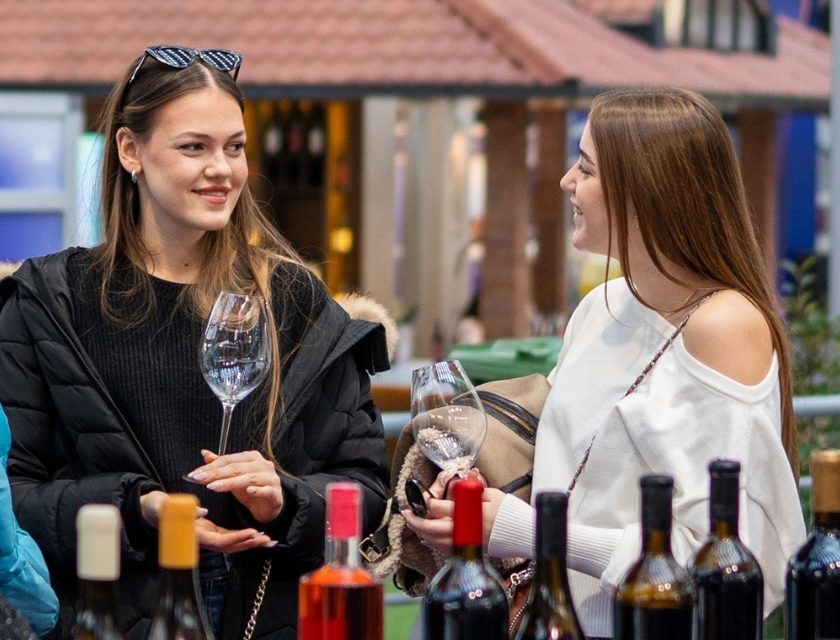
The other stop, still in the center, still vibrant Verona: Bacaro del Mona. The energy changes, but the underlying idea remains the same: wine and conviviality without pretension, except for the selfies the place is perfect for. Arrive early and there’s already movement. Small groups of friends, couples. Tourists trying to figure out what to order. And locals who don’t need to figure out anything, because they know the ritual well here. The counter works at a frantic pace. Glasses spin like tops (by the end of the evening, even the lamps in the place will be spinning, or rather dancing, swaying back and forth).
The cicchetti act as social glue: “Shall we order another and split it?” Bacaro del Mona is one of those places where you don’t go to “eat,” but to be part of an evening. Polenta, cold cuts, cheeses, small bites designed to accompany the wine without stealing the show. And that atmosphere of a true historic center spot. People close together, chatter all around, laughter, toasts without even looking at each other.
The point is this: Buglioni doesn’t do “wine bars.” It does places. And it does them in a contemporary, inclusive way. Here, wine isn’t put on a pedestal. It’s put in the middle. It’s the meeting point between generations. Between those who walk in by chance and those who already have their favorite glass. Buglioni hasn’t just created two venues. It has built a language. A format that feels televised. Cinematic. A way of being in wine, with wine. In Verona.
FROM FASHION TO WINE: BUGLIONI, A STORY OF COURAGE AND VISION

To truly understand why all this works, you have to go back. Because Buglioni didn’t start as a classic Veronese winery. The family comes from the fashion world and decided to change paths in the early nineties. A gamble: abandoning a historic fashion business to dedicate themselves to winemaking. With a precise and ambitious goal: becoming a benchmark in Valpolicella.
In 1993 the opportunity arrived with the purchase of a farmhouse with 3.5 hectares of vineyard (Corvina, Corvinone, Molinara, and Rondinella). The first step was both romantic and practical: harvesting, learning, building. Then, in 2000, the winery took shape under the renovated house. And above all, a key figure entered the scene: enologist Diego Bertoni, who still leads the technical side today.
The first Amarone debuted in 2004. But there was a problem: the market. For a young company without a “winemaker’s surname,” it’s not easy to get into the city’s venues. So Buglioni did something that perfectly describes the company’s spirit: instead of waiting for others to open the door, they built it themselves. In January 2005, Osteria del Bugiardo was born. The rest—literally—is history.
A MODERN VALPOLICELLA: WINES “TO BE LIVED,” NOT JUST CELEBRATED
Buglioni has a keyword: accessibility. Wines that are opened and finished. Wines that don’t ask for permission. It’s a powerful idea, especially in Valpolicella, where Amarone often risks becoming a monument rather than a wine.
Here, however, the direction is clear: intensity, yes, but also fragrance, freshness, and drinkability. And an approach that brings together technology and tradition without using slogans: amphora, concrete, experimentation, identity.
Even in “counter-current” choices. Like Molinara, an indigenous grape variety that left the Valpolicella Doc and Docg regulations, which Buglioni continues to promote in an unfiltered Classic Method sparkling wine (Molì) and in a Brut Rosé (Il Vigliacco). It’s a declaration of independence, but done the right way. Through the glass.
DIMORA BUGLIONI: THE RELAIS AMONG THE VINES, A STONE’S THROW FROM VERONA
Then there is the other side of the project: hospitality. Because if you live the evening in the city, the next day you can wake up among the rows of vines. Dimora Buglioni is a wine relais in San Pietro in Cariano, in the heart of Valpolicella. A nineteenth-century farmhouse elegantly restored with stone, brick, wood, and fireplaces. A place that doesn’t want to impress with special effects, but with consistency. It’s welcoming. Real. Attentive to detail.
The distance is perfect: 10 km from the center of Verona, 15 km from Lake Garda. So you’re not isolated, you’re in the heart. In the right spot. And the feeling is what you look for when you really want to “unplug.” Breakfast with homemade products (a tart that would make any grandmother envious), pergola, slow rhythms. Then maybe e-bikes, trekking, a horse ride. Or nothing at all. Just silence and vineyards.


LOCANDA BUGLIONI: CLOSING THE CIRCLE
In the evening, with a walk through the vineyards, you reach Locanda Buglioni, the family wine restaurant. Here wine returns as the protagonist, but with a different tone. More gastronomic, more “table-oriented,” more complete. In the dining room, a staff trained across the board, who “know” the top-quality ingredients of the kitchen and can talk about wine with simplicity and rhythm.
The cuisine is seasonal, tied to the territory. With a detail that perfectly illustrates the Buglioni philosophy: the grill fueled by vine shoots and vineyard waste. A concrete gesture, not rhetorical, that brings together sustainability and identity. A complete picture in the glass, where wine, here at Locanda Buglioni, is not just a product, but a context. It’s an experience. It’s belonging.
BUGLIONI VERONA: AN ITALIAN FORMAT THAT WORKS (AND SETS AN EXAMPLE)
In an Italian wine world often divided in many aspects, Buglioni is a rare case because it doesn’t choose: it integrates. It doesn’t just do a winery. It doesn’t just do dining. It doesn’t just do hospitality. It builds a system. And it does so with a contemporary touch. Capable of speaking to new generations without losing solidity and quality. It does so by putting its name on it, but without ego or excessive spotlight-seeking.
This is what makes Buglioni a true example. A unique entrepreneurial project, built with vision and a rare ability to transform Valpolicella into a total experience. From the glass to the table. From the alley in Verona to the silence of the vineyards.