IN BREVE
- Tenuta del Paguro ages its wines in the Adriatic Sea, at approximately thirty meters deep.
- The bottles rest on the seabed, where temperature and pressure create an ideal environment for aging.
- The project, initiated by Gianluca Grilli and Stefano Gardi, takes place near the wreck of the Paguro gas platform, which has created a unique marine habitat.
- The vineyards are located in Mazzolano and the wines include varieties such as Albana and Sangiovese, with integrated farming practices.
At approximately thirty meters deep, in the Adriatic Sea off the coast of Ravenna, Tenuta del Paguro entrusts its wines to the sea. An underwater aging method that places the wine in an uncontrollable natural environment. The bottles are laid on the seabed, where light fades, temperature remains stable between 10 and 13 degrees, pressure reaches four bars. Currents generate continuous and imperceptible movement. Aging lasts a complete annual cycle: 12 months, 12 moons, 4 seasons.
THE PAGURO WRECK
The project takes place near the wreck of the Paguro gas platform, which sank in 1965 following an accident during drilling operations. Over time, the structure has transformed into an artificial reef, now recognized as an area of biological interest. The sea has not preserved the platform, but modified it. Metal surfaces have been colonized by marine organisms, creating a habitat for various species. It is in this context that the wine is immersed in a space that has already undergone transformation.
THE PROJECT’S ORIGIN
The project was initiated by Gianluca Grilli together with winemaker Stefano Gardi of Tenuta Nasano. A kind of dialogue between the Romagna territory, the sea, and the Paguro wreck, which is also linked to historical memory: the salted wines of the Romans. Wines made with the addition of seawater for preservation.
THE VINEYARD AND PRODUCTION
The vineyards are located in Mazzolano, in the Riolo Terme area, on a gypsum vein. The soils are clayey, rich in limestone and potassium. Grape varieties include Albana and Sangiovese, along with Merlot and Cabernet. Management follows certified integrated farming practices, with minimal intervention and manual harvesting. Fermentation takes place in stainless steel at controlled temperature between 25 and 26 degrees.
IMMERSION AT SEA
After vinification, the wine is bottled with a cork stopper. Each bottle is sealed with a mixture of sealing wax and shellac. This layer protects from seawater without completely blocking micro gas exchanges.
The bottles are placed in metal crates designed to withstand the marine environment. This is the last controllable phase before immersion. After the aging period, the bottles are recovered.
TWO DIMENSIONS: LAND AND SEA
The project develops between two environments. The land, where time is visible and marked by the seasons. The sea, where time is continuous and unobservable. The wine is born in the vineyard and continues its evolution at sea. It is not a fusion, but a passage between two complementary conditions.
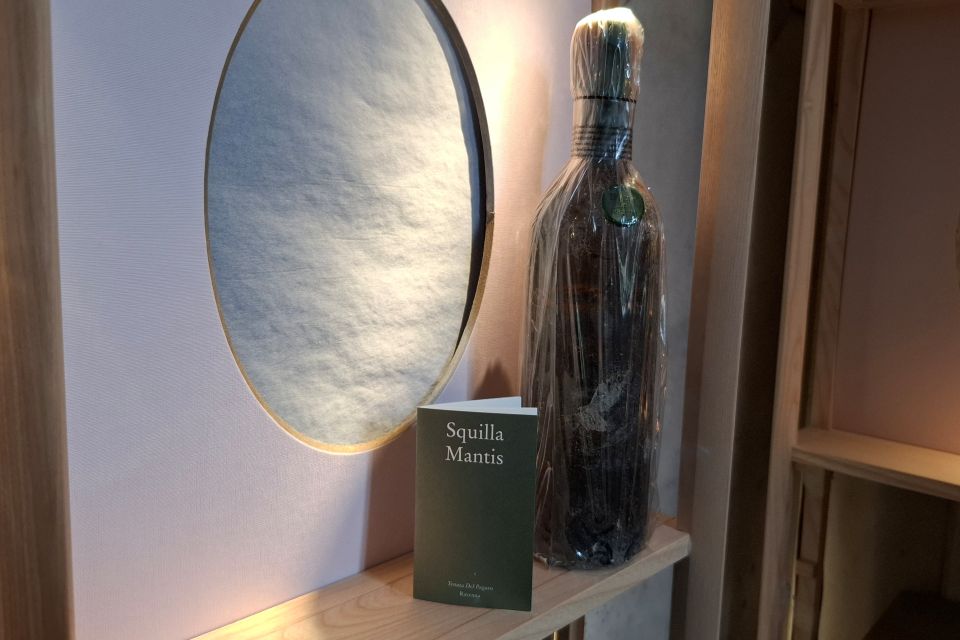
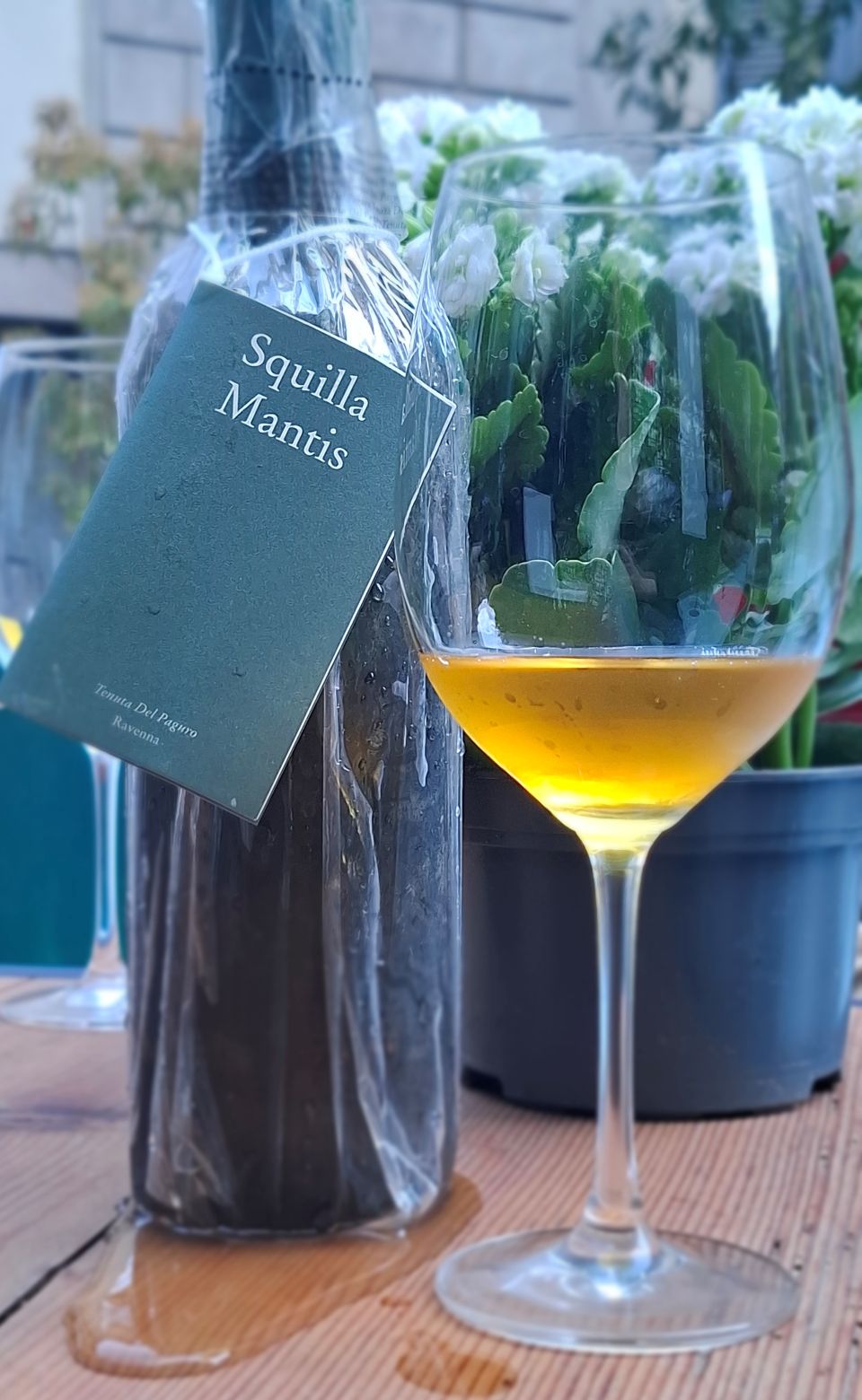
The wine names recall marine life forms. Among these stands out the Romagna DOC Albana “Squilla Mantis” 2014. 100% Albana, 20 days of fermentation in steel and 8 months of aging in cement before being entrusted to the sea. The result is a wine with a deep golden color. An engaging nose that alternates mineral notes, aromatic herbs, and ripe fruit. On the palate it is full, with great freshness despite the years, savory and delicious.