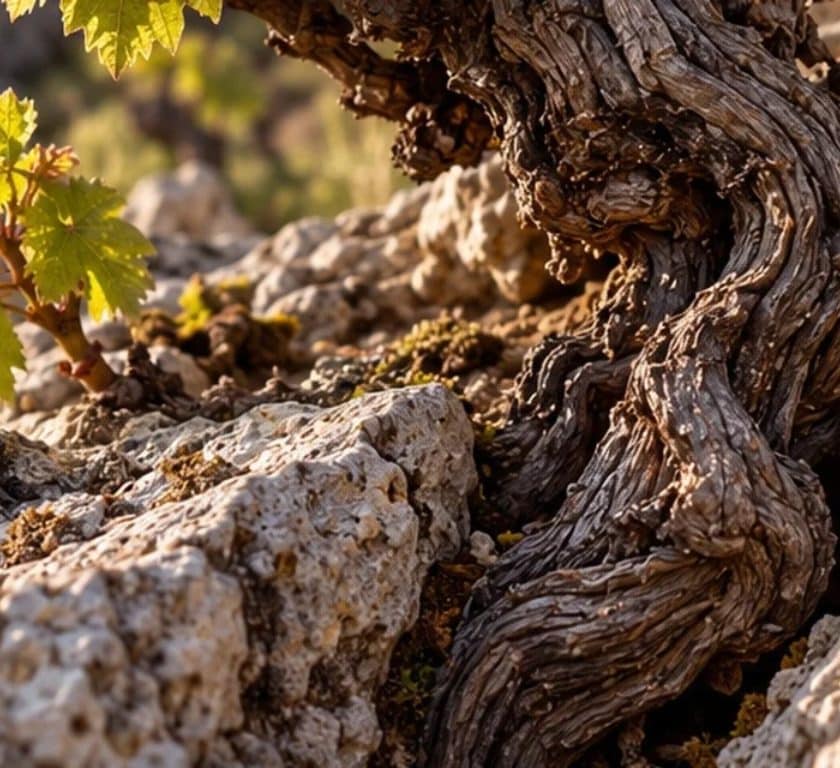
There is a moment in the life of every wine denomination when it must choose what to be when it grows up. An identity-driven wine. A territorial symbol. An agricultural flagship. Or a legal file.
Until recently, Turlupì di Scorzavacca Superiore was a fragrant, spicy, slightly tannic red, with a pleasant note of cherry in spirit and hay. As of a few hours ago, it is also a case.
But not an oenological case: a real legal case. The kind with a reconstruction, the witness who didn’t see the start but heard the bang. The overturned table, the brandished bottle. The inevitable contradictory escalation.
THE TURLUPÌ FESTIVAL AND THE MYSTERY AT THE STAND
We are in Scorzavacca, a charming town in the Bassa Alta, that area of Italy where every village has three things: a medieval tower, a local festival, and a producer who hasn’t spoken to the other since 1998. The Turlupì Festival was created to celebrate the indigenous Turlupì grape. An ancient, resistant grape, capable of surviving phylloxera, hail, production regulations, National Committees, Lele Adani and Antonio Cassano against Max Allegri, and press releases containing the word “resilience,” but above all, the cliché of “tradition and innovation.”
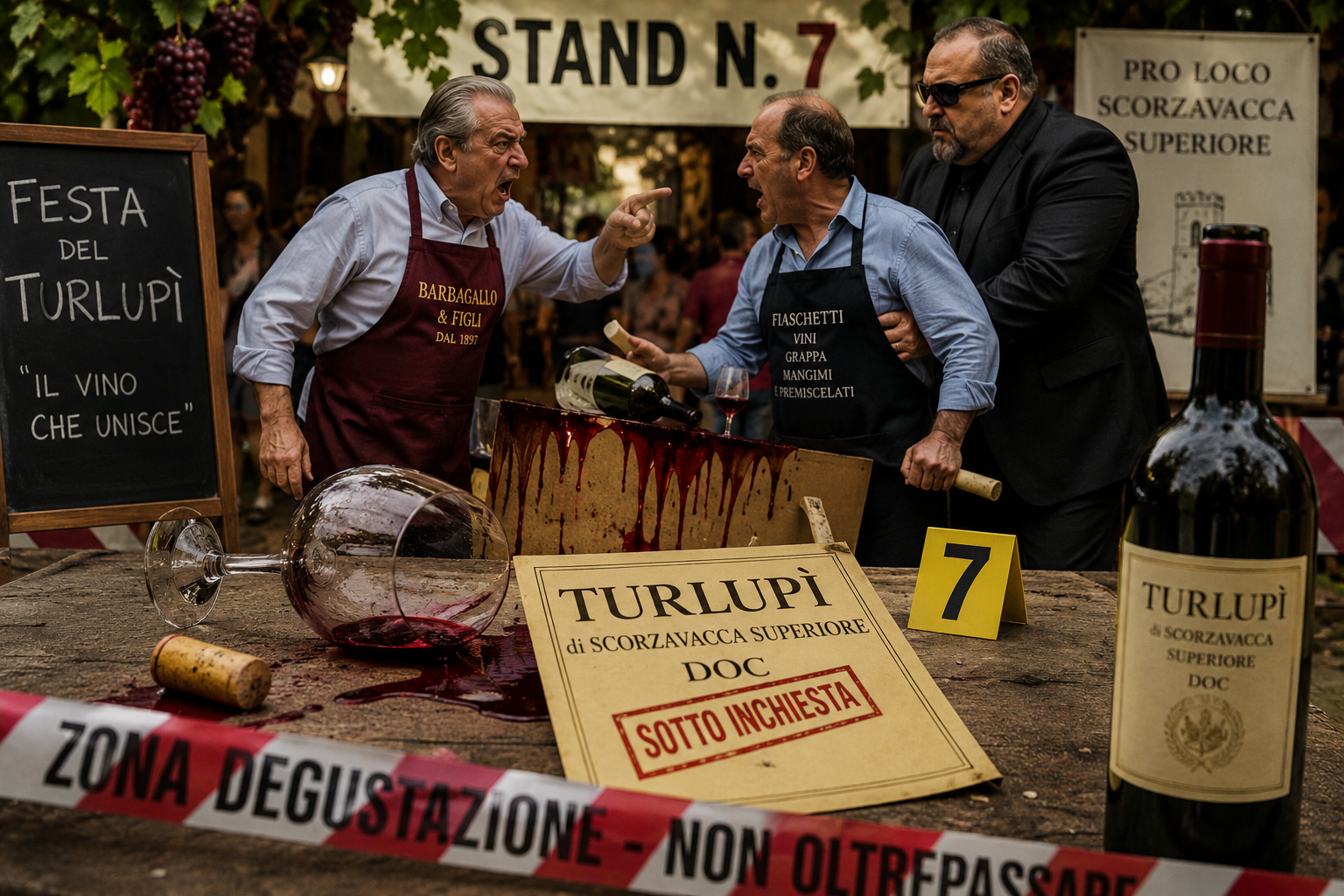
However, it was not prepared to survive a heated argument that ended in disaster between Cavalier Aristide Barbagallo, patron of the Barbagallo & Sons winery, and Nerino Fiaschetti, owner of Fiaschetti Wines, Grappa, Pre-mixed, Rich Prizes and Party Favors & Everything Else.
According to unofficial sources well-seated at the bar, the two crossed paths around 1:17 PM in front of stand number 7. The atmosphere there was already tense. Not because of the weather, but because of the lack of oxygen in the room shared with a lifelong enemy.
CONFLICTING VERSIONS: THE GLASS, THE LOOK, THE ALLEGED “SAMPLE”
According to Barbagallo’s version, Fiaschetti approached with a threatening stride, asking for a glass of Turlupì. So far, so normal. The problem allegedly arose later, when the requester added: “But give me the good stuff, not the one you send to competitions.”
A phrase that, at a village festival, can have three effects: silence, a chill, or an ambulance. Barbagallo claims to have responded with institutional composure: “Nerino, go back to your stand.” Fiaschetti, however, tells a different story. He says he presented himself “like a gentleman,” asked for “a democratic little taste,” and was met with an expression “like a disgruntled sommelier in front of a bag-in-box.”
At that point, again according to Fiaschetti, the first spit was launched. Barbagallo denies it. In fact, he apparently clarified: “I never spit during tastings, at most afterwards.” The Consortium Prosecutor’s Office, which doesn’t exist but would be handy in these cases, will likely acquire the spittoon, which somehow escaped the ministerial breathalyzer test.
THE BODYGUARD, THE BOTTLE, AND THE WITNESS WHO WAS ON HIS SIXTEENTH BREADSTICK
A third man also appears in the reconstruction. His name is Gennarino Lombrico, known as “Er Decanter.” Officially a baker. Unofficially a Turlupì tasting companion. Aesthetically, according to several unconfirmed testimonies, “someone dressed like an undertaker, who didn’t look like he was there to understand the terroir.”
Barbagallo claims that Lombrico arrived “like a mechanical harvester,” knocking over chairs, brochures, and a visually impaired lady from Canicattì who was just looking for the bathroom. Fiaschetti counters that his companion “only prevented a tragedy,” limiting himself to a technical containment gesture: a neck hold defined as a “preventative hug.” They teach it in Judo, but not to everyone.
The key witness is Osvaldo Cavatappi, a producer from the nearby hamlet of San Mostimetro. He says he didn’t see the beginning. Naturally. In Italian cases, no one ever sees the beginning. Everyone, however, hears the noise.
“I heard a thud, then I saw a bottle in the air,” Cavatappi reportedly declared, still shaken. “To be honest,” he added, “I’m not sure it was just one bottle. Maybe it was a 2012-2020 vertical tasting that ended up horizontal.”
DAMAGE TO THE DENOMINATION: FROM NOTES OF DRIED ROSE TO NOTES FROM THE EMERGENCY ROOM
The real victim, however, is the Turlupì. Until yesterday, it was looking for space on wine lists. Today, it risks ending up in legal papers. The Protection Consortium, meeting urgently in the small room above the local tourism office, released a note inviting everyone “to bring the discussion back to the tracks of territorial enhancement.” Translated: stop hitting each other in front of wineloversz and importers; do it behind the scenes of the municipal wine circus instead.
The president of the Consortium, Adalberto Svinacci, spoke of an “isolated incident,” otherwise “he would have preemptively guaranteed an escort for the other producers present and a bulletproof vest instead of a glass-holder pouch for the wineloversz.” As always in Italy, everything is isolated: the hail, the landslides, the apartment block wars. Producers chasing each other between stands. Then, when you look closer, the isolated incident has a WhatsApp group.
In the meantime, the Turlupì production regulations might be updated. In addition to yield per hectare, minimum alcohol content, and aging, a new entry might be added: mandatory distance between historically incompatible producers. More than a novelty, it’s a precaution that the National Wine Committee will be called upon to ratify, before passing the hot potato to Bruxellesz.
Bruno VespaZ considers a SCALE MODEL OF THE ROOM. Shocking rumor: it will be made of cork
To understand the dynamics, a scale model would be needed—not made of plastic, but of cork. By the nation’s own Bruno Vespaz, ça va sans dire. With the stands, the tasting counter, the crate of glasses. It will even indicate the point where the lady from Canicattì lost her way to the bathroom. And the point where the Turlupì lost its reputation (not forever, one hopes).
But in the area, for days, one question has been lingering: who started it? Perhaps we will never know. Just as we will never know why at wine festivals there are always tables that are too light, bottles that are too heavy (don’t tell Greta), and producers convinced that territorial prestige is better defended with a warning letter or an insult than with a good press release—one of those without the word “resilience” and the “tradition and innovation” cliché.
The Turlupì di Scorzavacca Superiore wanted to grow up. It wanted to be described for its scent of violets, its agile drinkability. Its biodiversity, the old vines. The marly-sandy-calcareous-volcanic-dusty-squeezed-broken-simultaneously fluid soils. And that beautiful acidity that the Northern Europaz markets, accustomed to birch juicez, like so much.
Instead, it ended up in the “crime” genre. Because from Pinchiorriz to Netflixz, it’s a short step in this disastrous wine world, where those who have broken things continue to break them, undeterred and proud. And the shards were never theirs, but belonged to posterity. And now, when someone asks: “What kind of wine is Turlupì?”, the risk is that the answer will no longer be “an indigenous red with great personality,” but “an indigenous red at the mercy of outsized egos.”
And so it goes. Until the next time we all make ourselves look a bit more ridiculous. Stopping the act of being fake-serious. By the way: the visually impaired lady from Canicattì found the bathroom: she is well and continues the fight with us. Prosit.