IN BREVE
- Tavel is a French rosé with a well-defined historical and territorial identity, yet different from today’s pale rosés.
- Its intense color reflects the complexity derived from a selection of grape varieties such as Grenache, Cinsault, and Syrah.
- Tavel has a precise function in Mediterranean cuisine; it is not a wine to be drunk without thinking.
- Consumers must recognize the value of Tavel, while the market shifts towards lighter and paler rosés.
- The key to Tavel’s success is clear communication about its uniqueness and gastronomic possibilities.
Among the best rosés on the market in the world today, Tavel occupies an anomalous place. It is one of the few French rosés to have a historical, territorial, and gastronomic identity so defined as to be immediately recognizable. But today Tavel does not present itself with the color that the international market has learned to consider “right” for a rosé. In the glass, the wines of this small Southern Rhône AOC often show more decisive hues compared to the average of contemporary rosés.
Not a secondary detail. It is the first sign of a diversity that begins in the vineyard, passes through the choice of grape varieties, and reaches vinification. Tavel is not the rosé of chromatic homogenization. It is a wine that asks to be judged for what it is: a Mediterranean rosé, structured, suitable for food. Capable of combining fruit, spice, sapidity, and a certain depth of sip.
Today this identity returns to the center of the debate. The global success of very pale rosés, especially from Provence, has changed consumer expectations. In many markets, a faint color has become an automatic synonym for freshness, elegance, and modernity. A dangerous reflex, because it reduces a broad and historically plural category to a single visual shade.
AN AOC BORN FOR ROSÉ
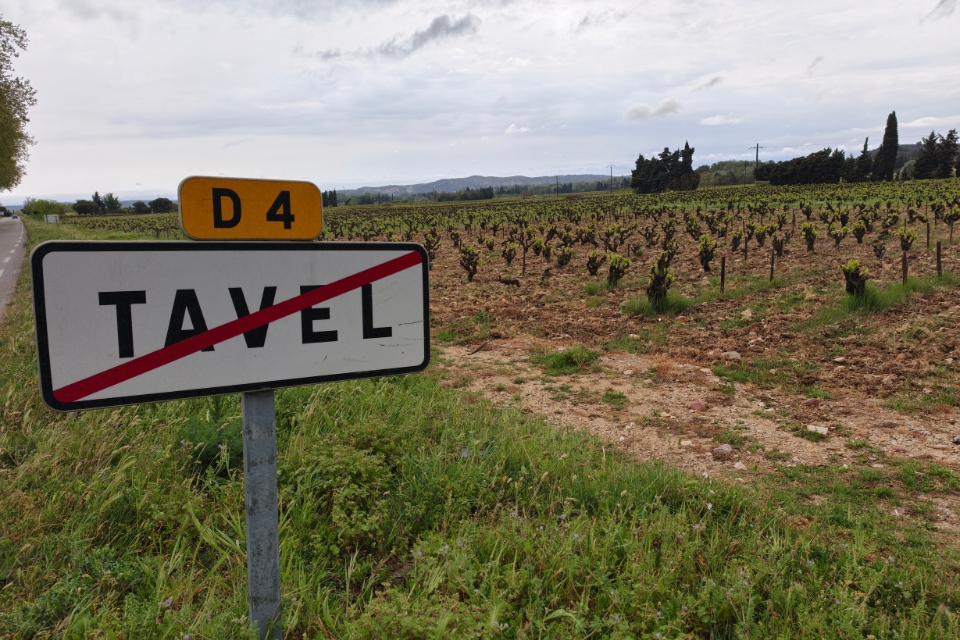
Tavel, named after the village not far from Avignon, is a particular denomination even in its setup. Recognized as an AOC in 1936, it belongs to the first historical phase of French appellations. It is traditionally referred to as France’s first AOC dedicated to rosé. This fact is important because it speaks of a vocation.
Here, rosé is not a marginal type alongside more or less important reds and whites. It is the center of the appellation. The production territory is located in the Gard, on the right bank of the Rhône, between Tavel and part of Roquemaure, in an area not far from Châteauneuf-du-Pape. The geographical location helps to understand a lot: Mediterranean climate, generous sun, ventilation guaranteed by the Mistral wind. Temperature excursions and a soil matrix that alternates pebbles, sands, clays, limestones, and marls.
The result could not be a neutral rosé. From the beginning, Tavel has built its reputation on a profile that is more vinous compared to today’s dominant image of rosé, for light consumption or even gastronomic use. Not a wine to drink without thinking, but a rosé with a precise function in the cuisine of Southern France. A wine that is literally perfect, more generally, in Mediterranean cuisine.
Taking the concept to the extreme: we could even define it as a light red—of the kind that seems to be in fashion today, instead of concentrated reds rich in extract and alcohol—rather than a deep rosé.
THE GRAPE VARIETIES OF TAVEL AOC: GRENACHE, CINSAULT, SYRAH
Tavel’s identity is also linked to its nature as a blended wine. Grenache is the cornerstone variety, but the regulations allow the use of several traditional Southern Rhône varieties. Among these are Cinsault, Syrah, Mourvèdre, Clairette, Bourboulenc, Piquepoul, Carignan, and Calitor.
This ampelographic composition explains the possible complexity of the wines. Grenache contributes volume and ripe fruit. Cinsault can provide momentum and airier aromas. Syrah and Mourvèdre often intervene on the side of spice, structure, and persistence. White and grey varieties, when present in the winery’s balance, can bring a fresher and more aromatic component.
Tavel’s color is also born from here. It is not a stylistic whim, but the consequence of an idea of rosé that does not fear greater extraction. In the best examples, the matter does not become weight. The wine retains energy, flow, and a finish capable of accompanying food without stopping at a simple thirst-quenching function.
THE MARKET LOOKS TO PROVENCE
Provence has played a decisive role in the modern success of rosé. It has built a clear, exportable image, recognizable in every market: pale color, elegant bottles. Lifestyle language, summer consumption. It has been one of the most effective operations in French wine over the last twenty years.
That model, acting as a driver for the entire category, now risks stalling Tavel and its too-narrow filter. If the consumer learns to recognize only almost transparent rosé as “good,” every other interpretation starts at a disadvantage. The more intense wine is suspected even before tasting: too alcoholic, too sweet, too old-fashioned. Often without any real reason.
Tavel is paying for this simplification today. Yet right here lies its opportunity. In a landscape crowded with rosés built to look alike, a denomination with such a sharp profile can transform its difference into value. Provided it is communicated better.
DON’T LIGHTEN, EXPLAIN
The temptation to lighten the color to be more marketable is understandable and has become a central theme among the vignerons of this corner of France. Producers know the shelf, the restaurant trade, foreign markets, and buying habits. They know that many customers choose a rosé in a few seconds, letting themselves be guided more by the hue than by the origin. But a denomination cannot base its future on chasing the codes of others.
Tavel needs to update, not camouflage. It can work on greater stylistic precision, freshness, aromatic cleanliness, image care, and a more direct narrative. It can make its positioning clearer, especially to restaurateurs, wine merchants, sommeliers, and buyers. It can explain in simple words that a deeper rosé is not necessarily heavier. That color does not automatically indicate sweetness. That structure, when well-managed, expands service possibilities.
The key is gastronomic. Tavel finds its space alongside dishes that require more backbone than that offered by many light rosés: fish in flavorful preparations, tuna, white meats, lamb, grilled vegetables. And again: cured meats, spicy cuisine, recipes with tomato and Mediterranean herbs. It is here that the wine shows its utility, as an autonomous category.
A DIFFERENCE TO DEFEND
Rosé does not have a single possible form. It can be subtle, saline, citrusy, almost impalpable. But it can also be fuller, fruity, spicy, suitable for cooking. Quality does not depend on the amount of color, but on the balance between maturity, freshness, extraction, and precision.
Tavel must start again from this evidence. Not to close itself in the celebration of tradition, but to avoid losing what makes it recognizable. Historical denominations stay alive when they manage to speak to the present without erasing their own accent. Tavel can do it. Indeed, today it must do so more decisively.
In a market that often rewards uniformity, its more marked profile is not an automatic limit. It can become a signature. And a signature, when backed by convincing wines, is worth more than any adjustment to the fashion of the moment. Tavel is “the” “deep rosé” par excellence. For some, it is even “the” “rosé,” tout-court. The hope is that a trend does not erase its history and character.