IN BRIEF
- Climate change could push Tokaj toward growing red grape varieties such as Kadarka and Kékfrankos.
- István Szepsy Jr, interviewed exclusively by Winemag, stresses the importance of defending Tokaj’s identity while diversifying production.
- Agronomic research is helping to study grape varieties better suited to new climate conditions.
- Szepsy criticizes overly permissive appellations that undermine the reputation of unique products and would favor a more ethical, sustainable model.
- The future of Tokaj’s white wines, however, remains tied primarily to Furmint, the central variety in local production.
Climate change could push some areas of Tokaj toward growing red grape varieties, such as Kadarka and Kékfrankos. Until a few years ago, this prospect would have seemed almost unthinkable in one of the world’s most celebrated regions for sweet white wines. Yet it is one of the possibilities that István Szepsy Jr is exploring, convinced that the future of the territory calls for a deep overhaul of production and commercial strategies.
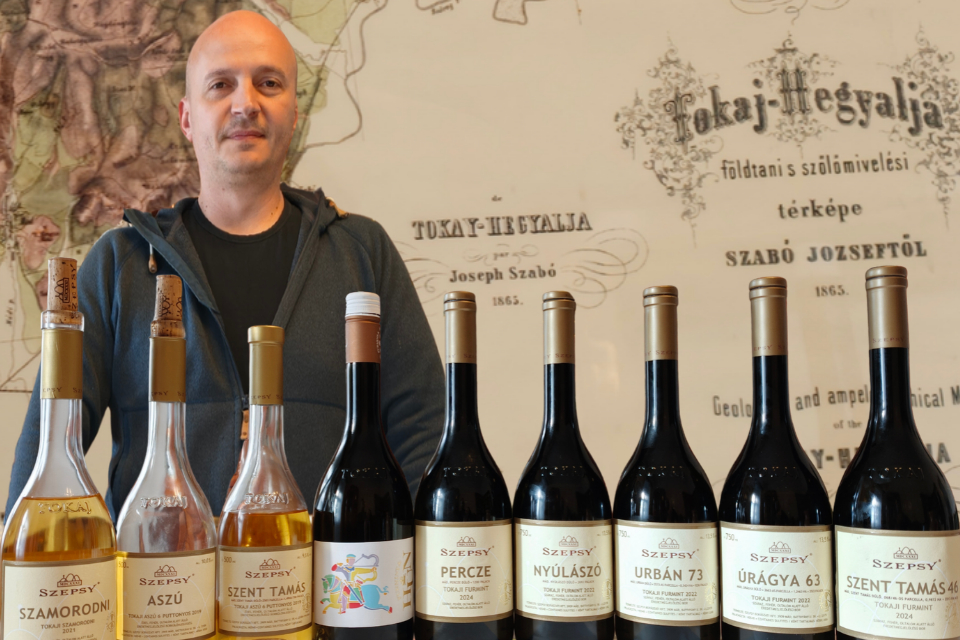
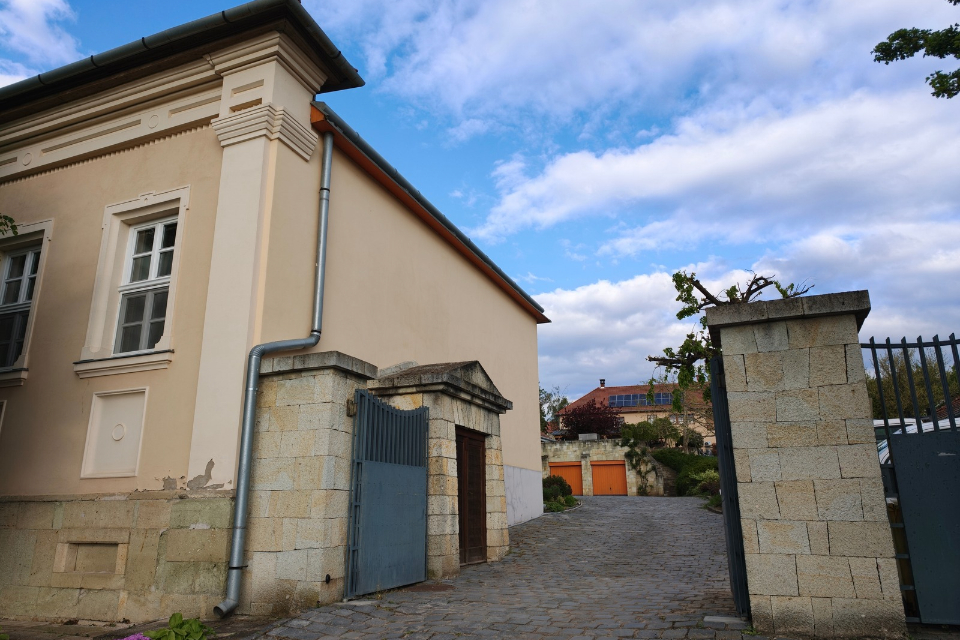
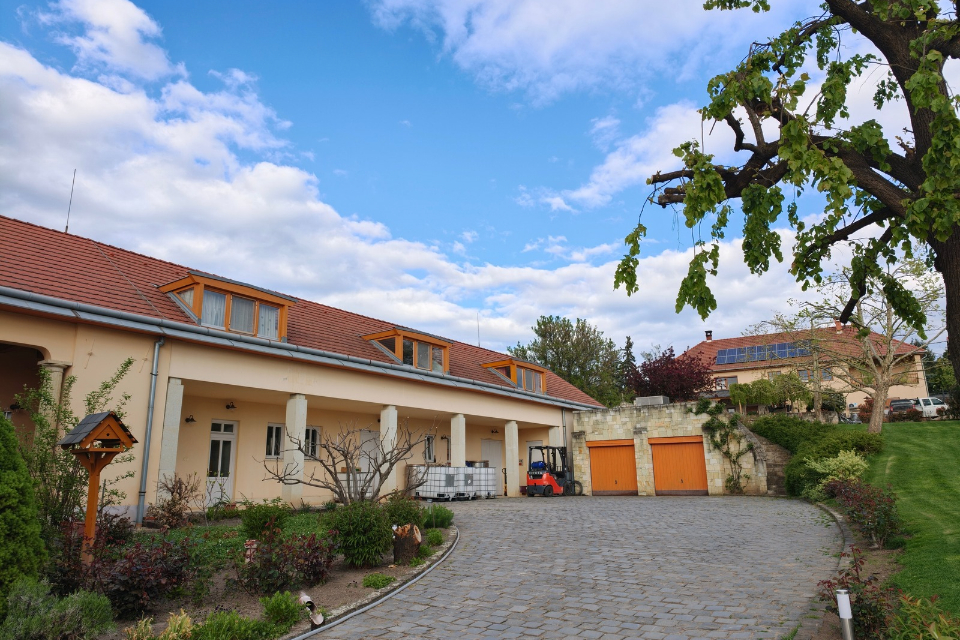
“And that wouldn’t mean giving up Tokaj’s identity,” the scion of the historic Hungarian winemaking family is quick to clarify, rolling up his sweatshirt sleeves in the winery’s elegant tasting room at 59 Batthyány utca, in the heart of Mád. On the contrary, “it needs to be defended more decisively, by clearly distinguishing the great sweet wines from dry Furmints and other emerging styles.” In the background looms an issue affecting all of Hungarian wine: the difficulty of building appellations that are recognizable and competitive on international markets.
In the exclusive interview given to Winemag, accompanied by a tasting of the estate’s latest vintages, Szepsy addresses the industry’s contradictions without diplomacy. He even points to a model worth drawing inspiration from: Piedmont’s Langhe.
CLIMATE CHANGE IN TOKAJ: HISTORIC ZONES ARE BECOMING TOO HOT
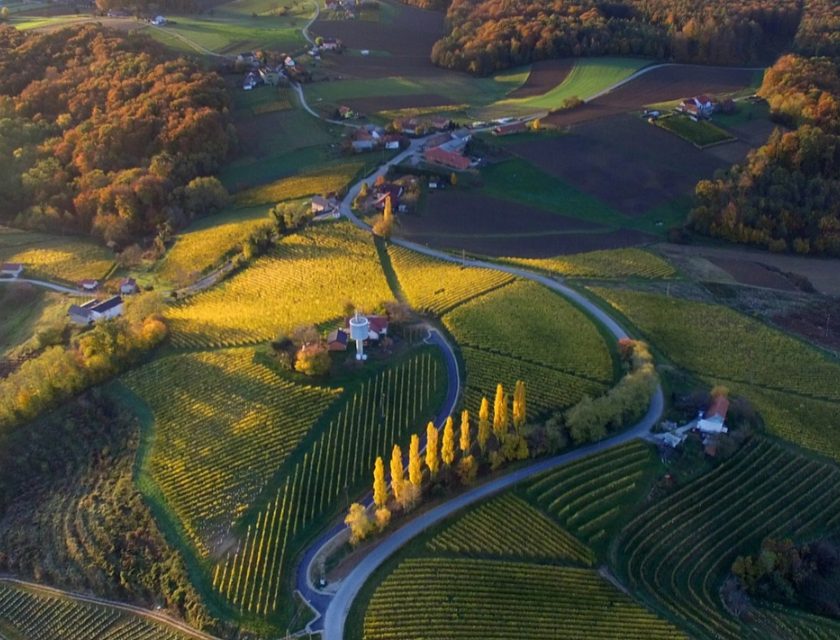
Standing in front of the map of Tokaj’s vineyards, Szepsy points to one of the most pressing issues. Some areas historically suited to producing highly concentrated grapes are becoming excessively hot and dry. “I don’t think this area has a serious future, because it’s already too hot,” he says, pointing to one of the region’s southern zones.
In the past, those very climate conditions favored the natural raisining of the grapes, making it possible to produce sweet wines even without the development of Botrytis. Today, rising temperatures threaten to upset that balance.
The answer may come from agronomic research and clonal selection. Szepsy works with universities and researchers to study how different varieties behave under different environmental conditions. Among the trials are also some clones of Kadarka and Kékfrankos, red grape varieties known for particularly late ripening, sometimes extending past mid-October.
These are still trials on a limited number of vines, with no immediate commercial purpose. But the goal is to understand whether red varieties could be an alternative in areas that may become less suited to whites in the future.
RED WINES IN TOKAJ? YES TO THE TERRITORY, NO TO THE APPELLATION
Szepsy, however, draws a clear line. The possibility of growing red grapes doesn’t necessarily mean they should enter the Tokaj appellation. “Tokaj wine, by tradition, must be white,” he points out. The distinction concerns the relationship between geographic territory and the appellation’s identity.
A Kadarka produced in the area could find its place as a red wine from northern Hungary, possibly promoted under a broader territorial indication, such as Zemplén, named after the mountain range of volcanic origin that underpins the very existence of the region’s viticultural excellence. It’s a prospect the producer finds more compelling than chasing international models.
“Pinot Noir, for example,” notes Szepsy Jr, “has to compete with already highly accomplished competition worldwide. Kadarka and Kékfrankos, on the other hand, offer the chance to develop wines with a genuinely Hungarian character.”
FURMINT: OVER A HUNDRED CLONES AND A RESOURCE STILL TO BE DISCOVERED
The future of white wines remains closely tied to Furmint, the variety on which Szepsy focuses most of his vineyard work. “I’m a vineyard man. I’m not a producer who thinks purely in business terms,” he remarks. According to the producer, over a hundred clones of Furmint are already known in Tokaj, with many more likely still unidentified.
A genetic wealth he considers “important evidence of the variety’s origin right here in this region,” especially in light of the recent discovery concerning Kolorko, a Turkish grape with the same genetic profile as Furmint.
Differences between clones also extend to how they respond to environmental conditions. Some show traits potentially useful for cooler areas, others for drought-prone ones.
Szepsy believes it will take decades of study to fully understand this diversity. Meanwhile, the rise of dry Furmints, which have driven Tokaj’s transformation over the past twenty-five years, raises new questions about vineyard classification and wine longevity.
418 HISTORIC CRUS, BUT FEWER THAN 60 VINIFIED SEPARATELY
Tokaj has an ancient classification system identifying 418 crus, 52 of which fall into the top category. An extraordinary heritage, but one not yet sufficiently explored through contemporary production.
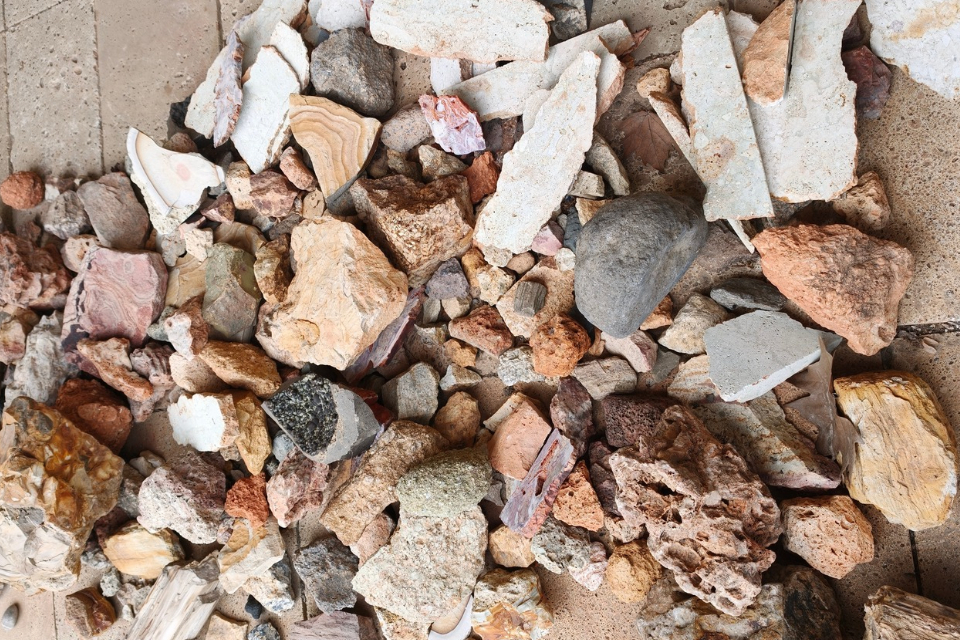
According to figures cited by Szepsy, about half of the historically identified units are cultivated today, and fewer than sixty crus have seen producers pursue separate vinification. The geological differences are considerable: Szepsy distinguishes, for instance, andesitic soils, associated with elegant, floral, long-lived wines, from rhyolitic ones, which can yield more powerful, structured wines.
That’s why he considers it “premature to define a definitive classification for dry wines.” “First we need to build experience,” he explains, “verify the consistent quality of individual vineyards, and understand which traits are truly linked to their origin.”
A NEW HIERARCHY FOR TOKAJ: “BUT SWEET WINES SHOULD STAY AT THE TOP”
It’s precisely on the structure of the appellation that Szepsy offers one of the most important reflections in the exclusive interview given to Winemag. The global decline in sweet wine consumption is a clear problem. But giving up Tokaj’s historical heritage “just to chase market trends” would, in his view, “be a mistake.”
“I would rather imagine a hierarchy in which the most prestigious quality tier remains reserved for sweet wines. An intermediate tier could showcase both these and dry Furmints, while less traditional productions would find room through a broader territorial identity.”
The reference is also to the relationship between Porto and the Douro, where different styles coexist without blurring their respective identities. This isn’t a reform already set in stone, but a possible direction. “In Tokaj,” Szepsy explains, “there’s still an underlying problem: the lack of sufficiently selective rules to distinguish the most prestigious expressions.”
An attempt to introduce stricter criteria has been underway in the Mád area, through a voluntary local system. The goal is to highlight varietal purity and grape provenance, especially for single-vineyard wines: just consider Szent Tamás, Öreg Király, Betsek, Nyulászó, and Úrágya. All of them exceptional, recognizable, and distinct expressions of Mád, which is just one of the 27 villages in the Tokaj wine region (a UNESCO World Heritage Site since 2002).
TOKAJ SPARKLING WINES, SZEPSY TEMPERS EXPECTATIONS: “‘FLAWLESS’ DOESN’T MEAN ‘INTERESTING'”
Another shift concerns sparkling wines. Szepsy estimates that about a third of Tokaj’s producers have started making them, taking advantage of Furmint’s natural acidity. He himself recalls getting into bubbles back in 2009, out of personal passion, an experience that taught him a lesson: “It’s not enough to make a technically correct wine.”
“I still remember an Italian friend’s verdict on a local sparkling wine: ‘No obvious flaws,’ he told me, before adding: ‘But nothing that really made it interesting, either.'”
It’s a judgment Szepsy extends to dry wines as well. “The real challenge today,” he stresses, “lies in achieving wines with a recognizable character, consistent quality, and a genuine ability to evolve over time. Simply multiplying styles, on its own, isn’t enough of a strategy for the region’s future.”
HUNGARIAN WINE, SZEPSY’S CRITIQUE: “EVERY REGION MUST FIND ITS OWN STYLE”
Broadening the discussion to Hungary as a whole, the producer identifies fragmented offerings as one of the main commercial limitations. “I think every region needs to find its own style,” he argues. “What’s needed is a core group of ten or fifteen wineries capable of sharing a shared territorial vision while still preserving their own individual character.”
The cautionary example is Eger and its Egri Bikavér, the “Bull’s Blood.” Szepsy sees Kékfrankos as one of the area’s most compelling varietal expressions, but questions the need to subordinate it to the tradition of blending. In his view, overly permissive appellations “end up encompassing products of widely varying quality and ambition, making it hard to build a unified reputation and command higher prices.”
The diversity of Hungary’s vineyards can be an asset for local tourism and dining, but abroad, it risks becoming a hurdle when there’s no immediately clear message: “If you don’t have your ‘elevator pitch’ ready, short and direct, you’re lost on the world stage.”

EXPORT: TOKAJ STILL SELLS MOSTLY IN HUNGARY
The problem is reflected in international markets. According to an outdated estimate provided by Szepsy, between 60 and 70% of Tokaj wines are sold on the domestic market. His own winery, despite relatively modest volumes, must maintain a presence in more than twenty countries to sell its production.
“Part of the weight,” the producer points out, “comes from the legacy of the socialist era, which did not foster the creation of an integrated market among Central and Eastern European countries.” But Szepsy doesn’t attribute the commercial difficulties mainly to recent political tensions.
Asked about the possible impact of Hungary’s diplomatic relations with certain European countries ahead of the elections that led to the change of the Orbán government, Szepsy dismisses overly simplistic explanations. “Merchants,” he says, “don’t give up profit just because of politics. Numbers always matter most; politics comes, at best, second.” The real issue, then, remains companies’ ability to make their wines competitive and desirable.
FROM FEWER THAN 50 TO NEARLY 300 LABELS: INTERNAL COMPETITION IN TOKAJ
The production landscape has also changed radically. According to Szepsy, before Hungary joined the European Union, fewer than fifty wine labels operated in Tokaj. Today there are nearly three hundred. “The rise in investment,” he recalls, “has helped restore buildings and vineyards, but hasn’t always resulted in economically self-sufficient and sustainable businesses.”
The producer criticizes “businesses backed by capital from activities unrelated to wine”, which can afford to keep operating even without real profitability. The Szepsy family, by contrast, has chosen to finance its business through bottle sales, avoiding competition in the lower-priced segments.
Hence the need to personally oversee international markets, building commercial relationships and constantly comparing notes with the world’s top producers. It’s no coincidence that Szepsy is a brand exclusively distributed in Italy by Ceretto.
THE LANGHE MODEL AND THE LESSON FROM ANGELO GAJA
It’s in Italy that Szepsy finds one of the most compelling examples of territorial development: “I think Barolo and Barbaresco are the best example for Hungarians of how a wine region can develop.” The producer regularly visits the Langhe, seeking out wineries and different interpretations of the territory. He also recounts a five-hour conversation with Angelo Gaja, without tasting a single wine.
“We spent that entire time talking about the economic and social transformation of the Langhe area. What strikes me is the journey that took vineyards, once abandoned, to reach extremely high land values. But above all, the ability to build a hierarchy in which Barolo, Barbaresco, and Langhe coexist alongside different varieties, such as Nebbiolo, Barbera, Dolcetto, and Freisa.”
A system that, in Szepsy’s reading, shows “how important it is to believe in your own grapes” and “to clearly define the characteristics of appellations.” It’s not enough, then, “to import a production model or imitate great foreign wines.” “What’s needed is to develop a sense of place,” he warns, “grounded in knowledge of the vineyards and a recognizable style.”
His sweatshirt sleeves stay rolled up at elbow height as the interview draws to a close at Szepsy’s headquarters in Mád. “In the end, we could sit here for hours talking. But it all starts with taste. Taste comes first. And then, once the taste is there, you can build the rules around it.” Sweet or dry, the “taste” in Szepsy’s glasses is a tribute to the most authentic Hungarian wine.
- Masters of Wine 2026: seven new inductees, Portugal and Hungary join the MW map
- Sweet and sparkling Tokaj wines: Hungary brings order to the categories
- Villány, new frontier for Cabernet Franc: Hungary hosts the first Franc du Monde competition
- Forget LGBT rights: Hungary asks Orbán for the right to drink wine at restaurants
- Juhfark, Hungary’s volcanic grape variety: a tasting of 26 labels with scores