IN BREVE
- Distillery tourism is becoming a priority in the Italian spirits sector.
- Distillery hospitality offers commercial opportunities and helps build trust with consumers.
- Wine tourism generates nearly 40 billion euros globally, but only 10% of tourists visit wineries.
- Collaboration between distilleries and local territories can enhance authenticity and the Made in Italy brand.
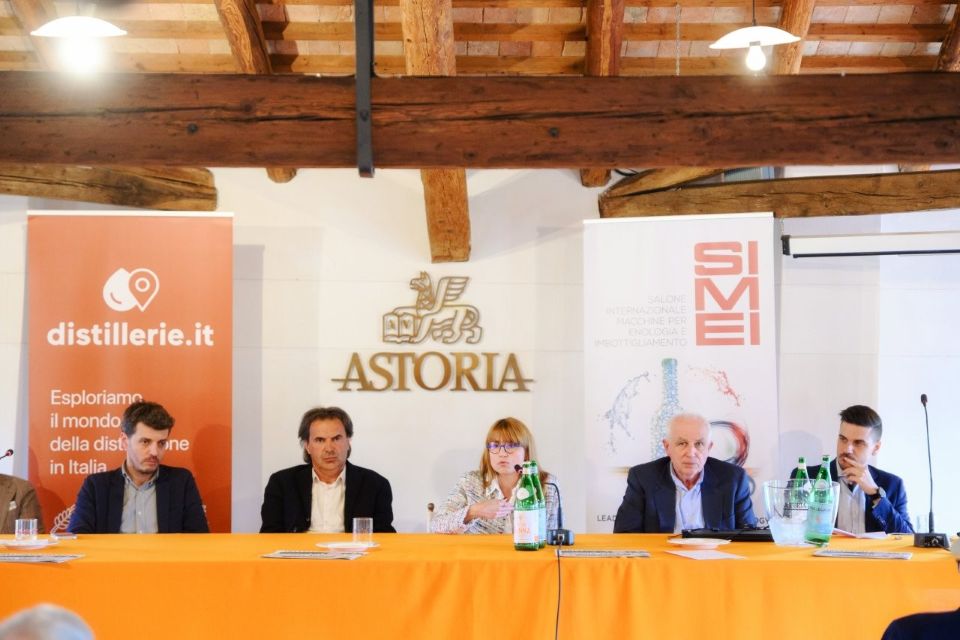
Distillery tourism is becoming a permanent priority for the Italian spirits sector. This is the message that emerged from the conference hosted by Astoria Wines and promoted by Distillo in collaboration with Simei and Unione Italiana Vini. The meeting brought together producers, consortia, and operators to analyze the opportunities and challenges of distillery hospitality, now considered an economic and cultural lever for the sector.
Opening the proceedings was Davide Terziotti of Distillo, who placed the topic within the context of the Italian market: “Italy starts from one of the lowest and most virtuous alcohol consumption rates in Europe, but with a strong vocation for premium products. In this scenario, distillery hospitality represents a concrete opportunity for commercial outlets, higher margins, and direct control of the relationship with the consumer.”
DATA AND NEW SCENARIOS
The economic framework was explored in depth by Fabio Ciarla, director of Corriere Vinicolo, who presented wine tourism data as a reference for the spirits world. Globally, wine tourism generates nearly 40 billion euros, with an average annual growth of around 13%. In Italy, in 2024, food and wine tourism approached 3 billion euros with approximately 15 million visitors.
“Wine tourism is now a true revenue asset, but only 10% of foreign tourists currently enter a winery. This is where the great challenge lies, and this applies to distilleries as well,” Ciarla explained.
Filippo Polegato, Vice President of Unione Italiana Vini and CEO of Astoria Wines, also spoke on the topic: “Wine tourism serves to diversify and increase margins, but above all to build trust and credibility. That is where you anticipate tastes and trends and speak to the new generations.”
EXPERIENCE AS A PRODUCT
During the discussion, a shift in the approach toward visitors emerged. “The visit is not a gift: it is the most important product we sell,” stated Alessandro Marzadro, President of the Istituto di Tutela Grappa del Trentino. “Tourism creates relationships, memory, and awareness: today it is one of the few real weapons against the structural decline in consumption.”
For Giulia Berta of Distillerie Berta, the competitive value of the Italian model lies above all in authenticity: “People don’t just fall in love with a bottle, but with a story, a family, and an experience they remember over time. Creating circuits between distilleries and territories would be a victory not only for the companies but for the entire tourism system.”
The experiential theme was also taken up by Bruno Pilzer of Distilleria Pilzer: “Distillation is magic: a solid that becomes liquid, a scent that becomes emotion. This is what truly fascinates those who enter a distillery.”
NETWORKING, IDENTITY, AND MADE IN ITALY
According to Fabrizio Mazzetti of Antica Distilleria D’Altavilla, there is no single model: “There is no format that works for everyone. Tourism must respect the identity, history, and audience of each distillery.”
Davide Mansouri, President of the youth section of Assodistil, presented the “Distillato di Valori” project: “Distillery tourism enhances culture and territory, providing a close-up look at the work and skills of the sector in continuity with the wine supply chain. An experience to make Made in Italy visible, telling stories of families, cooperation, generational transitions, and choices of quality and sustainability throughout the chain.”
Among the examples of collaboration, Paolo Brunello of Distillerie Aperte spoke: “Working as a system works. Bringing different companies together has allowed us to build a younger, more curious, and more aware audience.” On the same page was Sanzio Evangelisti of Mazzetti D’Altavilla: “The future is not about tending your own little garden, but about networking among producers.”
TOWARD DISTILLO AND SIMEI 2026
Closing the debate was Francesco Smolari of Distilleria Nardini: “The final tasting is the crowning achievement of a journey through the storytelling of places, people, and history. When visitors return home and share what they have experienced, they become our first true brand ambassadors.”
On the institutional front, Michele Viscidi of the Consorzio Nazionale Grappa reiterated the need to strengthen the narrative of grappa abroad: “We must first explain what grappa is, presenting it as a great Italian spirit of excellence. To do this, we need a system and the support of institutions.”
During the day, a certification dedicated to excellence in distillery hospitality was also presented, which will be awarded during Distillo and Simei 2026, scheduled from November 17 to 20 at Fiera Milano.
“This meeting is a first stone. We want to continue creating concrete opportunities for discussion and collaboration for the sector,” declared Claudio Riva. “Simei aims to be not just a technological platform, but also a cultural one, where these visions can transform into real projects,” added Monica Pedrazzini.