IN BREVE
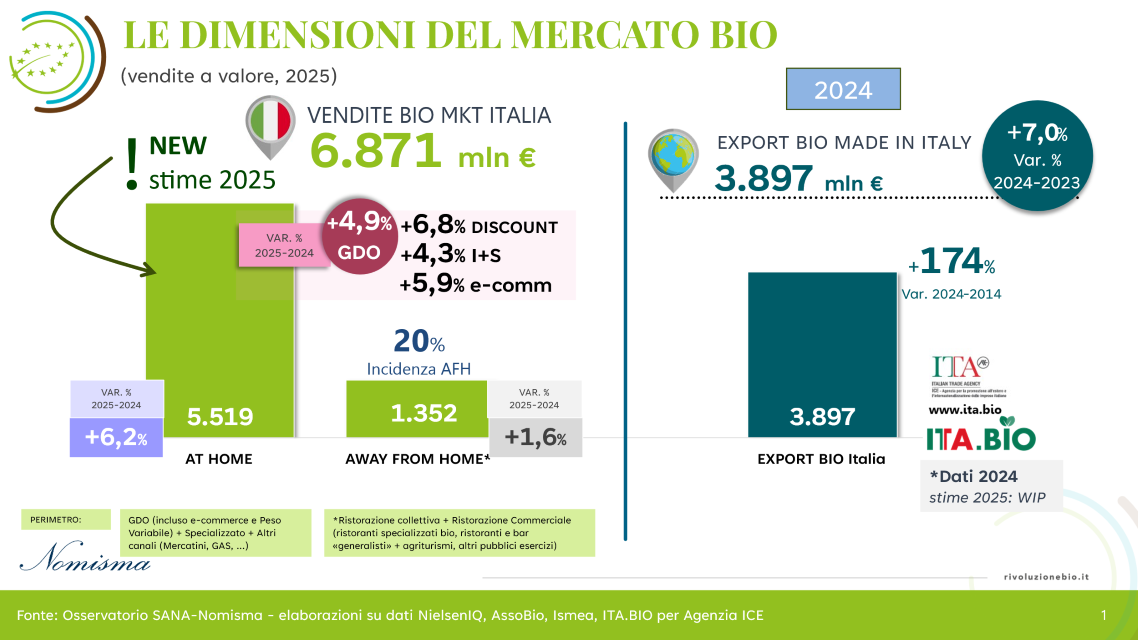
- In 2025, the organic market in Italy reaches €6.9 billion, with €5.5 billion coming from domestic consumption.
- Modern distribution accounts for 64% of domestic consumption, while the away-from-home channel covers 20% of overall organic consumption.
- About 8 out of 10 restaurants use organic ingredients, with motivations linked to sustainability and well-being.
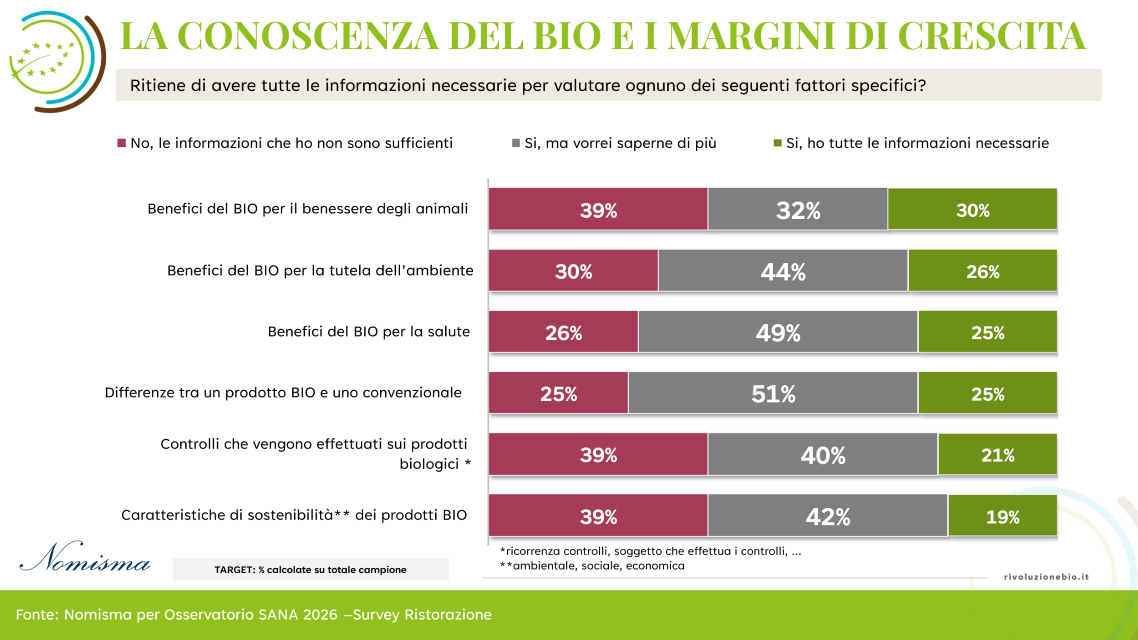
- 75% of operators indicate a lack of information about organic, highlighting the need for training and communication.
- Italy is the European leader in organic production, with 84,000 organic farms and 19% of cultivated land.
In 2025, the organic market in Italy reaches €6.9 billion. Of this, €5.5 billion comes from domestic consumption, while over €1.35 billion comes from the out-of-home channel. This emerges from data from the SANA Observatory presented by Nomisma at BolognaFiere during Rivoluzione Bio.
Modern Distribution confirms itself as the primary purchasing channel for domestic consumption, with a 64% share and sales of €3.5 billion, up 6.1% compared to 2024 (Nomisma estimates based on Nielsen IQ data, 2025, omnichannel scope). Organic specialty stores capture 20% of domestic consumption and recorded a 7.5% increase over the past year.
OUT-OF-HOME: STRATEGIC LEVER FOR ORGANIC
The away-from-home channel represents 20% of overall organic consumption. In the past 12 months, 7 out of 10 Italians consumed organic food or beverages out of home; 35% are frequent users.
The Nomisma survey of restaurants, bars, and public establishments reveals that over 8 out of 10 restaurants and 7 out of 10 bars use ingredients or offer organic products. Among the most common categories: fruit and vegetables, extra virgin olive oil, tomato sauces, milk, and honey. 85% of restaurants and bars offer organic wines.
The motivations driving the inclusion of organic in menus are linked to the premium positioning of the establishment (51%), ethical and sustainable choice (46%), and response to health and well-being needs (40%). 38% of restaurateurs state they introduced organic products at the initiative of local producers.
PROSPECTS AND INFORMATION GAP
75% of operators do not have sufficient information about organic production methods and their effects on the environment, health, and animal welfare. A limitation that, according to the Observatory, requires investment in training and communication.
For the next 2-3 years, 26% of operators expect an increase in the value of organic raw material purchases. 28% expect a reduction in out-of-home consumption occasions, as a strategy for families to contain spending.
“This is precisely where organic finds its full coherence,” comments Silvia Zucconi, New Market Intelligence Director at Nomisma. “Its characteristics align perfectly with consumers’ new expectations, who in out-of-home seek authentic and valuable experiences, based on simple and minimally processed dishes capable of satisfying the growing demand for alternatives suited to specific diets or healthier and lighter lifestyles.”
“The SANA Observatory data show organic growing and increasingly mature, with an ‘out-of-home’ component now strategic, capable of attracting new consumers and enhancing the supply chain,” states Maria Grazia Mammuccini, President of FederBio. “The fact that 7 out of 10 Italians have consumed organic in away-from-home and that restaurants and bars are increasingly including it in menus and offerings is a strong signal that, however, must be supported by greater investment in training and communication.”
“The survey reveals,” continues Mammuccini, “how most operators wish to increase their knowledge of production methods and the effects of organic on the environment, health, and animal welfare. To achieve this goal, we firmly believe that new relationships must be built between agricultural producers and out-of-home catering, to enhance supply chains capable of producing quality and territorial identity, creating economic and social networks essential for the regeneration of rural areas.”
EXPORT, TRADE FAIRS, AND COUNTRY SYSTEM
“SANA Food and Slow Wine Fair were created to bring together and give voice to the multiple facets of healthy and conscious eating,” emphasizes Rossano Bozzi, Business Unit Director at BolognaFiere. “Connecting food and wine in a combination that generates culture, economic value, and protection of territories. It is within this vision that the evolution of Italian organic fits. Today no longer a niche, but an economic and cultural infrastructure capable of guiding the entire agri-food system. In 2025, the Italian organic market reached nearly €7 billion in sales.”
“But the real paradigm shift,” continues Bozzi, “is represented by out-of-home: a strategic space where the value of organic takes shape in experience, storytelling, and direct relationship with the consumer. Quality, sustainability, respect for biodiversity, and innovation thus become concrete levers of competitiveness. BolognaFiere invests in building platforms for discussion, training, and networking among businesses, specialized distribution, and catering, accompanying a structural transformation of the supply chain.”
Matteo Zoppas, President of ICE, emphasizes the role of exports: “Exports of Italian organic products reached €3.9 billion in 2024, with 7% growth compared to the previous year and an extraordinary 174% increase compared to 2014.” In 2025, Italian agri-food exports reach €72.4 billion (+4.9%). For SANA Food, ICE brought to Bologna a delegation of approximately 150 international operators from 31 countries.
BUREAUCRACY: COLDIRETTI BIO’S ALARM
Organic results are weighed down by the issue of bureaucracy. Coldiretti Bio reports a surplus of requirements up to 30% more than conventional agriculture.
According to a Crea survey, excessive bureaucracy is the cause of abandoning organic production in 8 out of 10 cases. The burden particularly affects small and medium-sized enterprises, pushing them to give up certification.
Italy has 84,000 organic farms, with 19% of cultivated land under organic methods. In some regions, it exceeds 25%, achieving early fulfillment of EU Farm to Fork strategy objectives. Italy is the leading European country for organic production of cereals, vegetables, fruit, and olives.
“Consolidating Italian organic product supply chains through supply chain contracts, and the increasing presence of organic products in Campagna Amica markets. These are the tools we are implementing to promote awareness and enhancement of Italian organic,” emphasizes the president of Coldiretti Bio, Maria Letizia Gardoni. “The goal is to further develop domestic consumption of this excellence of our agri-food sector.”