IN BREVE
- Wine consumers are demanding greater transparency regarding wine ingredients, particularly the presence of sucrose.
- A survey reveals that half of the participants would prefer sucrose information to be on the physical label.
- Electronic labeling, accessible via QR Code, has provided a full list of wine ingredients since December 2023.
- Many consumers believe that knowing the ingredients, including sucrose, influences their purchasing choices.
- The president of Federmosti, Marco Bertagni, emphasizes that transparency is essential for respecting consumers and promoting food culture.
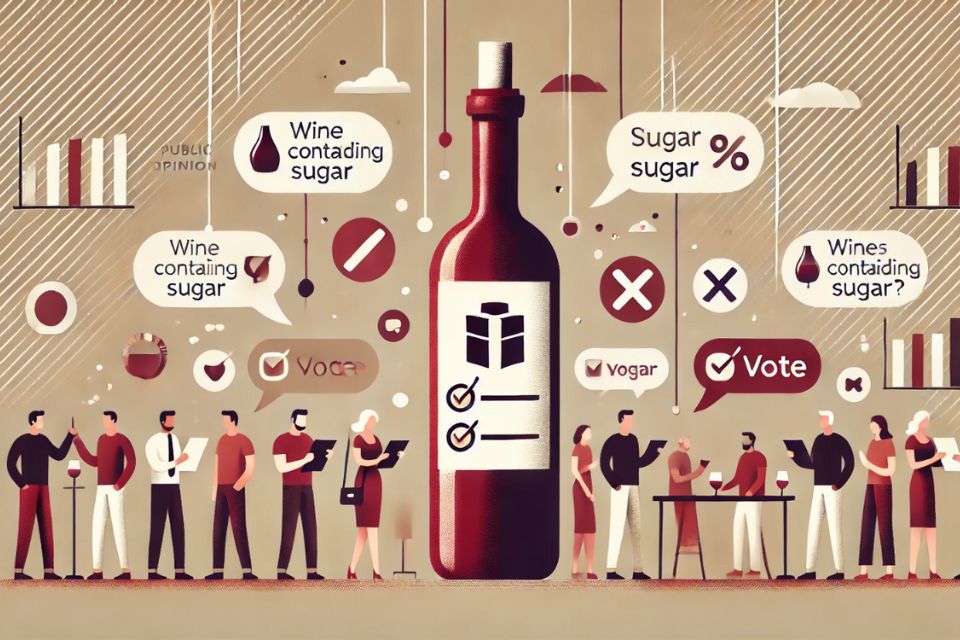
Wine consumers want to know what they are drinking. And they would appreciate greater transparency, especially regarding “wine ingredients.” This is what emerges from the survey conducted by Federmosti in collaboration with Winemag.it and its readers. The results reveal an increasingly strong demand for clarity on wine labels. Since December 2023, thanks to the new electronic labeling system, consumers can access—via QR Code—the complete list of ingredients present in wine bottles.
But is it really enough? According to the results of the Federmosti-Winemag.it survey, the answer is no: consumers want even more transparency. Let’s look in detail at the questions posed to an international audience.
1. Would you prefer the information on sucrose and concentrated musts to be on the physical label?
Yes: 50.6%
No: 49.4%
The split is evident: half of the participants ask for the presence of sucrose to be clearly indicated on the label.
Among the comments:
“Certainly, visible transparency above all else”
“It is an ingredient and it is only right that it goes in the ingredients list”
2. Did you know that wine is not always made 100% from grapes and grape musts?
Yes: 86.4%
No: 13.6%
Most respondents are already informed, but some comments still reveal surprise:
“I wonder what other elements they add to make wine!”
“If it is not the product of fermented grapes, it is not wine”
3. Did you know that in Central European countries wine can be enriched with sucrose, while in Italy only with concentrated must?
Yes: 83.1%
No: 16.9%
The practice of enrichment with sucrose, considered traditional and permitted in France, is known by most consumers who participated in the survey.
Among the comments:
“Even here in Italy many companies do it…”
“I thought it happened everywhere”
4. Do you think that knowing the wine ingredients, particularly the presence of sucrose, could influence the purchasing choice?
Yes: 105 responses (68.2%)
No: 49 responses (31.8%)
A clear majority wants to know what will be in the glass before buying a bottle.
“A wine with sucrose present is certainly of mediocre quality.”
“The presence of other additives, however, could influence me.”
5. Would you find it useful to be able to read phrases like “does not contain sucrose” on the label?
Yes: 68.2%
No: 31.8%
The data shows a line consistent with previous answers: knowing in order to choose consciously.
But there are also those who raise reservations:
“It could be misleading by ‘ennobling’ wines that are not deserving.”
“It would only be a further push to believe that one can drink more of it.”
SUCROSE IN WINE, FEDERMOSTI: “OUR COMMITMENT TO TRANSPARENCY REWARDED”
Marco Bertagni, president of Federmosti, says he is “very satisfied with the survey results.” “They demonstrate,” he comments, “how deeply the need for transparency is felt. Knowing if a wine contains sucrose can truly influence purchasing choices. It is not just a matter of labeling, but of food culture and respect for the consumer.”
“The positive response to the key question of the survey—whether information on the presence of sucrose in wine affects purchasing decisions—confirms a conviction we have always held,” concludes Bertagni. Supporting this intuition are the data: nearly 70% of respondents answered affirmatively.
“It is a strong signal,” the president of Federmosti further emphasizes, “that recognizes years of work to ensure clear and transparent information, without passing judgment on traditional practices adopted in other countries.”
But the journey, he warns, is not yet over. “We are only halfway there. The true goal,” Marco Bertagni concludes, “will be achieved when consumers worldwide are able to read and correctly interpret the new labels. We will continue to promote them, also collaborating with associations historically by our side, starting with Federconsumatori, as part of the In vino veritas project.”