IN BREVE
- The Milan-Cortina 2026 Winter Olympics are significantly influencing mountain tourism in Italy, with an increase in arrivals and investments since 2019.
- In 2025, total tourist arrivals in Italy reach 458.4 million, contributing to a strengthening of the international appeal of the Alps.
- Cortina d’Ampezzo emerges as a dynamic destination with 12,000 beds and an average spend of 310 euros per night in 2025.
- Foreign arrivals in Alpine destinations are growing, especially from Germany, Switzerland, and the United States, with higher average daily spending compared to Italian tourists.
- Alpine tourism will reach a historic peak in 2026, with positive impacts on employment and the labor market in Olympic areas.
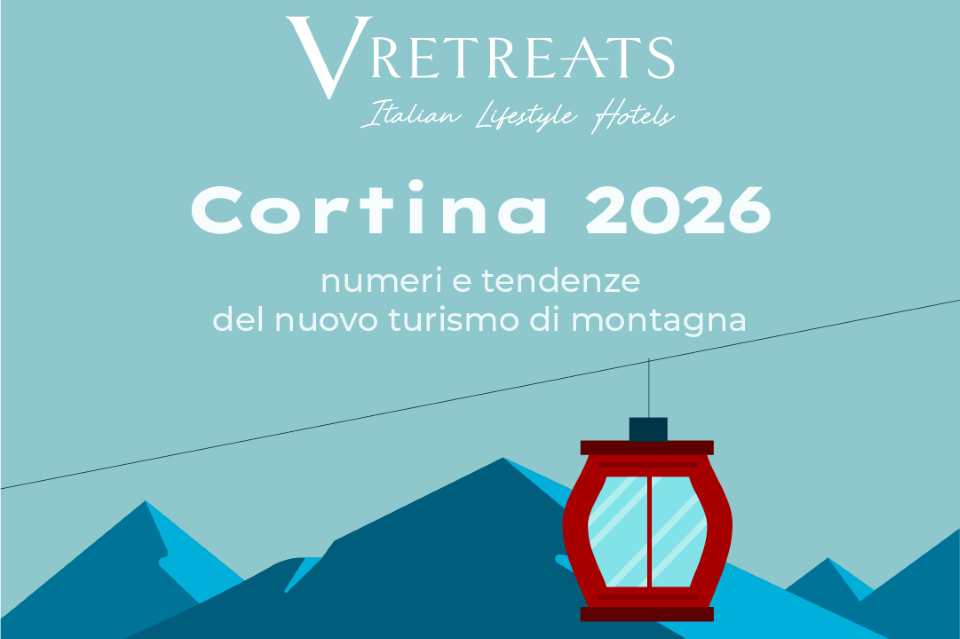
The Milan-Cortina 2026 Winter Olympics are having a structural impact on mountain tourism in Italy. Since 2019, the year the Games were awarded, the Alpine region has entered a phase of transformation reflected in arrivals, investments, and demand profile. The infographic “Cortina 2026: Numbers and Trends of the New Mountain Tourism,” created by VRetreats, captures this change.
After the 2020 collapse, with a 50% loss in arrivals, Alpine destinations showed a recovery capacity above the national average. Pre-pandemic levels were surpassed as early as 2023. In 2024, total tourist arrivals in Italy reached 458.4 million. 2025 confirms a positive trend, also supported by mountain tourism. The share of foreign tourists reached 55% of the total, a new all-time high, signaling a strengthening of the international appeal of the Italian Alps.
STRUCTURAL GROWTH OF ALPINE REGIONS
Between 2019 and 2025, the main Alpine regions consolidate their weight in the national tourism system. Valle d’Aosta goes from 3.6 to 4.01 million arrivals, with growth of 11%. Trentino rises from 6.9 to 7.75 million, equal to 12%. Alto Adige grows from 35 to 37.1 million arrivals, with an increase of 6%. The average length of stay also increases. In 2025 it stands at 4.6 nights, compared to 3.8 in 2019. This data indicates an evolution toward less fragmented tourism more oriented to quality of experience.
CORTINA AND ICONIC DESTINATIONS
Cortina d’Ampezzo emerges as one of the most dynamic destinations in the new mountain tourism. Between 2019 and 2025, arrivals grow steadily, supported by international relaunch and investments in facilities and services. In 2025, the destination has 12,000 beds, an average occupancy rate of 79%, and an average spend of 310 euros per night.
Positive performance is also recorded in Madonna di Campiglio and in the Matterhorn area. In these destinations, sports tourism, wellness, and the premium segment contribute significantly to the growth of flows and generated value.
THE ROLE OF INTERNATIONAL TOURISM
The contribution of foreign markets is central. Between 2019 and 2025, foreign arrivals in Alpine destinations increase steadily. The main source markets are Germany, Switzerland, Austria, the United Kingdom, and the United States. In 2025, the average daily spend of international guests reaches 182 euros, compared to 135 euros for Italian tourists. This data reinforces the economic weight of international tourism. At the same time, demand is growing for offerings that integrate high-end accommodation and attention to sustainability, with an increase in 4- and 5-star properties, environmental certifications, and experiences related to wellness and nature.
OLYMPICS AND TERRITORIAL INVESTMENTS
Milan-Cortina 2026 represents the turning point of the journey begun in recent years. The plan for works related to the Games includes 98 projects including sports facilities and transport infrastructure, for a total value of 3.4 billion euros. A significant portion of the investments is intended to leave a permanent legacy in the territories.
According to estimates by Isnart and Unioncamere, 2026 will mark a historic peak for Alpine tourism. In Olympic areas, 513,000 arrivals, 1.8 million overnight stays, and 281 million euros in direct tourist spending are expected. Considering construction and related activities, the overall economic impact exceeds 5.3 billion euros.
EMPLOYMENT AND POST-2026 OUTLOOK
The impact also affects the labor market. Between 2023 and 2025, hiring increases in the construction, hospitality, and tourism services sectors. Over 4,500 workers are directly involved in organizing the Games, alongside thousands of seasonal positions in Alpine destinations.
Looking beyond 2026, the VRetreats infographic identifies consolidating the results achieved as a priority. Forecasts indicate growth in summer flows, an increase in stable accommodation capacity, and greater adoption of green-certified properties. Milan-Cortina 2026 is thus seen as a key step toward a more balanced mountain tourism model, capable of competing with the main Alpine destinations in Europe.