IN BREVE
- The Italian coffee market is transforming, focusing on a complete experience rather than just quality in the cup.
- The “Ideal Bar” research by the Istituto Espresso Italiano highlights the centrality of customer satisfaction and service personalization.
- 60% of expert baristas identify equipment reliability and efficiency as the pillars of effective service.
- Over 50% of Italians consume coffee at a bar two or three times a week, showing strong loyalty to their blend.
- The Italian Espresso Collection is born, a selection of venues offering a complete Italian espresso and cappuccino experience.
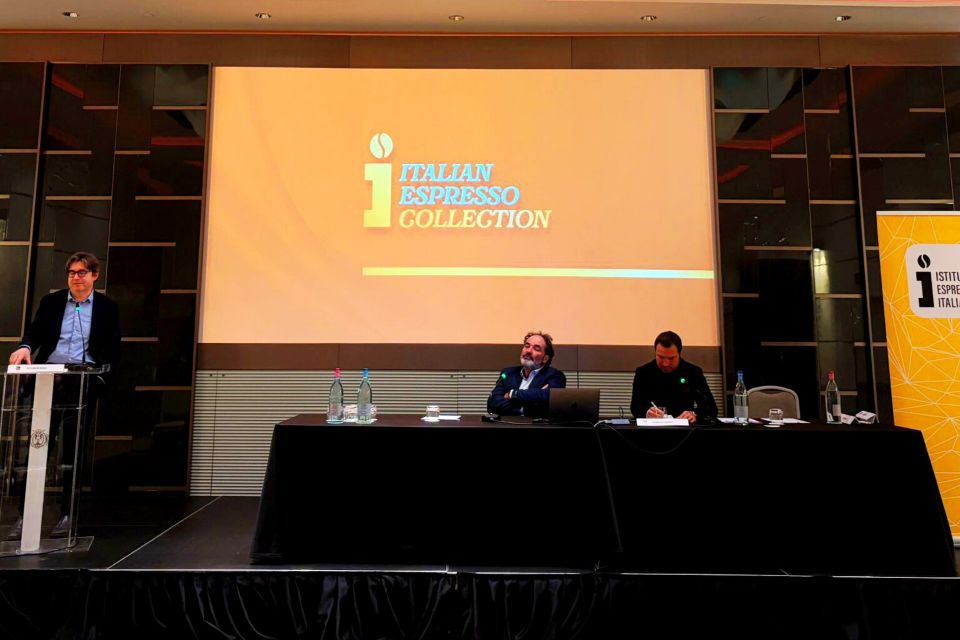
The Italian coffee market is going through a phase of transformation. On February 25, during IEI Connect 2026 at the Excelsior Hotel Gallia in Milan, the Istituto Espresso Italiano (IEI) presented the research “The Ideal Bar” conducted by Sylla.
The study redefines the concept of the bar. No longer just quality in the cup, but a complete experience. Service, environment, and the relationship with the customer become central elements. A new hierarchy of values emerges from the survey. Customer satisfaction surpasses every other factor. Equipment reliability, operational efficiency, and service personalization are considered key requirements.
«From the preparation of the espresso to the atmosphere of the venue, the research has generated a concrete snapshot of the real experience at the counter – explains the President of IEI, Alessandro Borea – but precisely to promote the most deserving bars, we have announced the creation of the Italian Espresso Collection, a selection of venues that stand out for excellence in both product and service.»
THE IDEAL BARISTA AND CUSTOMER CENTRALITY
For the consumer, the ideal barista is oriented toward “making the customer happy.” Relationship and service quality drive their work.
60% of the expert baristas involved in the survey indicate equipment reliability, efficiency, and personalization as the pillars of effective service. Innovation also concerns the spread of coffee culture.
Events and tastings are considered useful tools by 53% of the sample. Continuous training for baristas, indicated by 40%, is deemed necessary to acquire technical skills and respond to the evolution of Italian taste.
HOW COFFEE CONSUMPTION AT THE BAR IS CHANGING IN ITALY
Coffee at the bar remains a widespread ritual. More than half of Italians consume it two or three times a week. Almost one in five every day. Breakfast is the main occasion (55%), followed by mid-morning (51%). Consumption drops after lunch and in the afternoon. In the evening, it becomes marginal.
The counter remains the symbolic place of the experience, preferred by 58% of consumers. Loyalty to the blend and the venue is strong: 68% of respondents do not change their preferred taste.
Creaminess, intensity, and the pleasure of tasting guide the choice of espresso. Atmosphere, service quality, and brand trust complete the experience. The direct relationship with the barista remains central, being decisive for satisfaction and loyalty.
CONSUMER PROFILES AND THE BIRTH OF THE ITALIAN ESPRESSO COLLECTION
The research identifies different customer profiles. The Demanding Curators and Taste Seekers focus on quality and aesthetics. The Disaffected Utilitarians, Bar Communitarians, and Functional Disenchanted look for functionality and simplicity. The Concrete Pleasures value food and atmosphere. The Social-Playful prioritize the convivial dimension.
The study also proposes a dynamic method for evaluating bars based on objective, hedonic criteria and free descriptors. In this context, the Italian Espresso Collection was born. It is a selection of venues that serve as ambassadors for Italian espresso and cappuccino. The bars are chosen not only for technical compliance but for their ability to offer a complete experience to the customer.