IN BREVE
- Australia is exploring alternative grape varieties such as Fiano and Sangiovese, which adapt well to the local climate.
- Various Mediterranean varieties show good adaptability in warm regions.
- The masterclass at Wine Paris 2026 highlights Australia’s new wine identity with Italian, Greek, and French grapes.
- Wine globalization offers new territorial expressions and is an opportunity for the sector.
European explorers traveling to the land beneath the Asian continent called it The Land Down Under. The Country Down Under. Australia, today, is no longer a mystery. Not even for “alternative” grape varieties. As Emma Symington MW demonstrated during the Wine Paris 2026 masterclass “The Rise of Australia’s Alternative Varieties,” the island also speaks Italian fluently with varieties like Fiano and Sangiovese, alongside other “exotic” grapes such as Assyrtiko, Piquepoul, and Gamay.
ALTERNATIVE VARIETIES: THE NEW FRONTIER OF AUSTRALIAN WINE
In recent years, Australian viticulture has begun to look beyond classic international varieties—Shiraz, Cabernet Sauvignon, and Chardonnay—exploring grape varieties from the Mediterranean and other regions of the world. The goal is twofold: to better adapt to the country’s climatic conditions and to offer fresh, food-friendly wines.
Mediterranean varieties, in particular, show good adaptability to the hot, dry climates of many Australian regions. Hence the growth of Italian varieties like Fiano and Sangiovese, but also grapes like Assyrtiko from Greece or Piquepoul from southern France.
Also from Italy, there are examples of Barbera, Nebbiolo, Nero d’Avola, and Vermentino. Even more striking are the cases of Glera (Australian Prosecco is an unstoppable international case) and Montepulciano (much to the dismay of Abruzzo, committed to preventing its Marche neighbors from using the grape’s name).
BAROSSA PIQUEPOUL: LIENERT’S SALINE WHITE
Among the wines tasted during the masterclass, Lienert Vineyards “PIQ” Barossa Valley Piquepoul 2024 represents an example of Australia’s growing experimentation with Mediterranean varieties. Piquepoul, native to southern France, is known for its freshness and particularly food-friendly profile.
The wine shows aromas of lime, lemon zest, and marine notes, with hints of melon and oyster shell. On the palate it is light, mineral, and taut, supported by pronounced acidity and a saline finish that recalls its affinity for seafood pairings.
FIANO: ITALY ADAPTING TO THE AUSTRALIAN CLIMATE
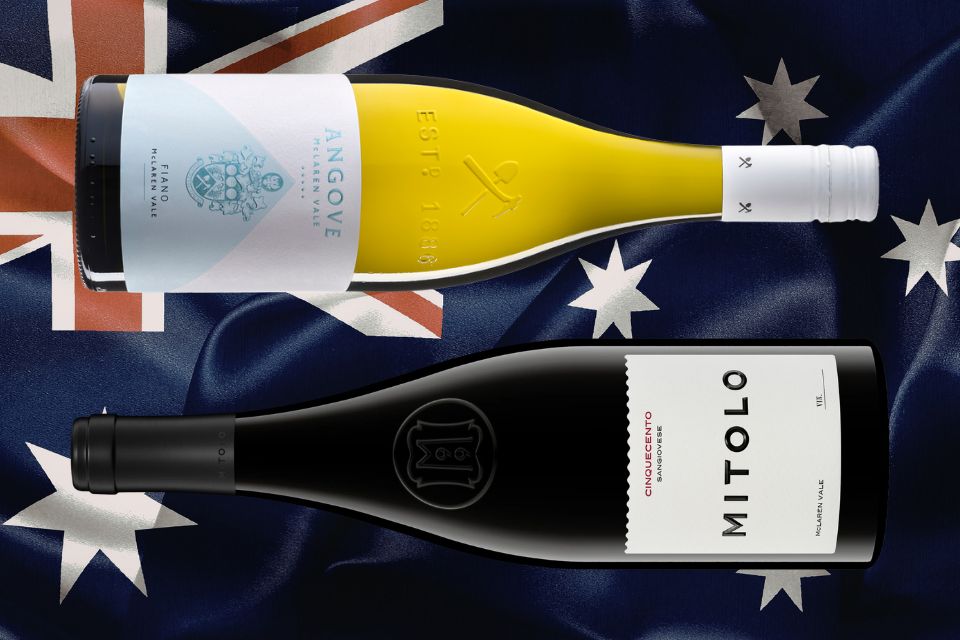
Angove Family Winemakers “Family Crest” McLaren Vale Fiano 2025 confirms how the Campanian variety is finding fertile ground in Australia, especially in the warm regions of South Australia.
Fiano is valued for its heat resistance and ability to maintain aromatic freshness, precious characteristics in increasingly extreme climatic contexts. In Australian wines it tends to express notes of ripe citrus, apple, and yellow stone fruit, with a full structure and good acid tension.
- Shiraz, Syrah: The Reasons Behind the Success of Australia’s Quintessential Red Wine
- International Master of Wine Symposium: 2027 Appointment in Adelaide
- Australian Prosecco Banned in New Zealand, Australia Outraged: “Clarifications Requested”
- Australian wine exports 2025: value and volumes down, Asia up (not China)
- Young Australians Abusing Bag-in-Box Wine: Medical Alarm Raised
- Mercato Centrale Opens in Melbourne, Australia
- Greece, Santorini Wine Tour: Wine on the Volcano Island
RIVERLAND ASSYRTIKO: GREECE IN AUSTRALIA
With Mallee Estate “Kati Allo” Riverland Assyrtiko 2025, the masterclass showcased another Mediterranean variety making its way on the oceanic continent. Native to the Greek island of Santorini, Assyrtiko is known for its natural acidity and great drought resistance, characteristics that make it particularly interesting for Australia.
In Riverland wines, citrus profiles emerge, with a lean body and great drinkability that also distinguishes this Assyrtiko, which is actually fruitier and much less “mineral” than the classic Greek “volcanic” version (Santorini). A confirmation of the variety’s ability to interpret the different soils in which it is planted.
GAMAY IN THE ADELAIDE HILLS
Hesketh Wines “Small Batch” Adelaide Hills Gamay 2025 represents the Australian version of Beaujolais’s signature variety. The Adelaide Hills, one of South Australia’s coolest areas, allow Gamay to develop a light, fragrant, and very fruity style, with notes of cherry, raspberry, and delicate spices, soft tannins, and great drinkability.
SANGIOVESE IN MCLAREN VALE
The tasting concludes with Mitolo Wines “Cinquecento” McLaren Vale Sangiovese 2024, further proof of Australian interest in Italian varieties. Sangiovese grown in McLaren Vale offers a Mediterranean style with aromas of red cherry, aromatic herbs, and spices, supported by an agile structure and good acid freshness. An interpretation that demonstrates how the Tuscan variety can also adapt to Australian soils and climate.
THE FUTURE OF MEDITERRANEAN VARIETIES IN AUSTRALIA
The Wine Paris 2026 masterclass thus showed how Australia is building a new wine identity also through these alternative varieties, including some Italian ones. Grapes from Italy, Greece, and France find new interpretations here that are often more food-friendly compared to the stereotype of powerful, ripe Australian wines.
A demonstration that wine globalization does not mean uniformity, but rather new possibilities for territorial expression, even thousands of miles from their lands of origin. And a warning, on the other hand, to those who continue relentlessly to promote territories through the names of the grape varieties grown there, instead of doing the opposite. Because while Australia may produce “Fiano,” it will never produce “Fiano di Avellino.” And Sangiovese, but never “Brunello di Montalcino,” “Chianti,” or “Chianti Classico.”