IN BREVE
- The Ronco della Chiesa vineyard is threatened by bulldozers following a landslide that hit Brazzano di Cormons in November 2025.
- The landslide caused deaths and extensive damage, destroying buildings and the Borgo del Tiglio winery, led by winemaker Nicola Manferrari.
- Ronco della Chiesa represents the identity of the winery and of Friulano del Collio, but it is at risk due to land safety measures.
- Authorities state that public safety is the priority. However, Confindustria is siding with winemaker Nicola Manferrari.
- The Collio Consortium hopes that technical solutions can be found to limit damage and preserve the vineyard.
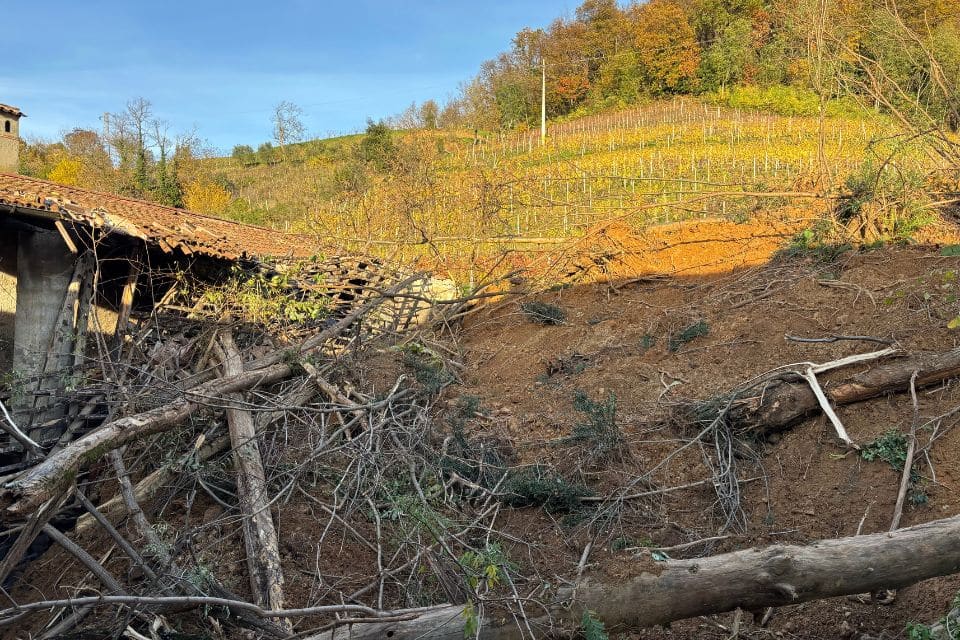
A monument-vineyard in a “red zone.” This is Ronco della Chiesa from the Borgo del Tiglio winery, now threatened by bulldozers. After the landslide that hit Brazzano di Cormons on the night between November 16 and 17, 2025, the future of one of the most symbolic vineyards of Collio Friulano depends on slope stabilization projects. This is no ordinary vineyard. It is the historic heart of Borgo del Tiglio. It is the wine upon which winemaker Nicola Manferrari built the company’s identity.
Ronco della Chiesa is the wine that, since the 1980s, helped bring Tocai—now strictly Friulano—to international restaurants. Back then, offering it by the bottle for haute cuisine was almost a gamble. Today, that story risks being cut short. Forever.
THE COLLIO FLOOD ON THE NIGHT BETWEEN NOVEMBER 16 AND 17, 2025
The landslide broke away on the night between Sunday, November 16, and Monday, November 17, 2025. In just a few hours, about 300 millimeters of rain fell on Brazzano. A mass of earth detached from a forest above the Borgo di San Lorenzo, the original heart of the village, overwhelming homes and structures. Six buildings were destroyed.
Two people died. A third was seriously injured. Among the injured is a collaborator of Borgo del Tiglio who lived in one of the houses razed to the ground. The mudslide directly hit the winery.
BORGO DEL TIGLIO: THE BURIED WINERY, THE DESTROYED ARCHIVE
Three Borgo del Tiglio buildings were destroyed. Among these was the archive-cellar that held about 10,000 historic bottles preserved since the late 1970s. The underground cellar was submerged by four meters of earth. Nicola Manferrari speaks of damage that was initially “extensive but not structural.” However, he claims that the ban imposed by authorities on propping up the attic to secure it is causing progressive deterioration.
Operations are now severely compromised. The area uphill from the company center is off-limits by order of the mayor. Access is only allowed on a limited basis to the bottle warehouse. The state road leading to the vineyards passes through the “red zone” and is closed, with no alternatives. The provincial road between Brazzano and Ruttars also remains closed indefinitely.
For a company with an annual turnover of about one million euros, the block is not just logistical. It is economic. “That money won’t come in two years from now,” Manferrari states. And the ban could impede the 2026 harvest. Insurance does not cover exceptional weather events. Compensation has not been defined. Timelines are unknown.






RONCO DELLA CHIESA: AN AGRONOMIC SYSTEM BUILT OVER SEVENTY YEARS
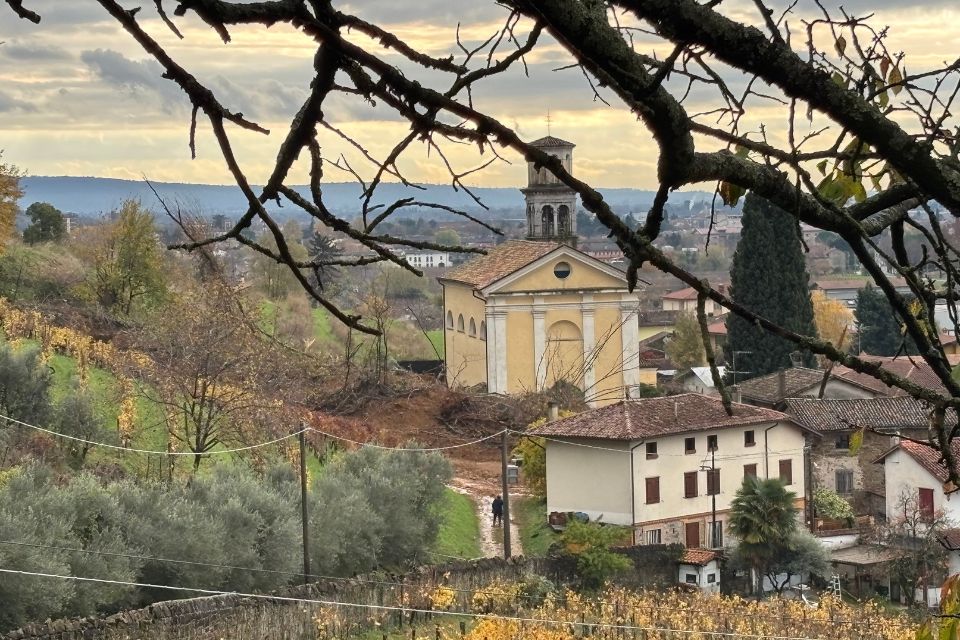
The most delicate point, however, concerns the vineyard. Ronco della Chiesa was directly hit by the landslide. In San Giorgio, where the winery produces its reds, 17th-century dry stone walls belonging to the Counts Florio collapsed. In Ruttars, another major landslide occurred.
But Ronco della Chiesa is not just a vineyard area. It is a system. Planted between the late ’40s and early ’50s, modeled in terraces (ciglioni), and drained with a traditional hydraulic system that intercepts deep springs in the flysch and channels them through underground conduits. No soil tilling since 1983. Shortly after, no fertilization. Permanent stable grassland.
Biodiversity built over time. «It is existential for the company,» says Manferrari. «It opened the roads of the world.» He summarizes with an image: «That vineyard should be preserved like the ‘original standard meter’ kept in a display case in a Paris museum.»
SAFETY VS. VINEYARD?
Ronco della Chiesa is located in the area affected by Civil Protection interventions. According to Manferrari, a portion of the vineyard has already been compromised during material removal operations. The winemaker claims that deep layers of flysch have been removed. He describes the probable future projects of the institutions as “devastating.” If implemented as suggested by early institutional comments, «the destruction of the vineyard is guaranteed.»
The Friuli Venezia Giulia Region, however, invokes the principle of safety. Regional Councilor for Agriculture Stefano Zannier clarified to Winemag that management falls under the jurisdiction of Civil Protection. He added that a request for recognition of the event has been forwarded to the Ministry. This step could activate further support tools. But on a legal level, the position is clear: «A vineyard is a vineyard. It is private property. Not a monument.» The law—Zannier cuts it short—does not allow for differentiated treatment between companies.
Riccardo Riccardi, Councilor for Civil Protection of Friuli Venezia Giulia, reiterated to Winemag that the interventions are linked to risk profiles and slope safety. Part of the work could be completed by the end of March, while the main intervention will require more time. «Available resources amount to about 40 million euros between works and compensation. We will do everything we can to try to safeguard it,» he says, referring to the vineyard. «But we can only do what the law allows us to do.» Safety, therefore, comes first.
consortium and confindustria on the future of the ronco della chiesa vineyard
The Collio Consortium, through president Luca Raccaro, reports having «assisted the Manferrari family also in managing critical issues related to wine certifications, after moving barrels outside the territory to a winery that showed its solidarity with Borgo del Tiglio. Furthermore, a fundraising account has been opened, which has collected—to date—2,500 euros.
«The hope,» Raccaro concludes, «id to find a technical solution that avoids total destruction, or limits its extent. As far as we are concerned, we can only defer to the law. But we are working together with the Colli Orientali del Friuli Consortium to help producers who have suffered damage.»
The position of Pierluigi Zamò, president of Confindustria Friuli, is more explicit. «I am a friend of Nicola and I reiterate a concept: 50 years ago, on the occasion of the 1976 earthquake, the bishop’s watchword regarding reconstruction priorities was “first the companies, then the houses, then the churches.” Today,» Zamò specifies, «they should do the same thing. Even if there are few companies, they are important for the territory. But from the news I have so far, it doesn’t seem to me that this is the path the institutions intend to take. If so, it would be a mistake.»
ARE BULLDOZERS REALLY INEVITABLE AT RONCO DELLA CHIESA?
Securing a territory after two victims is an absolute priority. But is it really inevitable that safety measures involve the erasure of one of the most iconic vineyards of Collio Friulano? The answer does not only concern Borgo del Tiglio. It concerns the relationship between public safety and viticultural heritage, which is itself at risk—not only in Friuli Venezia Giulia, but in much of Italy—in the face of climate change and the temper of Mother Nature.
The fate of hundreds of other plots scattered across the Bel Paese passes through the future of Ronco della Chiesa. The future of Italian viticulture passes through here. With the doubt that those who stand as defenders and champions of winemakers, of heroic viticulture, and of the role of winegrowers as guardians of biodiversity, only manage to do so from their offices. In the warmth. With dry feet. Especially when it rains outside. Or worse: when the land slides.