IN BRIEF
- The OIV held its first World Congress of Vine and Wine in China, attracting over 600 participants from 47 countries.
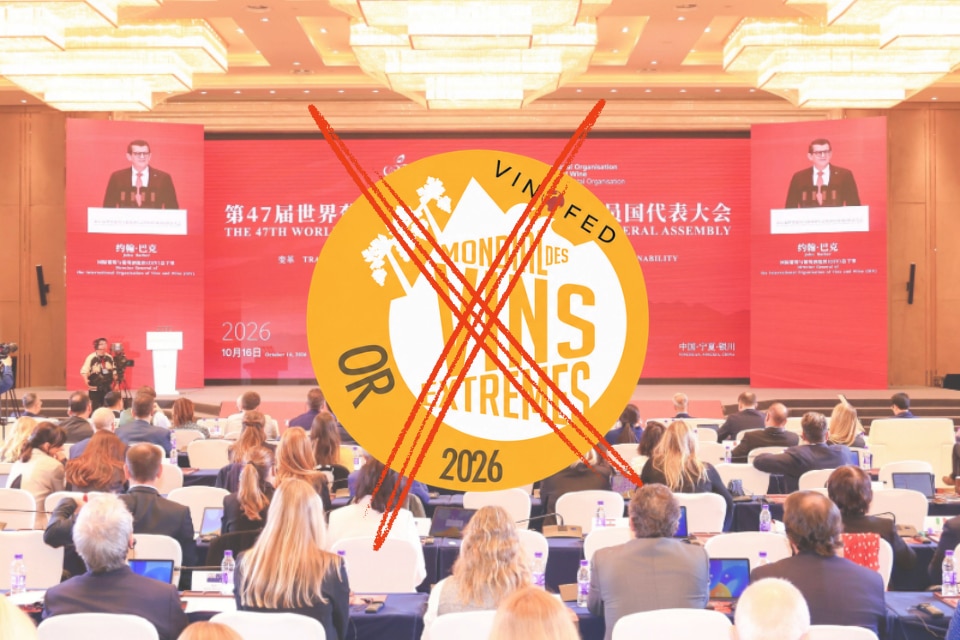
- The issue regarding the case of the Mondial des Vins Extrêmes 2026, under OIV patronage, remains pending after a gold medal was awarded to a non-compliant Ukrainian wine.
- Cervim justified the admission to the competition via producer self-certification, casting doubt on the good faith of the Ukrainians.
- The OIV must clarify the role of the observer present during the tastings and whether it considers the award for the winning wine to be valid.
- The OIV’s international credibility also depends on transparency regarding compliance with rules in the competitions it patronises.
The OIV celebrated a historic first in China: from October 12 to 16, its World Congress of Vine and Wine took place in Asia, in Yinchuan, in the Ningxia region. More than 600 participants from 47 countries, 420 scientific contributions, and six technical visits. Numbers that speak to the international scale of the event. Now that the Chinese mission has concluded, however, there is a matter that is only seemingly minor which the Organisation cannot leave pending: the case of the Mondial des Vins Extrêmes 2026, under OIV patronage.
On October 5, Winemag reported on the awarding of a gold medal to the Cabernet Sauvignon Oaked 2024 from the Ukrainian winery Big Wines Big Art. When questioned by the publication, the company stated that the wine did not come from terraced vineyards nor from vines with slopes equal to or greater than 30%. The competition regulations instead admit samples obtained from grapes coming from vineyards with at least one of the indicated requirements: altitude above 500 metres, slope over 30%, terraces or steps, or location on small islands. War (in Ukraine or any other territory) does not appear among these criteria.
AN OIV OBSERVER WAS PRESENT
Cervim attributed the admission of samples to the competition to self-certification by the companies, denying having invited the Ukrainian winery to participate. But this response does not resolve the core issue: a winning wine did not, according to the producer’s own statements, possess the characteristics required by the regulations. And the competition was not without external institutional presence: in Aosta, during the tastings, an OIV observer, Christine Collins, was present.
For this reason, Winemag contacted the OIV through its press office, Daniela Costa, after the article was published. The request for clarification arrived just days before the start of the Congress in China. It is possible that the preparations and then the mission absorbed the Organisation’s attention. We do not know if this is the reason for the silence. But an explanation must be given. Perhaps it will arrive next week, upon the delegation’s full return from China. The Congress, meanwhile, closed today: the Cervim dossier cannot remain indefinitely in the waiting room.
It is a matter of understanding what patronage and the presence of an observer entail when doubts emerge regarding the regularity of a competition that claims to follow the Organisation’s standards. The OIV must clarify what the observer’s role was, what they verified, and whether they reported any critical issues. If their mandate did not include checking sample requirements, as is conceivable, the OIV will nonetheless have to proceed with withdrawing the gold medal and awarding it to a producer who respects the canons of “heroic viticulture”.
DO OIV COMPETITION MEDALS CARRY WEIGHT?
The issue is not merely formal. A medal directs the attention of distributors, importers, and consumers. For a producer truly working in extreme conditions, the award certifies a concrete difficulty: altitude, slopes, terraces, isolation. If the scope of requirements expands without a written rule, or if controls fail, that recognition loses credibility. And those who pay the price are precisely the companies that respect the criteria.
Then there is the OIV limit on the number of awards. The article published by Winemag noted that at the Mondial 2026, 379 medals were awarded out of 1,175 wines entered: 32.26%, exceeding the 30% cap indicated by the Organisation’s standard.
THE OIV MUST BREAK ITS SILENCE
Cervim, which is careful not to comment further on the matter, perhaps hoping it will pass in silence, has its own responsibility: ensuring the regulations are applied. But the OIV cannot limit itself to patronising an event and then remain outside the discussion when its rules and standards are called into question. Silence does not clarify whether the observer provided oversight, whether the 30% limit was respected, or how the Organisation intends to protect the reliability of the competitions it patronises.
China offered the OIV a global stage and an audience of hundreds of professionals. An important opportunity to talk about cooperation, research, and the future of the sector, as the Congress theme stated. But international credibility is also measured by uncomfortable answers, when a gold medal risks having been awarded to a wine without the required prerequisites, taking space away from those who actually possessed them.
Now that the Congress has ended, let the OIV respond. For the Ukrainian wine. For the correctly admitted producers. For Cervim. And for the value of its own patronages. If they have any value at all.