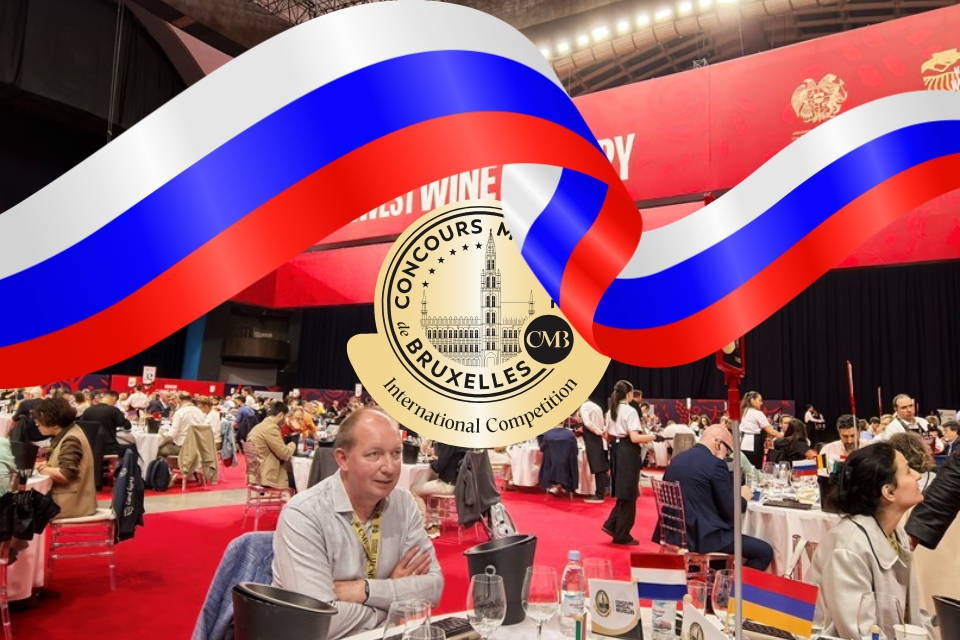
Wine has no flags. Or so it is often repeated, frequently with a certain convenience, when geopolitics knocks on the door of tastings. But the Concours Mondial de Bruxelles 2026, held in Yerevan, Armenia, from May 21 to 23, with an outlay of public money equal to 1.6 million euros, forces a question to be asked. Is it right to normalize relations with Russia? Because, after being banned from all European wine competitions, Russian judges and wines reappeared at the pharaonic Armenian edition of the CMB. And they did so by surprise. Without any prior notice, for example, for the Ukrainian judges.
According to Winemag sources, the return of the Russian flag among the international judges’ tables caused considerable perplexity and discontent. According to the Russian trade press, wines from the Russian Federation – also coming from occupied Ukrainian territories – won 42 medals at CMB 2026. Seven Grand Gold, 18 Gold, and 17 Silver, out of 125 samples entered.
The data was relaunched by Moscow as a national success, with predictably celebratory tones. Russian wines return to compete in an international arena, obtain recognition, and do so in the main session of the Concours Mondial de Bruxelles. A real stage erected for Russia among almost 6,700 wines from 50 countries.
CMB 2026: Russia returns to the Concours Mondial de Bruxelles
The point is not the medals. The point is that the Concours Mondial de Bruxelles is organized by Vinopres, a Belgian company based in Brussels, and therefore fully integrated into the European wine space.
For the first time so clearly since the outbreak of the war in Ukraine, Russian wines and Russian judges have returned to the international stage organized by a European structure. The official CMB 2026 website lists the “Russian Federation” among the countries present. Numerous names associated with Russia appear in the public list of jurors. A structured and organized participation, equal to that of other nations.
ARMENIA AS A BACKDOOR FOR RUSSIA, VIA CMB
The choice of Armenia as the host country has a decisive weight. The CMB emphasized that Yerevan hosted the competition for the first time in its history, presenting the event – with the classic self-celebratory rhetoric – as Armenia’s opening to the international wine community. The Armenian geopolitical context cannot be ignored.
Armenia is today a country in an unstable balance. On the one hand, Nikol Pashinyan’s government has strengthened its European orientation and distanced itself from Moscow, especially after the Nagorno-Karabakh crisis and the Armenian perception of a lack of Russian support. On the other hand, Armenia remains linked to Russia, also through the Eurasian Economic Union. And it still depends on Moscow for a significant part of its trade and energy.
Yerevan seeks Europe, but cannot afford to truly break with Russia. And precisely this gray area made possible what, in a European Union country, would have been politically much more difficult.
SANCTIONS, TRADE, AND GRAY AREAS
After the Russian invasion of Ukraine, Armenia was observed as a possible hub for trade triangulation towards Russia. The German Economic Team reconstructed the risk of circumvention through third countries, including Armenia, but also recognized that the Armenian government introduced specific control measures starting in 2023. The possible evasion of sanctions through Armenia reportedly practically stopped in the second half of 2024.
Moscow has imposed limitations on Armenian flowers, fish, fruit, and brandy. Measures that have impacted annual trade between the two countries by approximately 420 million euros, pushing for a possible European intervention to support Yerevan. CMB 2026 fits into this framework. Not a simple wine competition. But a diplomatic scenario, even if no one has ever considered it as such.
WINE UNITES, BUT DOES NOT ERASE REALITY
Wine unites people. But precisely because wine is culture, relationship, exchange, market, and reputation, it does not live outside of history. And history, today, says that Russia is still involved in a war of aggression against Ukraine. It says that Europe has built a system of sanctions against Moscow. It says that many cultural, sporting, and economic events have interrupted Russian participation in international platforms.
CMB 2026 instead chose another path. Legally possible. Technically explainable by the thirst for business. Politically – and above all humanly – very questionable. Certainly something worrying. Because it creates a precedent. A breach. Armenia, with its fragile balance between Europe and Russia, offered the ideal location. And Vinopres guaranteed support through the CMB brand to a Russia that obtained what it was looking for.
The question is not whether those 42 wines deserved the medals or not. The real question is another: before whom – and before what – will the medal machine called Concours Mondial de Bruxelles stop, which is organizing editions at a rapid pace exploiting a system based on public funding, for the hospitality of its judges in partner countries?
- Italy, over 1 million euros in public funds for the Concours Mondial de Bruxelles
- Tax authorities seize public funds for Concours Mondial de Bruxelles Calabria
- Concours Mondial Bruxelles, Centinaio: “Public money spent without logic”
- Calabria: new eldorado for publicly funded wine events
- Concours des Grands Vins du Monde in Macon: What No One Will Tell You