IN BREVE
- The book “The Molecule of Civilization” by Francesco Sorelli explores wine through history, myth, and beauty, covering an 8,000-year journey.
- Sorelli, former director and ambassador of the Consorzio Chianti Rufina, describes wine as a reflection of the human condition.
- The work also addresses the theme of wine abuse, showing its potentially destructive side.
- Attilio Scienza’s preface highlights the cultural richness of the volume, calling it a “unicum” that blends different fields of knowledge.
- The book invites reflection on the importance of sharing a glass as a gesture of harmony and mindfulness in life.
«The Molecule of Civilization – the journey of wine through history, myth, and beauty» is out, the new book by Francesco Sorelli, director and ambassador of the Consorzio Chianti Rufina, as well as author and communicator, published by Davide Falletta Editore. The volume recounts a journey that starts in the Caucasus, the origins of viticulture, and reaches contemporary glasses. An 8,000-year-long journey, reconstructed through history, anthropology, literature, religion, and art.
The narrative winds «like the weaves of a fiasco and the hypnotic, caressing waves of a red». The book traverses Noah, the Etruscans, and the wine-blood of ancient deities, the Greek symposium, and medieval monasteries, all the way to cinema icons. The key idea is that wine reflects the human condition: the search for beauty and the fear of death, the desire for community and solitude, consciousness and mystery.
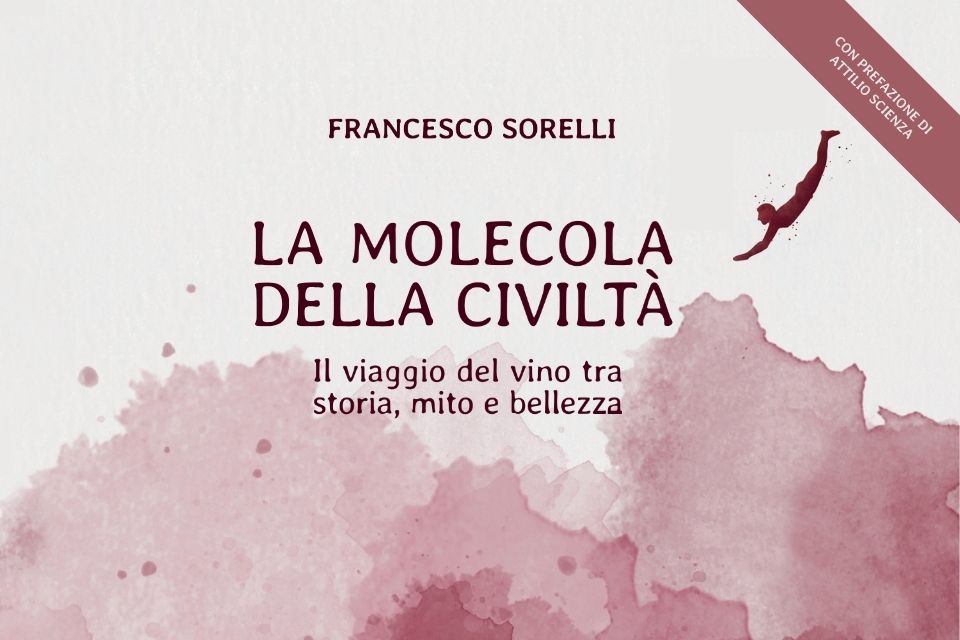
The cover image – a figure diving into a wine-colored cloud – evokes total immersion in the liquid that accompanies the birth of civilization. According to the author, wine is not just an agricultural product. It is a means to understand “the luminous possibilities of Man to determine his own happiness.”
THE JOURNEY OF WINE FROM GILGAMESH TO NOAH
Sorelli notes that “men – and women – have been drinking wine together for 8,000 years.” Before writing, humanity “was already pressing grapes with the intent of creating a magic drink to soothe the pains of life” and open a window to the sacred.
A central chapter is dedicated to the “Epic of Gilgamesh”, engraved in cuneiform characters in Mesopotamia about 4,000 years ago. In his moment of greatest loss, the hero meets the wine goddess Siduri. Her warning becomes the book’s common thread: “Gilgamesh, where are you hurrying? You will not find what you seek! When the gods created humans, they destined them for death. So Gilgamesh, feast and fill your body with delicious food. Dance and be merry day and night. Wear clean clothes, wash your head, and bathe in water. Look at the child holding your hand and be happy. And make your wife happy in your embrace! For this too is the lot of man.”
For Sorelli, this is “an incredibly powerful message”. An invitation to slow down, useful even for those today facing what many call a “perfect storm” in the sector. The author confesses to having “clung” to those words during difficult times. The introduction also features a reference to “supercalifragilisticexpialidocious.” For the Sherman brothers, it means “educating ourselves to the possibility of teaching delicate beauty.” Beauty does not remove ugliness, but tames it through imagination, love, and conviviality.
THE DOUBLE SOUL OF THE “MOLECULE OF CIVILIZATION”
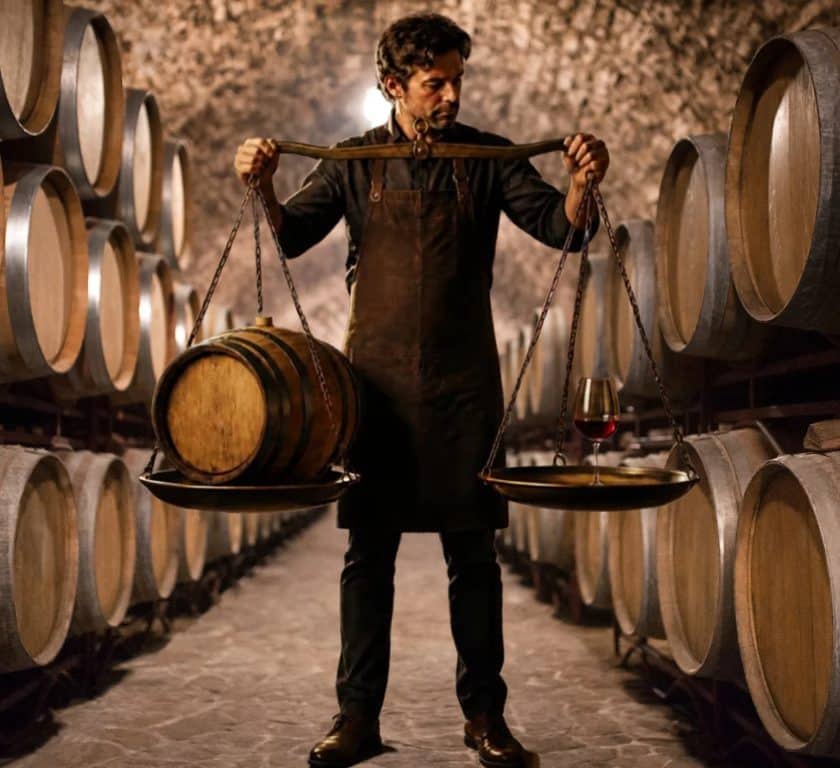
“Drunkenness, irresponsible consumption, is another key point of the work”. Wine, Sorelli writes, “exactly like humanity,” does not embody only positive aspects. It is an alcoholic beverage and can be “potentially destructive, especially if consumed in excess and in solitude.”
The book recounts episodes that show this “double nature”. From the demon Akratos, “the one of unshared wine,” to Noah’s drunkenness after the flood. From the “barbarian” slaves of wine to the stories of Lot. It is the flip side of a molecule capable of making us feel “divine, eternal, complete, happy,” but also of making us plunge “into the abysses of the psyche and hallucinated states of consciousness.”
The author draws on the Nietzschean reading of the human being, divided between the Apollonian and the Dionysian, measure and creative chaos. A dualism that also applies to wine: it can rise “into the sublime of art and poetry” or fall into misdeeds.
This permanent tension is the engine of the story. Wine is a “pillar of popular culture”. And, at the same time, a risk of loss. The reader is guided on a journey that “unfolds over time like the weaves of a fiasco and the hypnotic, seductive waves of a red in the glass.” In search of a “graceful beauty” that helps decipher existence.
BETWEEN ART, SCIENCE, AND NARRATIVE
The preface is signed by Attilio Scienza. The professor defines the volume as “an inexhaustible mine of facts, events, people, deities, heroes, works of art, literary and poetic references.” For him, the book is a “kaleidoscope” useful for observing scientific, social, and cultural progress and understanding the centrality of wine.
Scienza describes it as “an unconventional work”. The structure does not follow the canons of historical-literary treatises. It alternates philosophy, art history, enography, mythology, social sciences, and the history of religions. It is, according to him, “a deliberately anti-didactic unicum” based on narrative and intuition.
The professor argues that, in the era of “emotional illiteracy” and “liquid information,” wine can still “teach us to feel”. To recognize roots, celebrate community, and renew the sense of brotherhood. The civilization of wine is described as “an art form, a language of beauty, an exercise in harmony and conviviality.”
FRANCESCO SORELLI AND HIS PERSPECTIVE ON WINE
In the introduction to «The Molecule of Civilization – the journey of wine through history, myth, and beauty», Sorelli recounts an unexpected encounter with wine. It allowed him to rediscover smell, a sense “almost atrophied” in modern life. It taught him the value of travel and meeting other cultures. «The Molecule of Civilization» is presented as a work intended for wine enthusiasts and beyond.
It invites us to look at the glass as an interpretive key to human history. A key that requires awareness: the ability to unite and generate beauty, but also attention to the risks of abuse. A journey that suggests slowing down and returning to feel the fullness of life in a simple gesture: sharing a glass.