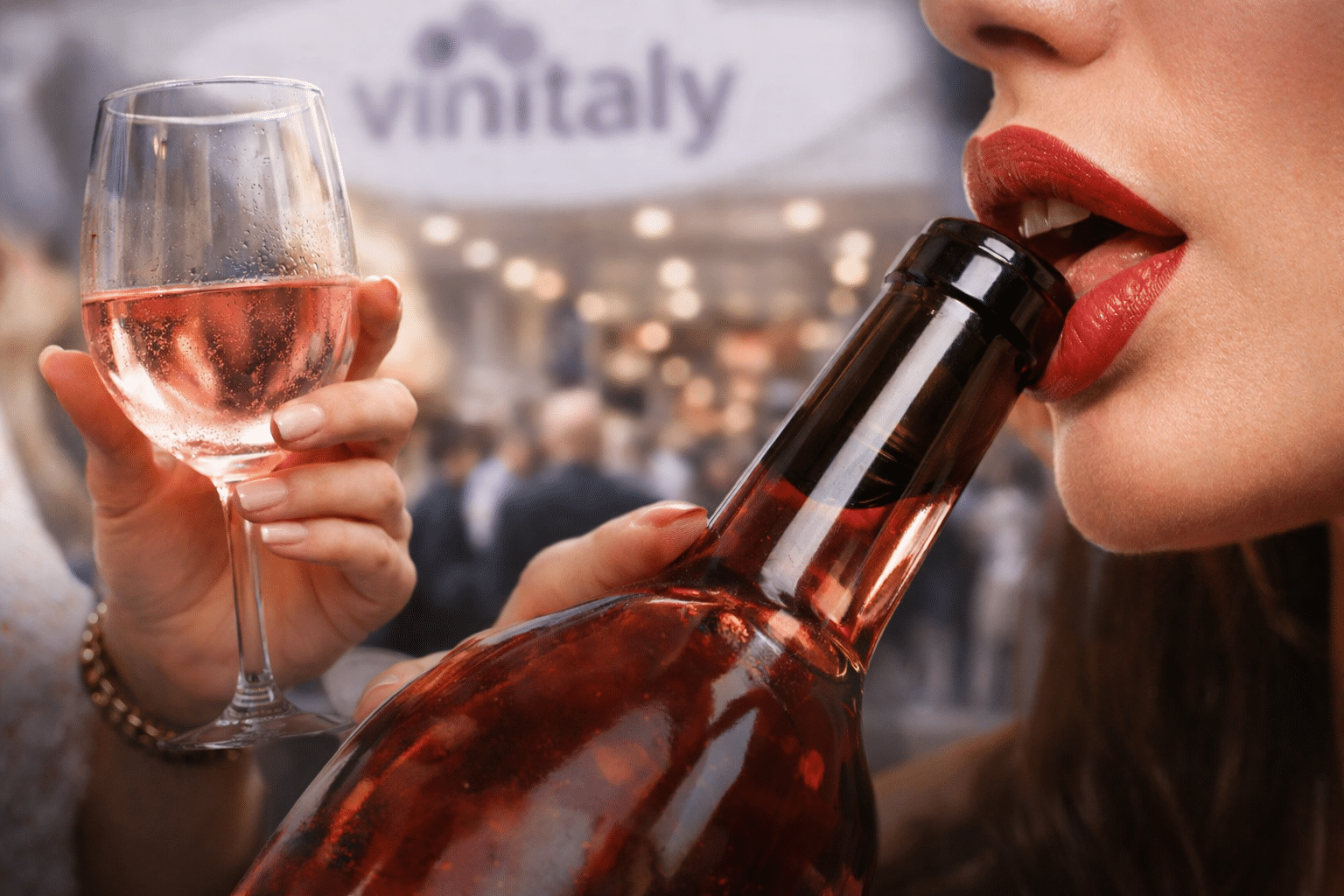
“Schioppettino Rosé, we are the only ones making it in this territory. A very Provençal French style. Aesthetically fascinating and striking. It makes you want to drink it and put it in your mouth.” Sexualization and wine: the winery’s reel for Vinitaly 2026 reopens the theme of limits in communication.
A reel published by a winery from Friuli to invite operators and visitors to its stand at Vinitaly 2026, featuring the winery owner herself, brings back to the center a question that the wine sector continues to postpone: how far can communication go when the language used borders on a sexually explicit register? The context is the 58th edition of Vinitaly, held in Verona from April 12 to 15, 2026.
WHEN WINE BECOMES A NARRATIVE PRETEXT
The point, mind you, without falling into specious errors, is not moralism. The wine sector is not forced to speak in a stuffy, institutional, or boring way. It can use irony, lightness, and break codes. It can also seek a pop, fast language suitable for social media. The problem arises when the product becomes an accessory. And attention is sought at all costs, trying to capture it only through un imagery decontextualized. Sexualized.
At that moment, the nature of the message changes. The bottle is no longer at the center. Wine stops being a story of territory, style, work, and production identity. It becomes a backdrop. It becomes a pretext for communication that seeks emotional shortcuts and immediate reactions.
THE CRUX OF THE TRADE FAIR CONTEXT
The choice carries even more weight because the reel—not surprisingly capable of garnering 103,000 views, +1,838% compared to the latest ones published by the Friulian winery in question—was created to promote their presence at Vinitaly, the main Italian trade fair in the sector. A fair is not just about visibility. It is about business relationships, reputation, and positioning. Credibility towards buyers, importers, journalists, restaurateurs, and operators.
Using borderline language to invite the public to the stand can certainly generate attention. It can get people talking (we are doing it right now). It can increase views, comments, and shares. But is this type of attention consistent with the image a winery wants to build in the medium term?
THE LINE BETWEEN IRONY AND OBJECTIFICATION
Because it’s one thing to stand out in the noise of social media. It’s another to define your public identity almost exclusively through provocation. If this is the goal, hats off to the Schioppettino rosé that not only makes you want to drink it, but ‘to put it in your mouth’.
Then there is a second, more sensitive level, far from denying freedom of expression. That is, asking what is being normalized in wine storytelling. If shortcuts built on the female body, or on a vocabulary that explicitly evokes the sexual sphere, are still needed to stand out, then the sector should question the quality of its communication tools.
SOCIAL MEDIA, ALGORITHMS, AND SECTOR SHORTCUTS
It is clear that social media pushes towards simple, fast, polarizing content. We noticed this with the publication of the editorial on Cracco’s half glass, which was echoed by some “social media operators” who were silent before, then suddenly very cool in front of the camera in an attempt to go viral, repeating the concepts expressed by Winemag, obviously without citing us (but in one case even tagging us).
The platform rewards what stops the scroll. In this context, provocation is an easy lever. But not everything that works in algorithmic terms truly strengthens a brand. Especially not a wine brand.
In the sector, the risk is twofold. On one hand, the product is trivialized. On the other, an imagery that the sector has been trying to overcome for years is reinforced: the idea that to sell a bottle or attract people to a stand, a staging built on sexual allusion is still necessary.
THE DOUBT REMAINS OPEN
The winery’s reel, rather than scandalizing (it takes much more than that in 2026), therefore raises a question of appropriateness. Is this really the most effective language to tell one’s story during an event like Vinitaly? Or is it a sign of a broader difficulty in the sector to find contemporary forms of communication without resorting to worn-out clichés?
The answer is not simple. But the doubt is legitimate. And it concerns not only this single case, but the relationship between wine, public image, and communicative responsibility. Because attracting attention is easy. Building value is much harder.