IN BREVE
- Barolo’s Additional Geographical Mentions (MGA), introduced in 2010, allow for the identification of specific sub-zones within the territory.
- MGAs offer an opportunity to distinguish micro-terroirs, but they can also create confusion for less experienced consumers.
- The Barolo market has seen price fluctuations, with some historic crus maintaining above-average valuations.
- Producers adopt different strategies regarding MGA labeling, influencing the commercial positioning of their wines.
- Italian wine exports have grown, highlighting the importance of clear MGA communication to attract buyers and consumers.
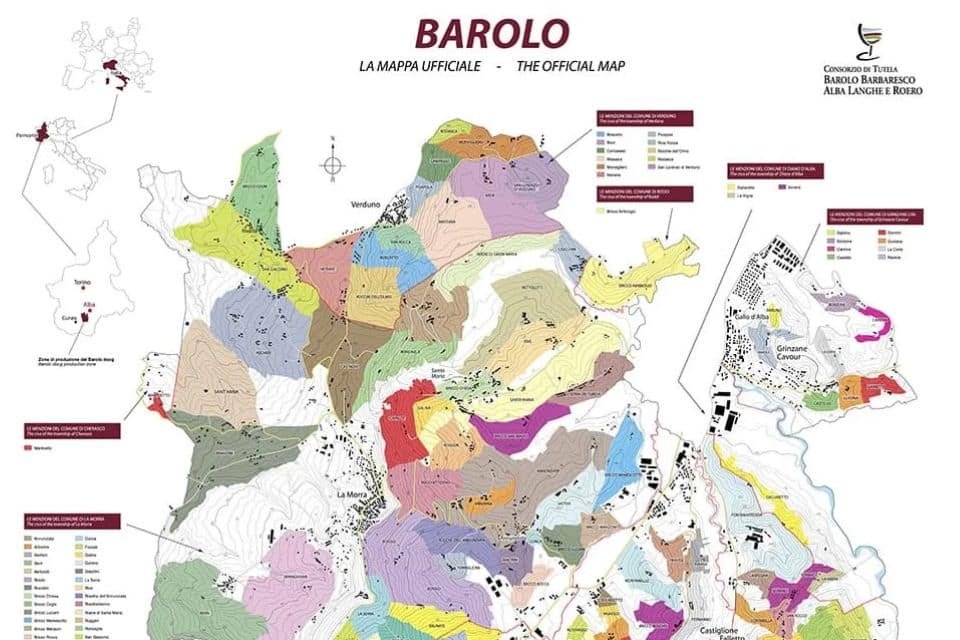
There are 181 Barolo Additional Geographical Mentions (MGAs), introduced by the 2010 regulation and applied from the 2010/2011 harvest. MGAs allow labels to indicate precise sub-zones of the Barolo territory, bringing the production code closer to a “cru” system.
WHAT ARE BAROLO MGAs?
MGAs identify delimited portions of the appellation based on historical, geographical, and soil-climatic criteria. They may coincide with a single vineyard, a hill, or a broader area recognized by local tradition. On the label, the mention can be listed alongside the term Barolo, but it is not mandatory. The goal is to provide greater transparency to the consumer and enhance the diversity of terroirs within the appellation.
MGAs AND PRODUCT DIFFERENTIATION
At a technical and communicative level, MGAs have provided a tool to distinguish micro-terroirs and winery practices. The most immediate effect has been allowing producers to showcase different soil-climatic and historical characteristics within the appellation. Not all MGAs receive the same market attention. Some have become synonymous with prestige, while others remain little known outside professional circles.
THE IMPACT ON BAROLO PRICES
The most visible economic impact is measured in price lists and auctions. Certain historic mentions such as Cannubi, Monprivato, Brunate, or Villero command prices well above the average for “generic” Barolo. Concrete examples of bottles from recognized crus show significantly higher average reference prices compared to the regional average.
CRITICAL ISSUES FOR THE CONSUMER AND THE MARKET
Increased territorial granularity brings benefits but also burdens. For the less experienced consumer, the 181 MGAs can create confusion. A clear segmentation is emerging in the market: benchmark products for collectors and professionals, alongside many labels that compete on price and brand recognition rather than MGA indication. In fact, some companies prefer to focus on the estate label rather than indicating the mention, so as not to fragment brand perception.
THE EFFECT OF THE FINE WINE MARKET
Over the last two years, the fine wine market has shown signs of correction: indices and auctions have recorded a decline compared to the 2021-2022 peaks. This phenomenon also affects high-end Barolo, in some cases compressing the premiums that were previously established for the most famous crus. The generalized price contraction has made demand more selective and prompted some buyers to prefer ready-to-drink bottles over en primeur investments or speculative collections.
HOW THIS TRANSLATES INTO WINERY STRATEGIES
Producers are reacting with different strategies. Those holding MGAs with established historical recognition tend to strengthen cru communication and maintain premium pricing policies. Smaller or less-known wineries are instead exploring alternative paths: emphasizing sustainable practices, direct sales, or packaging and storytelling that focus on brand identity. The choice to include the MGA on the label remains a strategic decision linked to the desired commercial positioning.
OUTLOOK: EXPORTS AND INTERNATIONAL DEMAND
Italian wine exports have performed positively in recent years, with overall value growth noted in industry reports. This context helps Barolo maintain interest in foreign markets, but competition is increasingly played out on clarity of the offering and the perception of origin. The ability of MGAs to add transparency will only be effective if accompanied by clear communication and quality data on the profile of individual crus.
BAROLO MGA: BETWEEN ENHANCEMENT AND THE RISK OF FRAGMENTATION
MGAs have given Barolo important tools for value enhancement. However, they have also introduced complexity for the market to interpret. In the coming years, their effectiveness will depend on the ability of producers and consortia to translate territorial specificities into understandable messages for buyers, importers, and final consumers. Without this simplification, the risk is that MGAs remain a source of value for a few crus and a source of confusion for many.
BAROLO MGAs IN NUMBERS
- Total number of MGAs: 181
- Official introduction: 2010 regulation, applied from the 2010/2011 harvest
- Total area: approximately 1,500 total hectares of the Barolo appellation
- Municipalities involved: 11 (Barolo, La Morra, Castiglione Falletto, Serralunga d’Alba, Monforte d’Alba, Novello, Verduno, Grinzane Cavour, Diano d’Alba, Roddi, Cherasco)
- Most famous crus: Cannubi, Monprivato, Brunate, Villero
- Objective: to enhance micro-terroirs and offer greater transparency to the consumer
- Label indication: optional, alongside the Barolo name
Barolo MGAs: How much do they impact price and the market? https://www.enotecadelbarolo.it/il-barolo/le-mga-del-barolo/.