A journey into the Cinderella of Eastern Europe where, in just a decade, the number of boutique wineries has grown from five to over seventy. This is thanks to the work of the Uniunea Micilor Producători de Vinuri, the Association of Small Wine Producers of Moldova, founded in 2010. Here is how a country known for its post-Soviet industrial wineries is emerging on the international quality wine scene through micro-enterprises of just a few hectares that know how to network. Thirty artisanal wines from 10 Moldovan wineries you shouldn’t miss.
PUNTI CHIAVE
- Atu Urban Winery is Moldova’s first urban winery, a symbol of a new world in the Moldovan wine sector.
- Urban wineries promote sustainable viticulture and the enhancement of native varieties, such as Codrinschii.
- In recent years, the number of boutique wineries has increased from five to over seventy, improving the quality and identity of Moldovan wine.
- Wine in Moldova has undergone a significant transformation, fostering stronger links with the European Union and the adoption of modern practices.
- The wine sector now offers wine tourism experiences and is becoming a true wine destination, with many wines winning international awards.
- The best Moldovan wines produced by small artisanal wineries
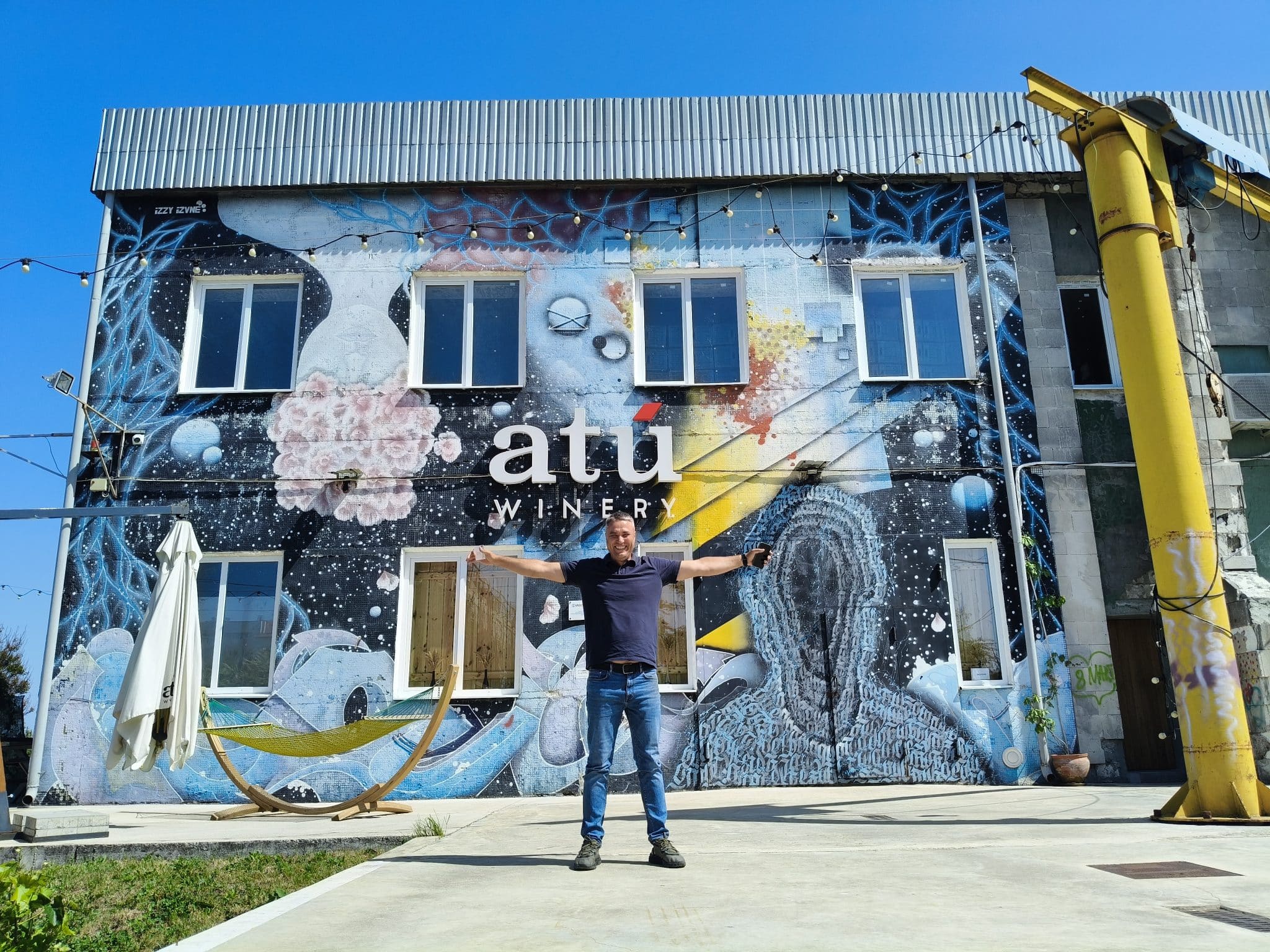
You get there by following a short dirt road, just off the busy main road connecting the airport to the capital Chișinău. Just enough time to get your passport stamped, collect your suitcase, and get in the car. And poof. Just 5 kilometers from the hustle and bustle of planes, in the Botanica district, lies the White Rabbit’s burrow. You feel a bit like Alice in Wonderland as you cross the entrance of Atu Urban Winery. It is just one of the urban wineries that, together with small artisanal winemakers, is changing the profile and “geopolitical” balance of wine in Moldova.
ATU URBAN WINERY AND MINIS TERRIOS URBAN WINERY IN CHIȘINĂU
The winery’s facade looks like a giant postcard. Victor Vutcărău, the founder, along with his wife Vlada Balica, has neither haste nor elegant Victorian clothes. On the contrary. He conveys serenity and welcomes you with a warm handshake. Preceded by the smile of someone who knows they have written history. And still has the pen in hand to trace new chapters for the sector. Indeed, since 2016, Atu has not only been Moldova’s first urban winery. It is the symbol of a symbolic transition toward a new world. Toward a new dimension for Moldovan wines. Much like Alice’s journey into the subconscious in Lewis Carroll’s imagination.
Small wineries among the buildings. This is what urban wineries are: set up in buildings recovered and repurposed for the production of quality wines. Nothing majestic. No chateaus, spectacular barrel cellars, or tasting rooms with views of infinity. Everything is focused (solely) on efficiency. Dan and Diana Prisacaru of Minis Terrios Urban Winery know this well. In the heart of Chișinău, in the Otovasca area, the couple has been setting up their urban winery since 2019—piece by piece, like a Lego set—after studying in France and England. In some ways, a second love nest. “Admire the things that seem impossible” is the slogan that appears on the few thousand bottles produced. And so it is.

WHERE THE WINE INDUSTRY IN MOLDOVA IS HEADING
It is the materialization of inverse thinking, the game upon which the present and future of Moldovan wine is played. Matrix-style viticulture and enology. But without Neo, Trinity, or Morpheus. The cyberpunk revolution lies in the overturning of the pre-established, statutory reality that existed until the early nineties. There is no longer a need for hundreds of hectares to be vinified in a hurry for Moscow, Russia, or the Soviet Union. The formula—or rather the philosophy, or better yet the policy—of urban wineries is minimalist. A few hectares, a few bottles. Great care for the raw material. Tailor-made production. And the valorization of native varieties. Like the unknown and very interesting Codrinschii—a variety obtained from crossing Rară Neagră and Cabernet Sauvignon—the flagship of Atu Urban Winery.
It seems like an impossible story, in fact, that of the winemakers who are changing the fate of wine in Moldova. After all, the country is in a phase of transformation marked by strong contradictions. The economy is growing unevenly, slowed down by political instability, the pandemic, and the effects of the war in Ukraine. The economy largely depends on remittances from emigrants, which represent between 15% and 20% of GDP. The agricultural sector, including viticulture, remains central. But it suffers from low productivity and technologies that are not always cutting-edge.
EUROPE AS A MODEL. AND THE OIV LANDS IN MOLDOVA
In recent years, the pro-European leadership of President Maia Sandu has launched a path of internal reforms and a strengthening of ties with the European Union. The Association Agreement with the EU, in force since 2016, has favored an increase in trade. Meanwhile, the official candidacy for EU membership, obtained in 2022, represents a significant political and economic goal.
However, the demographic decline and one of the highest emigration rates in Europe weigh heavily, with significant consequences for the labor market and social sustainability. As if that weren’t enough, the war in Ukraine has heightened internal tensions, especially in Transnistria. But it has also accelerated the country’s alignment with the West. Pushing toward a modernization that also involves the wine sector, culminating in the OIV’s (International Organisation of Vine and Wine) choice to organize its 2025 congress and general assembly in Chișinău, from June 16 to 20.

DIANA LAZAR: “HOW MOLDOVA MADE ROOM FOR WINEMAKERS AND ARTISANAL WINES”
“Moldova,” Diana Lazar, Wine Industry Director and Moldovan Senior Wine & Tourism Expert (pictured above), explains to Winemag, “boasts a millenary winemaking tradition. But until recently, it lacked a true culture of small winegrowers. An absence rooted in the Soviet-era model, which prioritized volume over quality. When the Russian embargo hit our wine industry so dramatically between 2006 and 2010, there was an urgent need to rethink its future. Returning from a Wine Master in Bordeaux, I worked with industry leaders and enthusiasts to draft a ‘White Paper‘ that laid the foundations for the revision of Moldovan wine legislation, harmonizing it with European Union standards to finally allow artisanal production.”
The birth of this new generation of signature wines was no accident. “Through carefully designed and implemented support programs,” Lazar continues, “we ‘cultivated’ these emerging winemakers, helping garage wine producers to evolve. How? By improving quality, their brand, and marketing. We focused on the return of talented Moldovan enologists with international experience, revitalizing the sector from within.”
THE WINE MATRIX IN MOLDOVA: FROM 5 TO 70 BOUTIQUE WINERIES IN 10 YEARS
Diana Lazar reports that, in just a decade, the number of boutique wineries has grown from five to over seventy. These producers now have their own association, a brand with the ‘signature wine’ label, dedicated festivals, and export programs. They have revived local grape varieties, innovated with new blends, and become the spearhead of the Moldovan wine offering. Support has also helped improve equipment, adapt vineyards to climate realities, and build strong brands, with over a third now offering wine tourism experiences.”
A transformation that has supported the dreams of businesses that have become profitable. “The success of this model,” Diana Lazar further highlights, “has fostered the development of a new generation of passionate winemakers. Moldova’s boutique wineries have become the authentic heart of its wine identity, winning hundreds of international medals and elevating the country’s reputation from a tradition-rich past to a credible and modern image, also as a true wine destination.” Proof of this is the birth of ‘guest houses‘ scattered across all wine regions, with the Buzilă family’s Casa Rândunicii leading the way in the village of Trebujeni.
SMALL WINERIES NOT TO BE MISSED IN MOLDOVA: THE ASSOCIATION OF SMALL PRODUCERS

So, which wineries are not to be missed in Moldova? The list, excluding industrial-scale producers like Purcari, Cricova, Radacini, and Asconi, who allowed the country to become known abroad, is starting to become substantial. The smaller entities are all part of the Uniunea Micilor Producători de Vinuri Dionysos, the Association of Small Moldovan Producers, chaired by Arcadie Foșnea in collaboration with director Elena Tomescu (pictured above).
It is a sort of Federation of independent winemakers, based on the French model—which later also became Italian—of the Vigneron Indépendant. “Under the aegis of the brand ‘Vin de autor‘, ‘Signature Wines’,” Elena Tomescu explains to Winemag, “our mission is to ‘create a sustainable ecosystem that fosters the institutionalization, competitiveness, and sustainability of small wine producers. Offering them legislative, organizational, and promotional support, both nationally and internationally.’”
From “garagiste” to a true artisanal Moldovan wine brand. The story of Ilie Gogu encapsulates that of dozens of other Moldovan winemakers who have successfully turned their desire to produce terroir-driven wines into successful businesses. We are in Căușeni, in the Ștefan Vodă wine region. Every stage of the production process, from the vineyard to bottling, is directly overseen by Ilie Gogu. Technical, modern rigor and the enhancement of the local terroir define the stylistic signature of this small 10-hectare winery. In the vineyard park, a spectacular “cru” with Saperavi vines over 60 years old.


THREE GOGU WINERY WINES NOT TO BE MISSED
- Metafora Alta 2018 (Cabernet Sauvignon, Saperavi, and Feteasca Neagră)
- Metafora Orange 2023 (Viorica and Riton, a variety obtained from crossing Villard Blanc and Gewürztraminer)
- Sauvignon Blanc 2024
Tel. +373 79 825 409
Email ilie.gogu@yahoo.com
We are on the Măgurii hills, a high-quality terroir and “home” to Crama Mircești, the winery that boasts the highest altitude vineyards in Moldova. We’re not talking about mountains: they range from 270 to 240 meters above sea level. But the temperature range between day and night, combined with the particular soil composition, gives a unique character to the grapes.
The true element that makes this winery’s wines special is the winemaker and owner, Arcadie Foșnea. The style is rather traditional, with long waits for perfect phenolic maturity—in several cases going even beyond—combined with prolonged macerations in the cellar. Crama Mircești’s wines, while extractive and full-bodied, and with significant alcohol content, maintain great elegance and finesse.


THREE WINES NOT TO BE MISSED
- Riesling 2023 “Bardul din Mircești”
- Orange wine 2023 “Bardul din Mircești”
- Fetească Neagră and Saperavi 2022
Tel. +373 69 174 419
Email: crama.mircesti@gmail.com
Te Wā—meaning “Time will tell” in Maori—is the result of the vision of Ela Petrașcu and her partner, both great wine enthusiasts. In the glass are the masterpieces of globetrotting enologist Vadim Mihailov, who after various international experiences in Napa Valley and New Zealand, chose his native Moldova to interpret the terroir of the Ștefan Vodă wine region in a unique and authentic way.
The formula is simple: limited editions that can read the soils and varietals of micro-parcels, including some old vines, as in the case of the Sauvignon Blanc. The winery is not limited to production. Te Wā has also opened Via Wine Bar, a well-stocked wine bar and shop at Strada Alexandru Hajdeu 122/1, in Chișinău. Here you can find the company’s wines, as well as a precious selection of Moldovan wines curated by Dana Rotaru.


THREE WINES NOT TO BE MISSED
- Codrinschii 2022
- Fetească Neagră 2022-2023 (multivintage)
- Sauvignon Blanc 2022 – Old vines
Tel. +373 68 626 666
Email: info@tewawines.co
4. Unicorn Estate, Saca – Straseni
Unicorn Estate is the winery founded in 2014 by Sergiu Galushka and Ion Sirbulet in Saca, in the municipality of Strășeni, in central Moldova. It is a boutique winery born with the aim of producing quality wines that reflect the character of the local soil and climate. The company owns vineyards in two distinct areas: 10 hectares in the center of the country, where white grape varieties are grown, and 5 hectares in the south, in the Purcari wine area, in the village of Olănești, on the Valea Sinodrei, ideal for red grapes thanks to the sandy, mineral-rich soil and the influence of the Nistru River.
The soul of the company is enologist Sergiu Galușca who, after studying in France and gaining experience in Napa Valley, chose to return to Moldova to start a project based on the enhancement of the territory. In this case too, the wines involve very low enological intervention.


THREE WINES NOT TO BE MISSED
- Pinot Noir 2016 “Equilibrium”
- Chardonnay 2021 “Equilibrium”
- Pinot Noir Late Harvest “Equilibrium”
Tel. +373 76 000 062
Email: s.galusca@gmail.com
Step by step, day by day, since 2021, the young enologist and director Valerian Scutelnic has shaped this small winery—a viticultural investment by the agro-industrial giant Pfanner—into a gem. Supervision is by Wilfried Pfanner, himself an enologist and owner of this must-visit Moldovan boutique winery, recently joined by his brother Johannes.
The name takes inspiration from the Prut River, which flows 200 meters from the winery, on the border between Moldova and Romania. It was founded in 2018, with 12 hectares of vineyard in one of the northernmost areas of the country, in the northern part of the Ungheni region. Great emphasis is placed on white grape varieties, among which Welschriesling stands out.

THREE WINES NOT TO BE MISSED
- Cuvée Symphonie 2024 (Fetească Regală, Sauvignon Blanc, Pinot Grigio, Welschriesling)
- Fetească Neagră rosé 2024
- Cuvée Prestige 2023 – Private collection (Fetească Neagră, Saperavi, Cabernet Sauvignon)
Tel. +373 694 84 577
Email: info@domainelaprut.md
Vinum Estate is the winery of the Uzhakov family. We are in Sociteni, in the heart of Moldova. The brand, young but with ancient roots, dates back to 1806, when the family’s ancestors moved from northeastern Bulgaria to southern Bessarabia, to Cioc Maidan. Since then, nine generations have dedicated themselves to vine cultivation and wine production, passing knowledge from father to son. Since 1996, the turning point year, Vladlen Uzhakov has been at the helm.


THREE WINES NOT TO BE MISSED
- Fetească Regală 2019
- Fetească Neagră 2021 “Selection Vladlen Uzhakov”
- Brut Nature 2022 (traditional method Vsq 18 months, Chardonnay and Fetească Regală)
Tel. +373 79 988 222
Mail: info@vinum.md
Crama Ulinici was founded in 2020 by Nicu Ulinici, who grew up among the vineyards managed by his father. Just five hectares of vines in Valea-Trestieni, in the Nisporeni district. After a long entrepreneurial experience in the lavender sector—also honored in the winery’s logo—the project took shape and is now launching.
The varieties grown include Sauvignon Blanc, Muscat Ottonel, Bianca, Cabernet Sauvignon, Merlot, and Saperavi. The clusters are hand-harvested in 10-kilogram crates, directly by the Ulinici family and the village inhabitants. In the cellar, the grapes are processed with modern equipment. In addition to increasing production and distribution year by year, Nicu Ulinici dreams of creating an agritourism among the vineyards to offer visitors an immersive experience in the Moldovan countryside.


TWO WINES NOT TO BE MISSED
- Fetească Neagră 2023
- Bianca 2024
Tel. +373 68 222 271
Email: ulinici_nicu@yahoo.com
Equinox is the brand created by Constantin Stratan. The project started in 2002 with one hectare of Cabernet Sauvignon and has expanded over the years to 5 hectares of vines around Olănești, in the Purcari region, along the Nistru valley. Organic farming combined with biodynamic techniques allowed the winery to obtain sustainability certification as early as 2013, the first entity in Moldova to apply it fully (also) to the winemaking process.


TWO EQUINOX WINERY WINES NOT TO BE MISSED
- Orange 2023 “5 elemente” (Chardonnay, Pinot Grigio, Fetească Alba, Băbească Neagră, Fetească Regală)
- Luchineasa 2023 (Fetească Neagră, Rară Neagră)
Tel. +373 69 500 505
Email: costistratan@gmail.com
From the nursery Elvitis-Com, one of the most important and well-stocked in Moldova, to the founding of an urban winery, it was a short step for Victor Vutcărău and his wife Vlada Balica. The production site, with a tasting room ready to welcome guests, is located just minutes from Chișinău International Airport. Atu is a brand born in 2016 with the aim of bringing a new vision to the Moldovan wine scene, with the country’s first urban winery.
From the harvest to the labeling of the bottles, everything is done manually and artisanally. Among the varieties, there is a good mix of international and native Moldovan vines. Like Codrinschii, which truly deserves to be discovered. Production is 40-50 thousand bottles per year, thanks to 17 hectares of owned land.


THREE WINES NOT TO BE MISSED
- “O scrisoare pierduta” 2020 (Codrinschii)
- “Revedere” 2019 (Codrinschii and Saperavi)
- “Nunta in cer” 2023 (Floricica, Viorica, Sauvignon Blanc)
Tel. 0 (69) 222237
Email: atuwinery@gmail.com
Minis Terrios is a small family winery founded in 2013 in Chișinău by Dan and Diana Prisăcaru, who trained in Burgundy. Production is around 10 thousand bottles per year, with manual harvesting and separate lots to express the specificities of each variety. In this case too, international white and red varieties sit alongside native ones. Here you will find the absolute best red wines tasted in Moldova, from the blend created with two other Moldovan enologists to the Merlot, and a very young Cabernet Sauvignon with exceptional potential.


THREE WINES NOT TO BE MISSED
- Manifest 2018 (Cabernet Sauvignon, Merlot, and Fetească Neagră: a magnum created by Dan Prisăcaru in collaboration with other Moldovan enologists Ion Luca and Ilie Gogu, each with their best grapes)
- Cabernet Sauvignon 2021
- Merlot 2021
Tel. +373 795 84 163
Email: prisacaru.dan@gmail.com
Wine in Moldova: Urban wineries and winemakers in the country’s future. https://www.vindeautor.md/.