IN BREVE
- ‘Lu Sciampagnine’ is a low-alcohol beverage created by Germano D’Aurelio, revisiting the Abruzzese tradition of wine mixed with lemon soda.
- The drink comes in three variants, ‘Tre Quarti’, ‘Mezz’ e Mezze’, and ‘Quartine’, and uses biodynamic ingredients without added lemon soda or refined sucrose.
- However, the name ‘Sciampagnine’ clearly evokes Champagne, raising legal concerns related to the protection of designations.
- The product has already begun promotion in Abruzzese retail outlets, seeking to reintroduce a humble drink in a modern way.
- The main risk lies in the name, which could attract the attention of the Champagne PDO, undermining the authenticity of the project.
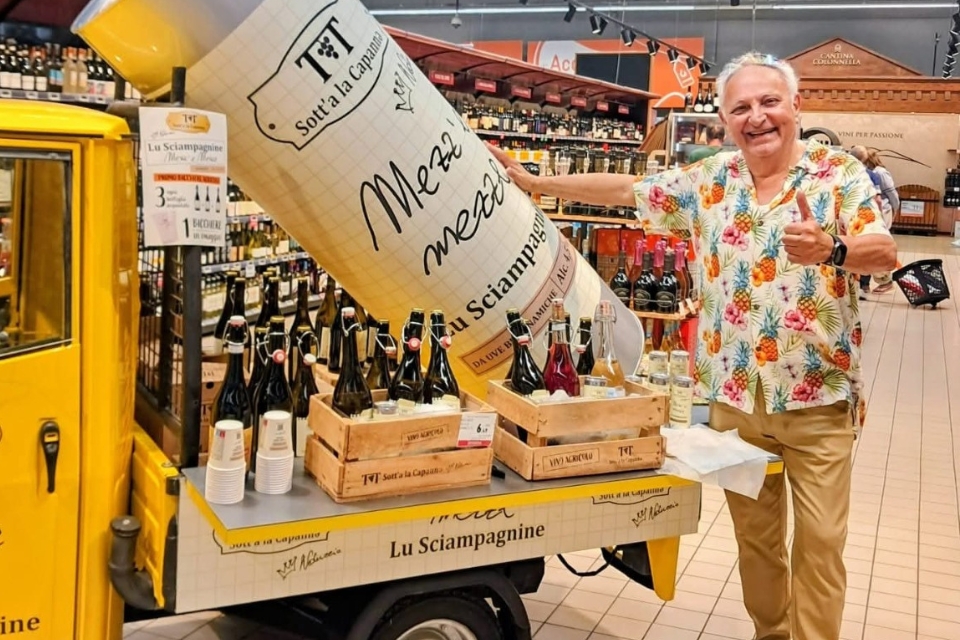
Born in Abruzzo, “Lu Sciampagnine” in the “Mezz’ e mezze” version is the low-alcohol beverage launched by Germano D’Aurelio, aka ’Nduccio. The stated idea of the 72-year-old Abruzzese comedian, cabaret artist, singer-songwriter, and musician—active in viticulture with the Sott’a la Capanne project, inspired by the land and his family’s farming traditions—is to recover a folk memory: wine diluted with lemon soda. A humble, everyday drink from the Abruzzo countryside, here reinterpreted with biodynamic must and white wine.
The project is curious, local, even clever. But the chosen name risks opening a much more delicate front than expected. Because “Sciampagnine,” even in dialect, sounds like a clear evocation of Champagne. And recent history shows that when the most protected designation in the world is involved, irony, folklore, and good faith aren’t always enough to avoid trouble.
A PRODUCT THAT PLAYS ON FOLK MEMORY
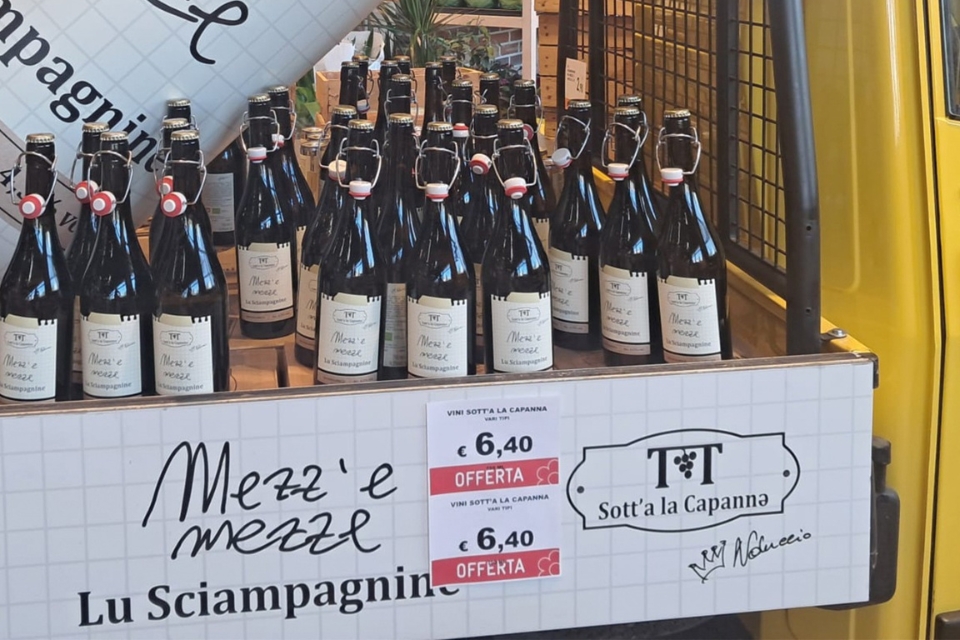
According to the announcement, “Lu Sciampagnine” was born as a sparkling low-alcohol beverage, made with “natural sugars from biodynamic must, biodynamic lemon extract, Demeter-certified biodynamic wine, and natural carbonation.” No lemon soda. No refined sucrose. No added carbon dioxide. And no artificial lemon flavorings.
There are three planned versions. “Tre Quarti”, with 7% ABV and 75% wine; “Mezz’ e Mezze”, with 4% ABV and 50% wine; “Quartine”, soon to be released, with 2% ABV and 25% wine. It is therefore not a non-alcoholic aperitif in the strict sense, but a low-alcohol drink designed for summer consumption and aperitifs.
The narrative chosen by ’Nduccio focuses on tradition. “In the Abruzzese tradition, the “Mezz’ e mezze,” served cold and prepared with lemon soda and house wine, was a moment of celebration, but also of necessity,” D’Aurelio explains. The new product, he clarifies, contains no lemon soda: “There is only the must meeting the wine, which, as they used to say in the countryside, “returns to love,” as it resumes fermentation.”
THE PROBLEM IS THE NAME: “SCIAMPAGNINE” EVOKES CHAMPAGNE
The issue, however, is not the recipe. It’s the name. “Lu Sciampagnine” clearly evokes the word Champagne, albeit through a dialectal and popular form. There is a cultural explanation. D’Aurelio recalls that wine and lemon soda was ironically called “lo champagne”, also due to the shape of the old Peduzzi lemon soda bottles from Chieti.
But designation law doesn’t just think in terms of intentions. It also thinks in terms of evocation, piggybacking on reputation, and the risk of direct or indirect exploitation of a PDO. And Champagne is a PDO defended with particular care by the Comité Champagne, which even has a branch in Italy.
The most famous precedent is that of “Champanillo,” a sign used in Spain by some tapas bars. In 2021, the Court of Justice of the European Union clarified that the protection of the Champagne PDO can also extend to services, not just products, when the use of a sign evokes the protected designation. The case specifically concerned the use of “Champanillo,” translatable as “little Champagne,” to promote catering establishments.


INTERNATIONAL PRECEDENTS DO NOT HELP ’NDUCCIO
It’s not an isolated case. The protection of Champagne has been triggered several times even outside the strict perimeter of wine. The EU Court has already dealt with the “Champagner Sorbet” case, regarding a sorbet sold by Aldi Süd, confirming the relevance of the designation’s protection against commercial uses capable of exploiting its reputation.
More recently, the Comité Champagne has also challenged the advertising strategies of international sparkling wine brands. The Della Vite case, the Prosecco linked to the Delevingne sisters, came under scrutiny for a campaign that played on the comparison with Champagne, with provocative slogans like “Cheat on champagne.” The Comité Champagne sent a cease-and-desist letter, believing the communication could exploit or devalue the reputation of the French designation.
In Great Britain, Bollinger also intervened against the English brand Folc for an advertisement that referenced “Bollie” and “pink champers.” The challenge was specifically about the attempt to use, with an ironic tone, the symbolic world of Champagne and its brands to promote another product.
The point is clear: in the sparkling wine sector, mimicking Champagne is a dangerous game. It is for large international brands, let alone for an Abruzzese aperitif that, despite all the mitigating factors of local tradition, chooses a name phonetically close to the most closely guarded designation in the wine world.
BETWEEN FOLKLORE, MARKETING, AND LEGAL RISK
“Lu Sciampagnine” could defend itself by claiming the dialectal root of the name, the historical reference to wine and lemon soda, and the absence of any claim to imitate Champagne. But the risk remains. The product category is still close to the world of wine-based sparkling drinks. The product is offered in bottles and cans, in tasting, aperitif, and convivial consumption contexts. And the phonetic link to the word Champagne is hard to deny.
Another delicate point is the vocabulary. In the press release for “Lu Sciampagnine,” the biodynamic wine used as an ingredient is literally defined as “natural and healthy.” Regarding alcoholic beverages, even low-alcohol ones, health-related communication is always slippery ground.
The product, distributed by Viticoltori del Mediterraneo, has already been presented in various Abruzzese stores and venues, with a tour that will continue until autumn. The stops include supermarkets, beach clubs, bars, farmhouses, grape festivals, and agricultural parades. A widespread, very popular promotion, consistent with ’Nduccio’s character and the narrative of everyday wine.
A GOOD IDEA WITH THE WRONG NAME?
The operation has its own strength. It recovers a humble drink and reinterprets it in a contemporary key. It uses biodynamic raw materials. And it taps into the favorable moment for light, sparkling, less alcoholic, and more informal drinks. The problem is that all this could have been done without getting so close to Champagne.
The risk is that the most interesting part of the project—the Abruzzese memory of the “Mezz’ e mezze”—will be overshadowed by a name choice that is too exposed. If the name attracts the attention of the French PDO’s defenders, ’Nduccio might find that the line between folk irony and infringement by evocation is much thinner than it seems. For now, “Lu Sciampagnine” makes people smile. But in the wine world, when you play with Champagne, the smile might not last long.
No post found!