IN BREVE
- The U.S. Wine Trade Alliance warns that tariffs on European wine would harm businesses and workers in the United States.
- The association maintains that imported wine and American wine are not competitors, but parts of the same economic ecosystem.
- Several industry experts testified about the negative consequences of tariffs for the distribution network and the entire American wine supply chain.
- The mobilization has gathered support from WineAmerica and Wine Institute, requesting exclusions for wine from tariffs.
- USWTA president Ben Aneff emphasizes the importance of telling the story to avoid an increase in tariffs.
Tariffs on European wine would harm U.S. businesses, workers, and wineries. That’s the message brought to Washington by the U.S. Wine Trade Alliance, which appeared before the Office of the United States Trade Representative as part of the Section 301 investigation into policies against forced labor. Not a novelty, but a confirmation of the industry’s concerns regarding Trump-era foreign policies, which negatively impact—first and foremost—American workers themselves.
The mobilization was anticipated by Winemag on June 29, when USWTA called together American importers, distributors, and sales representatives. The risk is the application of an additional 10% tariff on European Union products, wine included, despite the absence of direct accusations against the wine sector.
Last week the association therefore brought the dossier to the U.S. capital, arguing that imported wine and American wine are not competitors, but parts of the same economic system.
THE SECTION 301 HEARING IN WASHINGTON
The USTR organized the hearing at the Court of International Trade, asking stakeholders to also illustrate the possible economic consequences of tariffs on imported products.
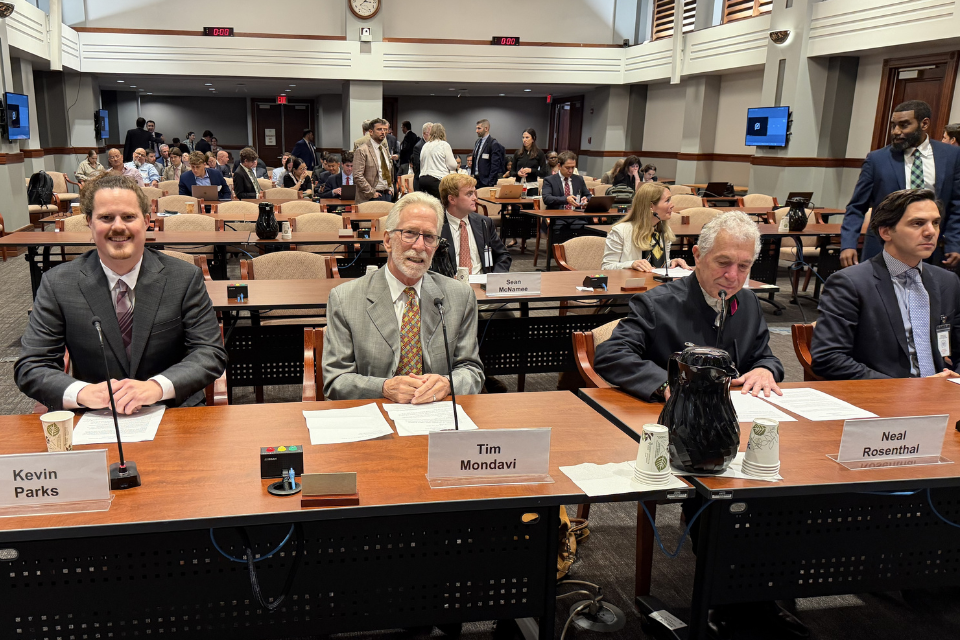
The U.S. Wine Trade Alliance coordinated testimony from three operators representing different segments of the supply chain: importer Neal Rosenthal, California producer Tim Mondavi, and sales representative Kevin Parks.
Neal Rosenthal, founder of Rosenthal Wine Merchant, recalled the role of American entrepreneurs in building the modern wine market and the distribution network that supports both imported labels and those produced in the United States.
“It was Americans—Parks emphasized—who built the wine market in the United States, and it’s Americans who benefit from it, many times over. Imported and domestic wines are not in opposition: they’re complementary. They support the same ecosystem.”
TIM MONDAVI: TARIFFS HIT AMERICAN WINERIES
Tim Mondavi spoke as a third-generation California winegrower. His family contributed to the rebirth of Napa Valley after Prohibition. Mondavi is now founder of Continuum and was long the winemaker at Robert Mondavi Winery.
His testimony focused on the repercussions that tariffs on imported wine would also have on U.S. producers. Economically weaker distributors have fewer resources to invest in personnel, develop the market, and add new wineries to their portfolios.
“When distributors are strong, they invest in people, relationships, and new wineries. When they’re under pressure, the entire system contracts,” Mondavi emphasized.
The argument is that weakening importers does not automatically transfer sales and market share to American producers. On the contrary, it reduces the commercial capacity of the network that sells both categories.
“WITHOUT IMPORTED WINE I CAN’T SELL AMERICAN WINE”
Kevin Parks, a commission sales representative for Grassroots Wine Wholesalers in South Carolina, brought to the hearing the perspective of someone who sells wine daily to restaurants, wine shops, and retailers.
According to Parks, imported labels often form the foundation of the portfolio that allows distributors and agents to successfully present American wines as well. “I can’t sell American wine—he stated—without a solid portfolio of imported wines.”
This is one of the aspects on which USWTA had built the mobilization announced in late June. In the U.S. three-tier system, European wine and American wine often go through the same distributors, the same sales networks, and the same commercial channels. The contraction of one part of the portfolio can therefore reduce revenue, commissions, personnel, and investment capacity of the entire structure.
WINEAMERICA AND WINE INSTITUTE REQUEST EXCLUSION
In addition to testimony, the U.S. Wine Trade Alliance submitted detailed comments on the economic consequences of tariffs along the wine supply chain.
The mobilization was also joined by WineAmerica and Wine Institute, which formally asked the USTR to exclude wine and some essential materials for wine production from tariffs.
Sales representatives from various states also signed a national letter against the tariffs. The goal is to demonstrate that a tariff on European wine would not only represent an obstacle for Italian, French, or Spanish producers, but would have direct repercussions on American salaries, commissions, and economic activities.
THE LETTER FROM AMERICAN WINE PIONEERS
USWTA also presented a letter signed by some of the pioneers of the U.S. wine trade, including Neal Rosenthal, Kermit Lynch, and Leonardo LoCascio.
The document recalls that the American imported wine market was built by U.S. entrepreneurs and supports hundreds of thousands of jobs in the United States.
The message directed at the administration is clear: imported wine and domestic wine do not belong to opposing systems. They share importers, distributors, agents, restaurateurs, wine shops, retailers, and consumers. When tariffs weaken one of these players, the consequences spread throughout the entire industry.
OVER 100 BUSINESSES RESPOND IN LESS THAN 24 HOURS
The U.S. Wine Trade Alliance delegation also met with some U.S. administration officials to illustrate the costs of tariffs for the country’s businesses and workers.
From the meetings additional requests for data emerged. In less than 24 hours, over 100 U.S. wine businesses responded to a survey promoted by USWTA. The responses enabled the association to quickly prepare a report on the negative consequences of tariffs for American businesses.
Ben Aneff, president of the U.S. Wine Trade Alliance, thanked the operators who testified, signed letters, submitted comments, and participated in data collection.
According to Aneff, the mobilization could increase the chances of avoiding an increase in tariffs or obtaining specific exclusions for wine. “If we don’t tell our story, no one else will,” he concluded.