IN BRIEF
- Collio Pinot Grigio can age, as demonstrated by the old vintages tasted at Collio Evolution 2026.
- The old vintages showed a quality and complexity that challenge a reductive narrative about the grape variety.
- Pinot Grigio accounts for almost 30% of Collio’s production, with around 2 million bottles produced per year.
- Collio has proven it can interpret Pinot Grigio well, which in the area is marked by sapidity, freshness, and good complexity.
- Collio Evolution 2026 suggests that a denomination’s identity depends on terroir, not just on the grape variety.
Collio Pinot Grigio can age. The glasses at Collio Evolution 2026, the Friulian Consortium’s event that wrapped up in the afternoon in Cormons, proved it. Wines capable of retaining freshness, sapidity, and precision after ten, fifteen, and even more than twenty years. The tasting, dedicated to around ninety labels from the new 2025 vintage back to 1999, put to the test the most widespread idea about the grape variety in Italy: that its value lies mainly in immediate fragrance and drinkability.
Far from the industrial volumes of “delle Venezie,” Collio Pinot Grigio surprised with mature vintages that offered some of the most convincing showings. Among the young wines, examples of tension and substance alternated with simpler interpretations meant for immediate consumption.
According to data provided by Consortium president Luca Raccaro and director Lavinia Zamaro, Pinot Grigio is Collio’s leading variety and accounts for almost 30% of total production. That means that of the roughly 7 million bottles produced in the area, about 2 million bottles are Pinot Grigio.
- Collio united in defense of the Ronco della Chiesa vineyard at Borgo del Tiglio
- Collio (in) Evolution without the Produttori di Cormòns cooperative
- Friulano takes center stage at Collio Evolution 2025
- Collio Evolution 2025: confidence from Nomisma wine and wine tourism research
- Luca Raccaro new president of the Collio Consortium: the youngest in its history
THE OLD VINTAGES, STILL FRESH
All seven samples between 1999 and 2016 reached at least 90 points in Winemag’s blind tasting, with an average of 94.1/100. Among the 2017-2020 wines, the average “drops” to 92.6 points, with ten of eleven tastings above the 90-point mark. The 2021-2023 group settles at an average of 90.5/100, and the 2024 and 2025 vintages, which together counted 45 samples, averaged 88.6/100. In this latter group, 12 wines reached at least 90 points and six fell below 87.
The difference alone is not enough to declare an absolute superiority of the old vintages. And yet, in the more mature glasses, quality appeared with a frequency and depth that are hard to ignore. Even the intermediate vintages showed that time can add complexity without erasing the grape variety’s identity. Not mere “survival” in the bottle, then, but an evolution capable of multiplying the wine’s registers.

DRINKABILITY ISN’T ENOUGH TO TELL THE GRAPE VARIETY’S STORY
The 2025 flight brought out a younger, more immediate face of Pinot Grigio. The one best known commercially. Crisp fruit, citrus, flowers, freshness and, above all, sapidity: an element that distinguishes Collio Pinot Grigio from others. The issue carries commercial weight too.
With Collio Doc Pinot Grigio priced on shelves on average between 15 and 25 euros, consumers encounter a price range that invites questions about the wine’s overall value. Not just its appeal at the moment of purchase, but also its staying power and the possibility of following its evolution. The old vintages tasted in Cormons show that this potential exists. The challenge is understanding how many of today’s interpretations are built, or rather designed, to preserve it.
A GRAPE VARIETY THAT READS THE SOIL
Collio Evolution 2026 also offered a response to a narrative that often reduces Pinot Grigio to easy drinkability, commercial recognizability, and value for money. In Collio’s glasses, the grape variety showed it can give voice to the place. The substance, tension, aromatic profile, and texture of the sip all change. More or less Mediterranean scrub herbs emerge, along with yellow or red fruit. Phenolic components, sapidity, and mineral notes.
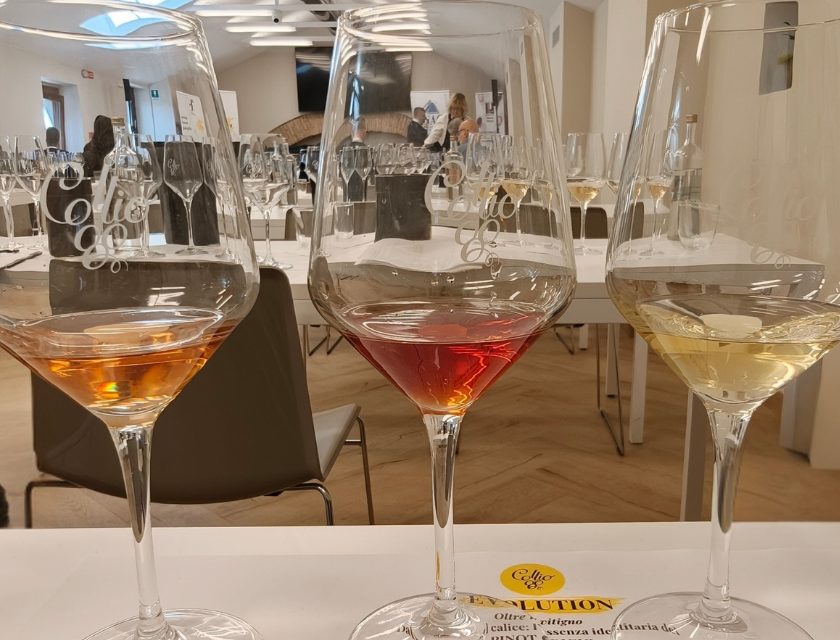
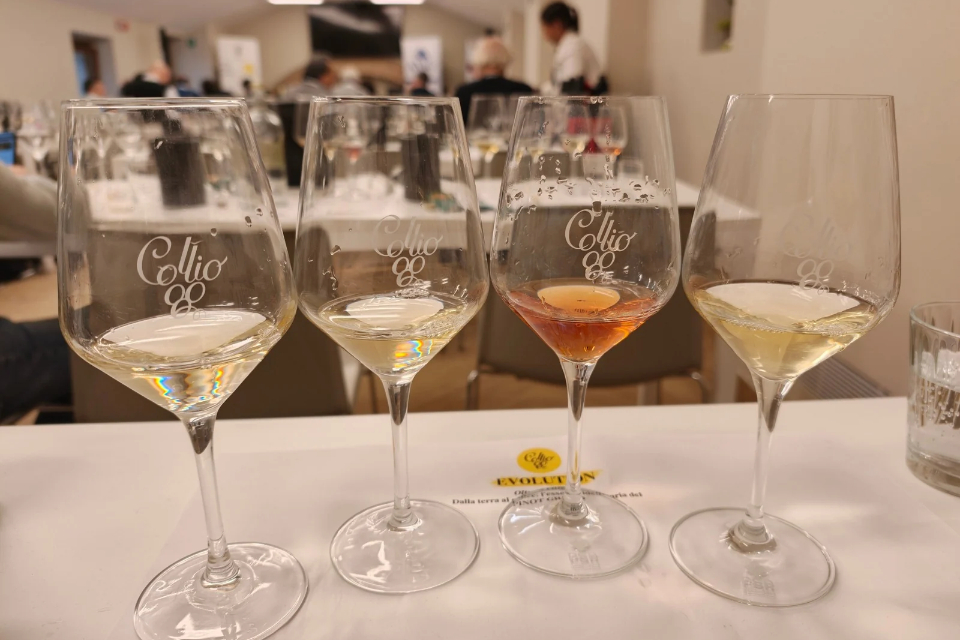
The color, ranging from straw yellow to golden and even coppery tones, made the variety of interpretations tangible. But it was above all on the palate that Collio Pinot Grigio revealed it is not «all fruit». Structure and sapidity often guided the progression, while evolution broadened the profile in a positive way, well beyond the primary aromas. It demonstrates that even an international grape variety, in Collio, can become an effective tool for reading soils, microclimates, and production choices.
COLLIO EVOLUTION 2026, THE COMPARISON THAT WAS MISSING
This very richness makes Collio Evolution 2026 a missed opportunity, at least in part. The comparison should not have been limited to Pinot Grigio from other Italian territories, against which Collio would have had good reason to claim a position of strength (at times appearing clear-cut, even overwhelming).
It would have been very useful to measure the variety against international interpretations. Not to draw up a ranking, but to see where Collio stands, especially in terms of its ability to evolve in the bottle. The old vintages showed that the territory can hold its own in that comparison.
BEYOND THE COLLIO BIANCO SQUABBLES
The choice to place an international grape variety at the center of the second edition was not a departure from Collio’s story, following the “first” edition of Collio Evolution 2025, dedicated to Friulano. On the contrary, it was a way of showing its ability to interpret the territory even through a variety grown worldwide.
The Pinot Grigio flights tasted in Cormons conveyed a simple message: a denomination’s identity does not depend solely on the grape variety’s origin, but on what the place manages to impart to it. It’s a perspective that could also help the debate on Collio Bianco, too often trapped in the opposition between «native-grape purists» and «internationalists».
When it becomes a battle of allegiance, this dispute stops clarifying the wines and ends up impoverishing the communication of a complex, one-of-a-kind territory. Collio Evolution 2026 suggests another path: start from the glasses, observe how the terroir expresses itself. And let the wines show just how recognizable Collio can be. Whatever the grape variety. Or the age of the bottle. Even with Pinot Grigio. Eureka.