IN BREVE
- Why calorie management is a matter of health and performance for professional tasters.
- For wine professionals, managing calories is crucial for health and sensory performance.
- Wine provides 7 kcal per gram, and it is important to consider this in your daily diet.
- Alcohol provides no essential nutrients and can lead to an unconscious calorie surplus.
- A balanced meal before consuming alcohol helps maintain blood sugar stability and reduce negative effects.
- Regular physical activity improves insulin sensitivity and supports liver function for wine professionals.
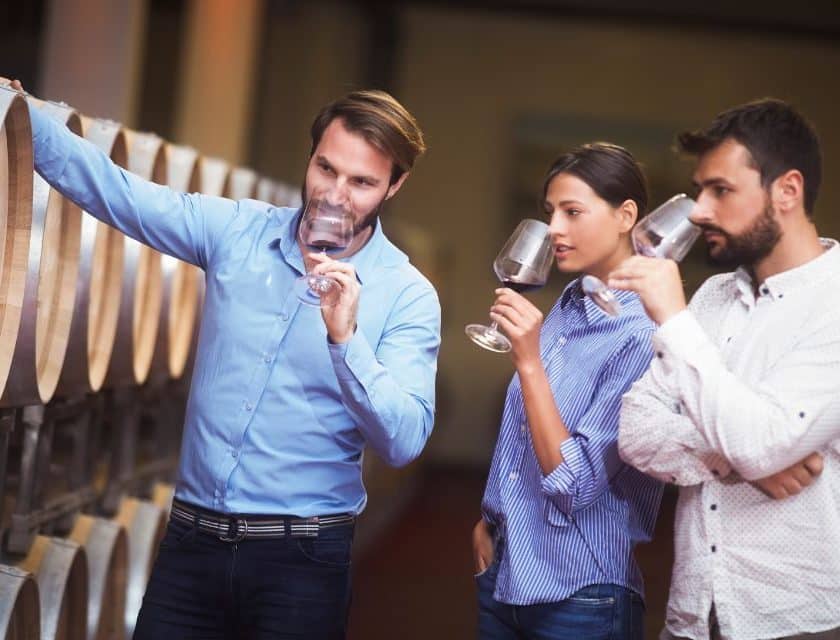
For wine professionals, nutrition is not a secondary issue. Sommeliers, winemakers, buyers, critics, communicators, and industry operators face daily tastings, travel, evening events, and irregular schedules. In this context, calorie management—particularly those from alcohol, but also from a diet that is often difficult to manage systematically—becomes a central issue of health, sensory clarity, and professional sustainability.
Wine is an integral part of the job. But from a nutritional point of view, it remains a specific energy source, often underestimated. We discuss this in Winemag’s new column, Alcohol and Health, under the supervision of nutritionist biologist Umberto Rossi.
WINE FROM A NUTRITIONAL PERSPECTIVE
According to leading international scientific authorities—the World Health Organization, EFSA, and national nutrition institutes—the energy provided by wine comes almost exclusively from ethyl alcohol. This provides 7 kcal per gram, a value higher than that of carbohydrates and proteins (4 kcal/g), and second only to fats (9 kcal/g).
In practical terms:
- dry wine 12–13% ABV: 70-80 kcal per 100 ml (just under a “classic” 125 ml glass)
- technical tasting pour (40–50 ml): 30-40 kcal
- professional session with 25–30 samples: 800-1,000 kcal
«These are calories often not perceived as such, because they are consumed in small, repeated quantities outside of a meal context,» explains Umberto Rossi.
ALCOHOL CALORIES: “EMPTY ENERGY” FOR THE LIVER
From a biochemical perspective, alcohol calories are defined as “empty” because:
- they provide no vitamins, minerals, or fiber
- they do not contribute to satiety
- they are metabolized with absolute priority by the liver
The liver, busy detoxifying alcohol through enzymes such as alcohol dehydrogenase and acetaldehyde dehydrogenase, temporarily suspends other metabolic processes, particularly fat oxidation. This mechanism is widely documented in scientific literature.
The result is that calories introduced with alcohol are used immediately, while those from other foods are more likely to be stored.
ALCOHOL METABOLISM: WHAT HAPPENS IN THE BODY
Metabolic physiology studies agree on several key points:
- alcohol cannot be stored and must be eliminated quickly
- its metabolism takes priority over carbohydrates and lipids
- repeated consumption, even in moderate amounts, alters the overall energy balance
«For a wine professional,» Rossi comments, «the problem is not the occasional tasting, but the daily or weekly frequency. This is often associated with irregular meals and forced sedentary behavior: travel, trade fairs, static tastings.»
PROFESSIONAL TASTINGS AND CALORIE BALANCE
One of the most significant issues is the so-called unconscious calorie surplus. Calories from wine are rarely subtracted from those of meals. In the medium term, this can lead to:
- gradual weight gain
- increase in visceral fat mass
- worsening of the metabolic profile
- reduction in mental energy and concentration
«Nutritional guidelines,» Dr. Rossi emphasizes, «suggest that energy from alcohol should not exceed 5–10% of total daily calorie intake. A threshold that wine professionals easily exceed on intense work days.»
EATING BEFORE TASTING: SCIENTIFIC EVIDENCE
Numerous studies indicate that consuming a balanced meal before drinking alcohol:
- slows down ethanol absorption
- reduces blood alcohol peaks
- improves blood sugar stability
The most effective combination, from a physiological point of view, includes:
- low-glycemic index complex carbohydrates
- lean proteins
- a moderate portion of unsaturated fats
This approach does not alter taste sensitivity, but protects the body and improves endurance during prolonged tastings.
HYDRATION AND SENSORY PERFORMANCE
Alcohol has a documented diuretic effect. Even mild dehydration compromises:
- aromatic perception
- palate precision
- ability to concentrate
For this reason, continuous hydration during tasting is not just a good health practice, but a professional tool. Guidelines suggest alternating every sip with water, avoiding sugary or flavored drinks.
AFTER THE TASTING: COMPENSATE, DON’T ADD
From a nutritional point of view, the meal following a tasting should rebalance the caloric and metabolic load:
- plenty of vegetables and fiber
- quality proteins
- limiting further alcoholic beverages
Adding wine or spirits at dinner, after a day of tasting, is one of the main factors of imbalance for those working in the sector.
PHYSICAL ACTIVITY AND ALCOHOL METABOLISM
Regular physical activity is one of the most effective tools for:
- improving insulin sensitivity
- promoting fat oxidation
- supporting liver function
CLARITY, HEALTH, AND PROFESSIONAL LONGEVITY
«Scientific evidence,» Rossi remarks again, «shows that an active lifestyle reduces the metabolic impact of moderate alcohol consumption. Not only that: it also improves physical and mental stamina in sensory professions.»
Chronic fatigue, weight gain, and decreased concentration «are not inevitable effects of working in wine.» They are often the result of a lack of nutritional management. For a wine professional, nutrition is part of performance, just like sensory training and technical education.
AWARENESS AS A WORK TOOL
«Managing calories does not mean giving up wine,» highlights biologist and nutritionist Umberto Rossi, «nor demonizing it. It means recognizing it for what it is: a specific, powerful energy source to be consciously integrated into one’s diet.»
In a sector that talks more and more about sustainability, personal sustainability—physical and mental—remains one of the least addressed topics. Yet, for those who taste for a living, it is one of the keys to continuing to do it well, and for a long time.