IN BREVE
- The Carmignano 1925 from Tenuta Capezzana is a symbol of quality and winemaking tradition in Tuscany.
- The Contini Bonacossi family has managed Capezzana since 1926, maintaining a deep connection with the Carmignano territory.
- Capezzana is among the oldest wineries in Italy, with a history spanning over 1,200 years.
- Carmignano DOCG wine reflects centuries of excellence but remains somewhat in the shadows compared to other Tuscan denominations.
- Upon tasting, the Carmignano 1925 continues to demonstrate its longevity and quality, embodying a winemaking tradition in constant motion.
If it had human form, the Carmignano 1925 from Tenuta Capezzana would be a witty old man. Still lively and talkative. Ready to fight for what he believes in. Body and soul. He would always dress elegantly. A garnet-orange tie. He would engage without frills in yet another passionate discussion about life. In front of an enthralled audience. Admiring and sighing. After every syllable.
But Capezzana’s Carmignano 1925 is not human. Rather, a Martian wine. It doesn’t speak. Yet it is heard perfectly. It is classical music. An adagio. In an early twentieth-century ballroom. A testimony. Liquid, sonorous. It would have gladly remained closed for at least another decade in that dark green glass room, with its curious shape. A bit Burgundian, a bit like a large flask.
A PROMISE KEPT
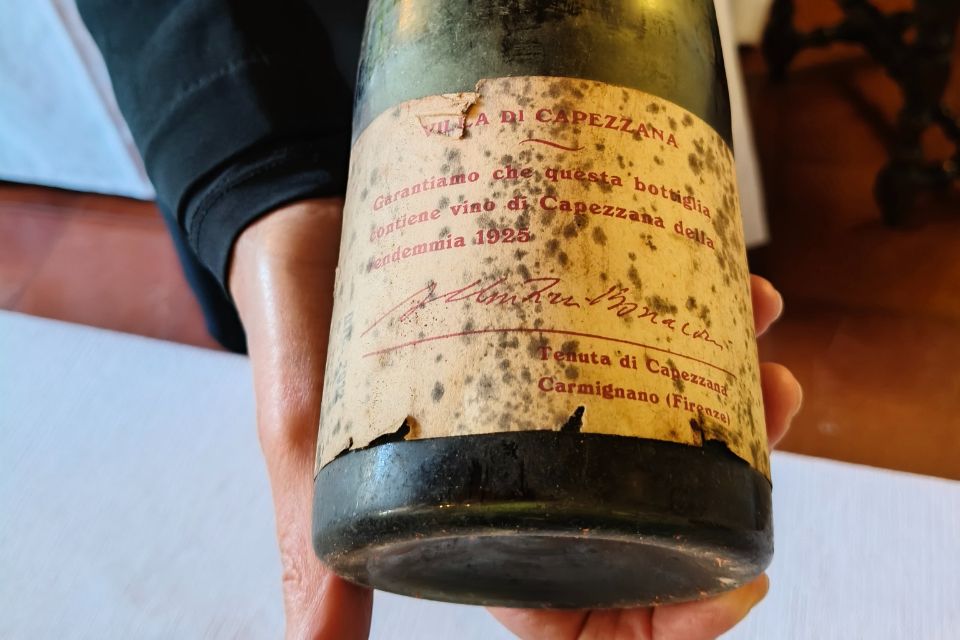
“We guarantee that this bottle contains Capezzana wine from the 1925 vintage,” reads the yellowed label, bearing the weight of a promise kept. A calling card. A manifesto of integrity for a land and an entire family. A handshake between men of honor. Prominently displayed is the signature of Alessandro Contini Bonacossi. A commitment, a guarantee of a bright and uninterrupted future in wine production. From generation to generation, until today.
Since 1926, Capezzana has been owned by the Contini Bonacossi family. A year earlier, in 1925, the first vintage of Villa di Capezzana was born—a label still in the cellar—traditionally composed of 80% Sangiovese and 20% Cabernet Sauvignon. It was recently the star of a vertical tasting that felt more like a journey through time, to celebrate 100 years since its creation.
VILLA CAPEZZANA: VINTAGES THAT DEFY TIME
A wine, the 1925 harvest, still alive and well. Capable of going beyond the emotion of tasting such a historic vintage, thanks to a disarming technical precision that seems almost an oxymoron when comparing early twentieth-century technology with today’s. Extremely clean and delicious, as well as fresh and full of life, are also the 1995 and 1983 vintages, superior to the 1979. The 2005 also performed well among the old vintages presented in the glass.
Wines that still have a raison d’être thanks to a meticulous approach that has never changed, from the vineyard to the cellar. For the first leap in quality at Tenuta Capezzana, one must wait until the 1960s. Ugo Contini Bonacossi began the transformation of the estate during that era, moving from sharecropping to a modern model open to foreign markets, supported by his children.
Today, the fifth generation of the family carries forward the management of the company, guardians of the memory and history of a Tuscan territory still in the shadows compared to “big” names like Montalcino, Chianti Classico, and Montepulciano: Carmignano, in the province of Prato, 25 kilometers from Florence.


CAPEZZANA: FAMILY CONTINUITY AND IDENTITY
The handover from Ugo’s children to his grandchildren, now in key roles within the company, represents the natural continuity of a reality that, as promised on the Villa di Capezzana 1925 label, looks to the world while maintaining deep roots in its origin. Differences of opinion within the family have always yielded to a stronger bond: the indissoluble connection with Carmignano, the beating heart of this microcosm. As Ugo Contini Bonacossi always said: “Tradition is not a statue, still and motionless, but a ship in constant motion.”
Capezzana is among the oldest wineries in Italy, with a production tradition in Carmignano exceeding 1,200 years. A lease agreement preserved at the State Archives of Florence, dated 804 AD, already mentions vineyards and olive groves cultivated on the estate.
THE VALUE OF CARMIGNANO IN THE MIDDLE AGES
Evidence suggests that the hills of Carmignano were suited for viticulture well before the Middle Ages. Archaeological finds of tools used by the Etruscans for wine production and storage indicate an ancient continuity in the vocation for the vine.
In the 14th century, Carmignano wines were already prized in trade. The merchant Francesco di Marco Datini, among the most influential figures of the time, wrote of Carmignano wines, considering them so precious they could be used as a form of payment.
THE MEDICI ERA AND THE BARCO REALE
The Medici era marked another turning point for Carmignano and Capezzana. In 1626, Grand Duke Ferdinand II de’ Medici established a large hunting reserve in the Montalbano area, delimited by the imposing fifty-kilometer-long wall of the Barco Reale. The Capezzana vineyards were located within this protected land.
The Barco Reale not only protected the wildlife but also preserved the landscape itself, safeguarding forests, vegetation, and agricultural land from urban expansion for centuries. This isolation allowed the territory to maintain a unique ecological balance, favoring high-quality viticulture.
CARMIGNANO DOCG
Recognition of Carmignano’s excellence thus reached the highest levels. In 1773, Grand Duke Peter Leopold of Lorraine cited Carmignano wine as a quality benchmark in his Reports on the Government of Tuscany. Its reputation was such that the wine was used as a parameter to evaluate the production of other Tuscan wine regions. The DOCG status of Carmignano today reflects this centuries-old prestige.
Its official recognition dates back to 1716, when the Grand Duke of Tuscany issued a decree delimiting four wine zones in the Grand Duchy—including Carmignano. It is one of the oldest documented denominations in Italian wine history. Today it has 280 claimable hectares, with an annual production of about 600,000 bottles of Carmignano DOCG. Even those who do not yet know these wines can be certain of one thing above all: their longevity. Just ask that elegant old man, still in great shape. Born in 1925.