IN BREVE
- The 33 Ugas of Soave will not change their names, but they could change their weight in the denomination’s hierarchy.
- The revision involves moving the Additional Geographical Units from the DOC to the Soave Superiore DOCG.
- The term ‘Classico’ remains in the Soave Superiore DOCG, while ‘Colli Scaligeri’ will not be reintroduced as an autonomous sub-zone.
- The reform aims to simplify label communication and improve the distinctiveness of grapes and wines.
- An increase in the maximum yield per hectare and less restrictive parameters for alcohol content are expected.
The 33 Ugas of Soave will not change their names or boundaries, but they could change their weight in the denomination’s hierarchy. The revision of the production regulations approved by the Consorzio Tutela Soave involves moving the Additional Geographical Units out of the DOC and concentrating them in the Soave Superiore DOCG. From the DOC, “Classico” and “Colli Scaligeri” would also disappear.
The project has already received the green light from the Consortium’s board of directors and the assembly. Now it awaits approval from the Ministry. Until the process is completed, the current rules naturally remain in force. The proposed amendments for the Soave DOC and Soave Superiore DOCG were published by the Veneto Region in April 2026.
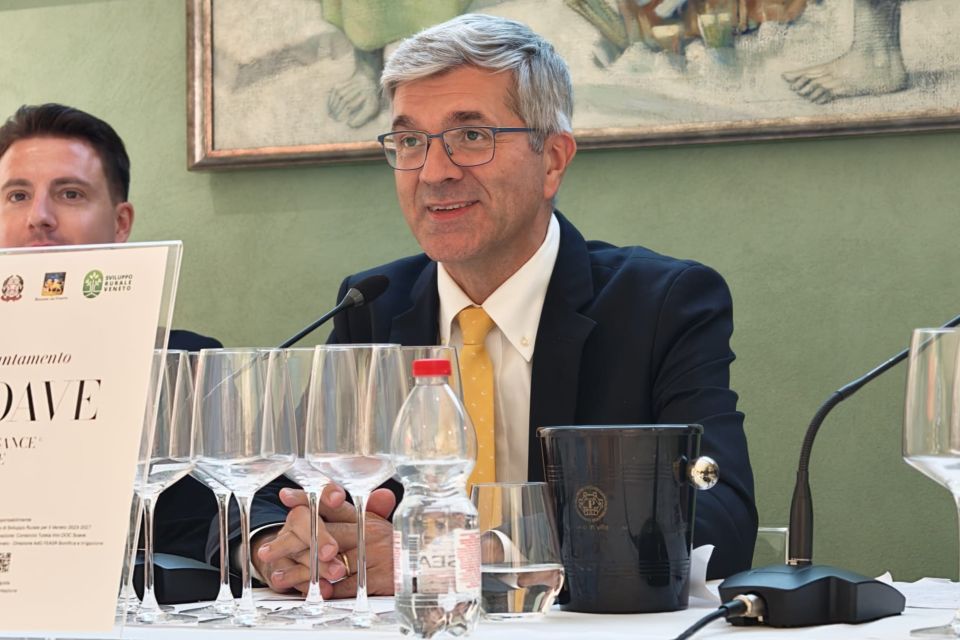
“We want to move forward on two tracks, parallel but different, with different destinations for Soave DOC and Soave Superiore,” explained Cristian Ridolfi, president of the Consorzio Tutela Soave, to Winemag. “The Ugas can help us in this work.”
UGAS LEAVE THE SOAVE DOC
Today, Ugas can accompany Soave DOC (including Classico or Colli Scaligeri) as well as Soave Superiore DOCG on the label. The amendment, however, removes the entire reference to Additional Geographical Units from the DOC regulations, including the annex with the 33 names. The same list remains unchanged in the DOCG regulations.
This is not about creating new crus, but about their different placement in the pyramid. To continue featuring an Uga on the label, a dry Soave wine would have to be claimed as Soave Superiore DOCG and comply with its conditions. The 33 Geographical Units officially entered the regulations starting with the 2019 harvest, following European recognition of the zoning process initiated by the territory.
“That category is a container for hillsides, Ugas, old vines, and many family stories,” Ridolfi emphasized. The DOC production area, however, is not physically redrawn: the change mainly concerns the claiming possibilities and the language used on the label.
CLASSICO MOVES UP TO DOCG, FAREWELL TO COLLI SCALIGERI
The new structure would eliminate both the “Classico” specification and the “Colli Scaligeri” sub-zone from the DOC. The “Classico” reference would remain in the Soave Superiore DOCG and could be placed before the word “Superiore.” On the label, it would then be possible to read Soave Classico Superiore DOCG, instead of Soave Superiore Classico.
It is one of the central steps of the reform: Soave DOC would remain the broadest and most immediate denomination, while hillsides, Ugas, and territorial references would be concentrated in the upper level. “Classico” would continue to identify the historical zone; “Colli Scaligeri,” however, is not reintroduced as an autonomous sub-zone in the new DOCG text.
LONGER WAIT FOR UGA AND VIGNA, BUT DOCG YIELDS INCREASE
The proposal also assigns a precise temporal difference to the Ugas. Soave Superiore, including Classico, could be marketed from February 1st of the year following the harvest. Wines with Uga and/or the “Vigna” mention would instead have to wait until February 1st of the second year following the harvest.
The “Riserva” category would simultaneously disappear. The minimum total alcohol content would be set at 11% for Soave Superiore and 11.5% for Uga and Vigna.
The basic DOCG would, however, become less restrictive than the current one regarding other parameters. The maximum yield would rise from 10 to 12.5 tons per hectare, while the minimum natural alcohol content of the grapes would drop from 11% to 10%. The plan therefore appears oriented toward creating a broader category for hillside Soave, relying primarily on declared origin and longer aging to distinguish the Ugas.
The minimum share of Garganega would remain at 70%. Chardonnay would no longer explicitly appear alongside Trebbiano di Soave in the maximum 30% share, while other non-aromatic white grapes suitable for the province of Verona could contribute up to 15%, compared to the current 5%.
THE 50% CUT IS ALREADY IN FORCE
The reform of the production regulations should not be confused with the production limitation already in operation. For the 2026, 2027, and 2028 harvests, the maximum area claimable as Soave DOC without “Classico” or “Colli Scaligeri” is equal to 50% of the company’s Garganega surface suitable for the denomination. An equivalent area must be destined for another denomination, IGT, or wine without geographical indication. Exemptions are provided for organic production and for companies that did not generate surpluses in the two previous campaigns.
For the 2026 harvest, the yields that can actually be classified have also been reduced: 13.5 tons per hectare for Soave and 12.5 for Soave Classico and Colli Scaligeri.
“It is the beginning of a journey, a beginning of awareness,” Ridolfi concluded. A journey that aims to reduce the weight of generic Soave and make the denomination’s territorial hierarchy more readable.