IN BREVE
- Etna has the potential to become a recognized sparkling wine region, thanks in part to the experience being gained by Tenute Nicosia.
- For the production of Metodo Classico, the winery uses local varieties such as Nerello Mascalese and Carricante, including long aging on the lees.
- To develop a true sparkling wine identity, Etna will need to ensure production continuity and market recognition.
- Events like “Bolle in Vigna” place Etna in comparison with other wine areas, contributing to its promotion.
- The challenge lies in positioning Etna’s Metodo Classico as a distinctive and internationally recognizable category.
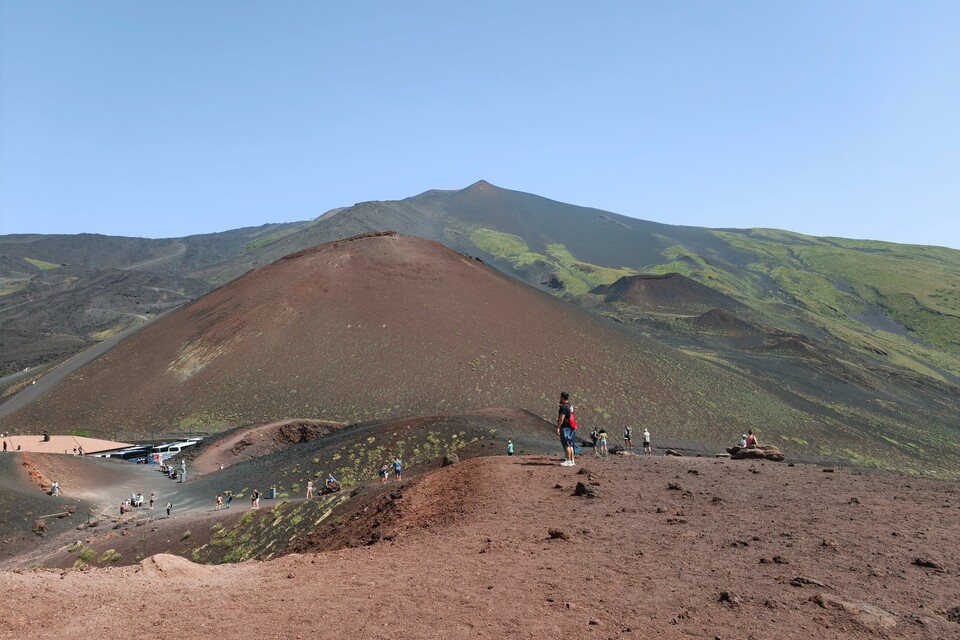
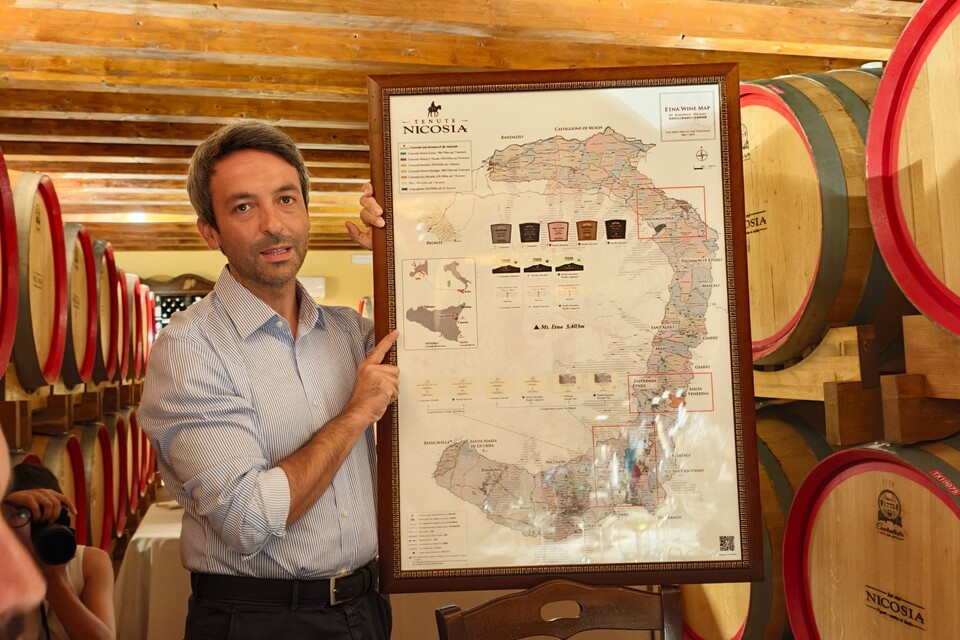
Can Etna become an internationally recognized sparkling wine region? The experience gained by Tenute Nicosia with Metodo Classico suggests that the volcano has already moved past the stage of simple experimentation. After over 15 years of work on Nerello Mascalese and Carricante, the Trecastagni winery has built a range capable of focusing the identity of Etna’s bubbles. These are wines in which altitude, volcanic soils, temperature excursions, and the influence of the Ionian Sea are not just narrative elements, but determining factors in the style.
The path taken by the company through the Sosta Tre Santi line also offers an interesting perspective on the future of the entire territory, which has decades of experience in sparkling wine production, even before the start of Nicosia’s “sparkling project.” Indeed, Etna possesses the conditions to complement the reputation earned with its still red and white wines with a more defined position in the landscape of Italian Metodo Classico.
To succeed, it needs production continuity, recognizability, and aging suitable for enhancing the two varieties from an international perspective. And a greater ability to present itself to the markets as a sparkling wine district. Not just as a sum of individual labels—today there are 40 wineries producing sparkling wine on Etna, for a total of 500,000 bottles (+50% compared to 2018)—that are more or less convincing in the glass.
Nicosia: OVER 15 YEARS OF METODO CLASSICO ON ETNA
Tenute Nicosia has been producing Metodo Classico on Etna for over 15 years. An experience developed on the two varieties that best represent the territory: Nerello Mascalese, used for Blanc de Noirs and rosés, and Carricante for Blanc de Blancs. Some labels reach 60 months of aging on the lees. A duration that allows for a concrete verification of how Etna’s sparkling wine bases hold up over time.
Longevity is one of the central aspects of the project. The goal, as Graziano Nicosia and enologist Maria Carella explain, is not to derive a sparkling version from grapes normally intended for still wines. Rather, it is to identify vineyards, harvest times, and cellar protocols functional to the production of bubbles. This is a decisive step for any territory aspiring to build a true sparkling wine identity.
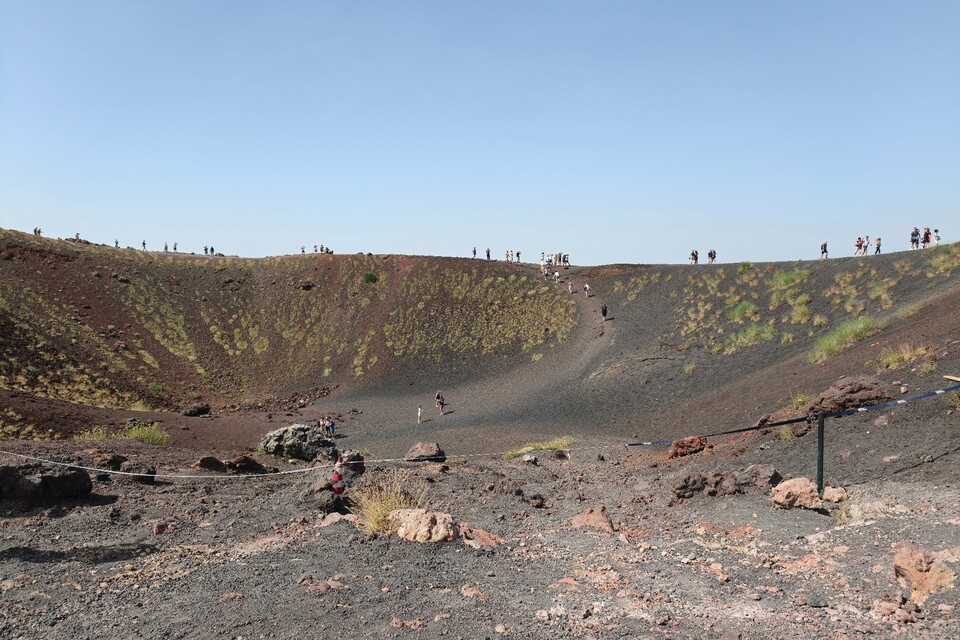
Grape ripening on Etna is conditioned by altitude and strong temperature excursions between day and night. On the south-eastern slope, there is the added exposure to the Ionian Sea, with ventilation that helps define the vineyard conditions. In this context, maintaining acidity and relatively gradual ripening can offer bases suitable for secondary fermentation in the bottle and prolonged stays on the lees.
NERELLO MASCALESE AND CARRICANTE, TWO COMPLEMENTARY PATHS
The possibility of working with two varieties with different characteristics expands Etna’s potential. Nerello Mascalese allows for the production of Blanc de Noirs and rosés with structure, tension, and character. Carricante, on the other hand, brings acidity, verticality, and a savory component that can gain complexity during aging. And it is precisely the aging that offers the broadest guarantees for an objective evaluation of the prospects for Etna’s sparkling wines.
While Nerello Mascalese tends to lean toward a “comforting” profile for the average consumer, comparable in notes and profile to Pinot Noir, Carricante wears the jersey of the quintessential native grape in Etna sparkling wine. The more it evolves, the more it takes on a unique profile compared to national and international sparkling wines: the varietal gains complexity on the lees and post-disgorgement, well beyond the notes of autolysis. It returns the characteristic oily and volcanic notes of its terroir.
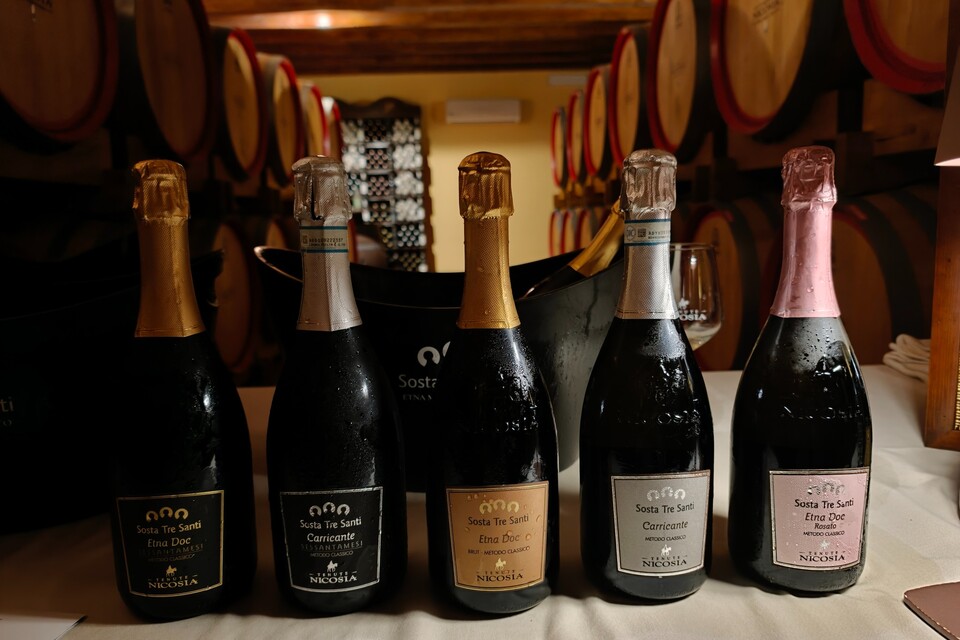
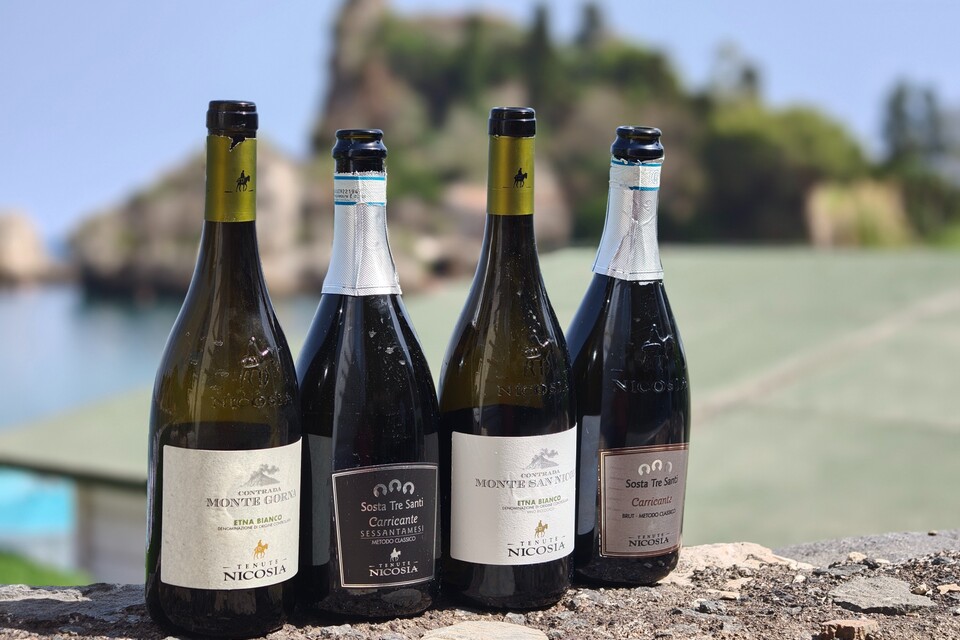
Anything but a given, this could draw attention to Etna as a sparkling wine area with characteristics and peculiarities unique in the world. Whether you are a fan of Carricante or Nerello Mascalese with bubbles, the Sosta Tre Santi range from Tenute Nicosia interprets this complementarity intelligently. And consciously. That is, through Blanc de Noirs, Blanc de Blancs, and Rosé.
It’s not just about chromatic variations. They are different ways of measuring the response of native grapes to secondary fermentation. And to the long stay on the lees. It is precisely the centrality of local grape varieties that distinguishes Etna from many other emerging Metodo Classico areas. The territory does not need to replicate models built elsewhere or to offer itself on the market from a quality-price perspective, as some Lombard territories seem inclined to do (the reference to Oltrepò Pavese is intentional).

ETNA SPARKLING WINES: WELL BEYOND FADS OR THE MARKET
Etna—from Nicosia and the group of maisons of the Etna champenoise—proves it can develop an autonomous, coherent, and authentic language. Founded on varieties already strongly associated with the volcano. Already recognizable in the main international markets by an audience capable of placing the winemakers’ hard work and the terroir’s peculiarities where they deserve. A territorial project that goes well beyond an alternative to categories in crisis: on Etna, sparkling wine is not produced in response to the decline in consumption of reds and whites, but by a nature supported by decades of experimentation, started long before it was trendy.
Etna’s sparkling wine vocation was not born in recent decades. The first traces date back to the end of the nineteenth century, when Baron Spitaleri experimented with a Metodo Classico from Pinot Noir between Adrano and Biancavilla, marketed under the name “Champagne Etna“. After that pioneering parenthesis, interrupted also by phylloxera, the contemporary season began in 1989 with Emanuele Scammacca del Murgo and the first Metodo Classico from Nerello Mascalese. In 2002, Benanti then paved the way for the sparkling production of Carricante. Followed, among others, by the Nicosia family.
FROM CORPORATE PROJECT TO TERRITORIAL IDENTITY
The growth of a sparkling wine region, however, requires a further step. The quality of individual bottles must transform into a collective perception. The consumer must come to recognize Etna’s Metodo Classico as a category, associating it with sufficiently clear and constant characteristics.
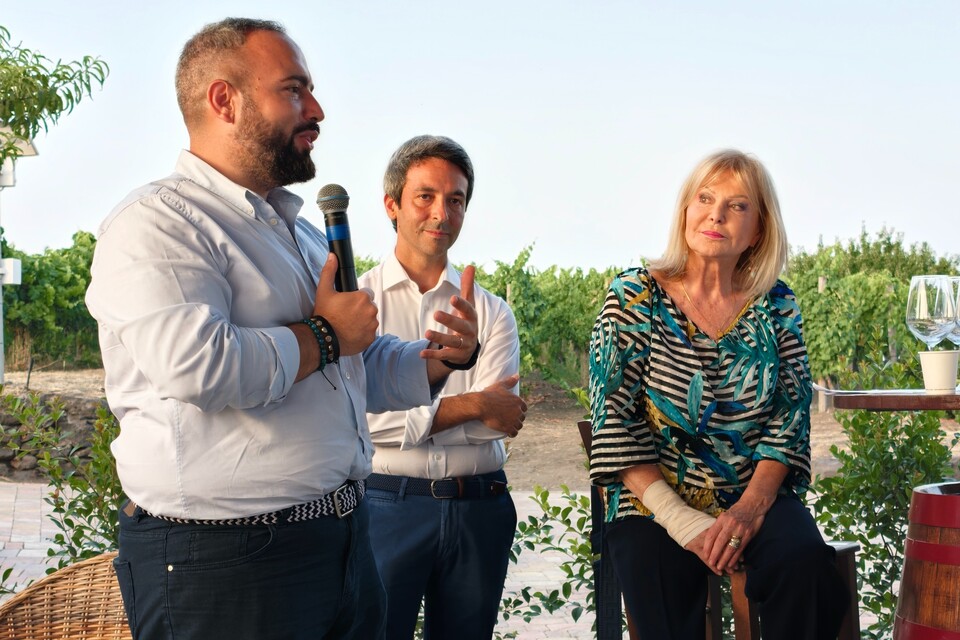
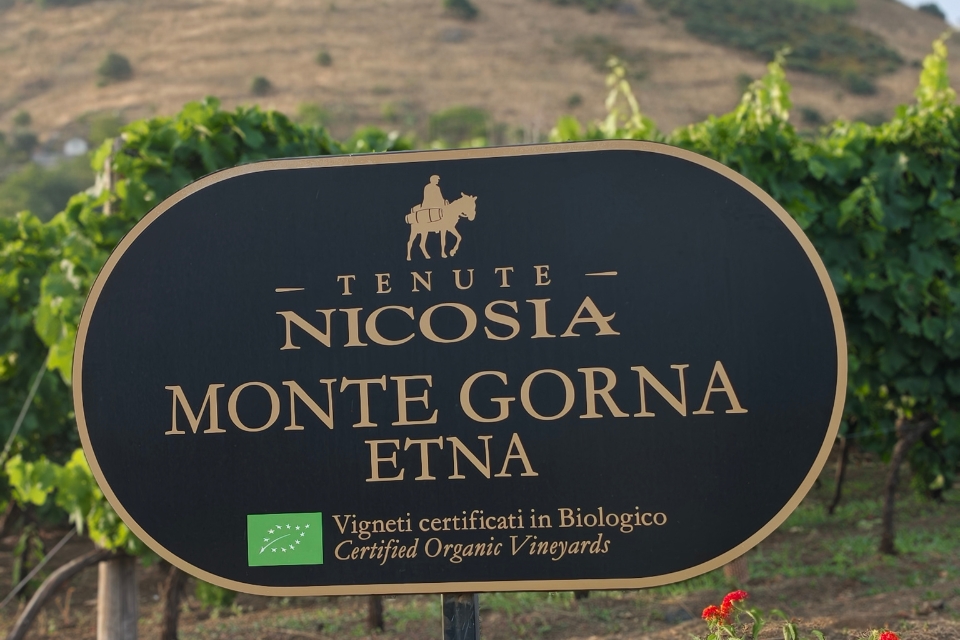
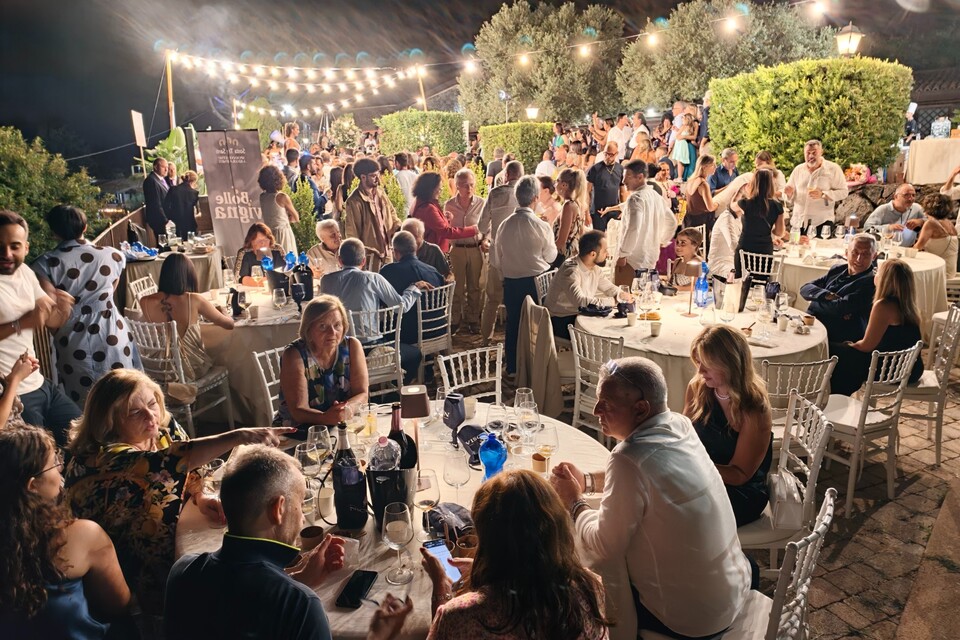
Moving in this direction is Bolle in Vigna, the event organized by Tenute Nicosia in the Monte Gorna vineyards together with the Associazione Spumanti dell’Etna, led by Francesco Chittari, a true encyclopedia of Etna wines and international Metodo Classico. Reaching its seventh edition in 2026, the event—which took place last July 22—was born around the company’s experience. But it has progressively taken on a broader function: putting the volcano’s bubbles in comparison with other Italian and international territories.
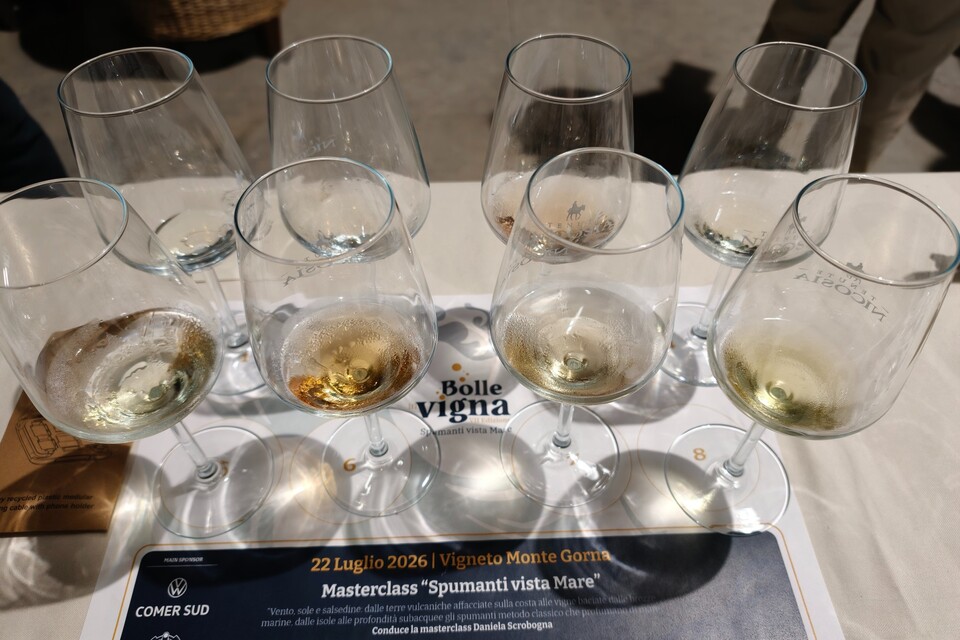
The theme “Sparkling wines with a sea view” chosen for the latest edition placed Etna’s Metodo Classico within a family of wines produced in coastal, island, or otherwise sea-influenced areas.
The blind tasting of eight labels, led by the president of the Scientific Committee of the Fondazione Italiana Sommelier (Fis) Daniela Scrobogna, allowed for a move beyond self-referential comparison. And to evaluate Etna alongside Champagne, South Africa (Méthode Cap Classique – MCC), Lanzarote, Sicily (a new, interesting release from Gorghi Tondi, Pinot Noir base, crafted by Tonino Guzzo), Liguria, and Campania (Ischia).
INTERNATIONAL COMPARISON AS A TEST OF MATURITY
Measuring oneself against more established denominations or with varieties that take root in similar soils or share similar microclimates is indispensable in 2026. For Etna, however, the comparison should not translate into an imitation of Champagne, Trentodoc, Franciacorta, or Alta Langa, and from no corner of the volcano does this seem to be the intention. The challenge consists in demonstrating that “a Muntagna” can express a Metodo Classico that is recognizable precisely because it is different.
The volcanic origin of the soils, the altitude, the Mediterranean luminosity, and the presence of the sea constitute an uncommon combination. This natural base must be matched by a precise production vision: selection of the most suitable vineyards, harvests calibrated for sparkling bases, careful management of pressing (the latter element emphasized by chef de cave Nicolas Secondé in his new experience at Cantina del Taburno, in Campania). And again: sufficiently long aging and dosages consistent with the profile of the wines.
Nicosia’s experience also indicates that time represents a decisive ingredient. Fifteen years are enough to observe the evolution of the bottles, correct initial choices, and consolidate a style. They are not yet enough, on their own, to transform a territory into an international reference. They do, however, offer a credible base on which to build a brand within a brand—that of Nicosia sparkling wines—after the consolidation that has already occurred internationally with still white and red wines.
WHAT ETNA’S BUBBLES NEED NOW
The next phase concerns the ability of producers to act as a territory. What is needed is a shared narrative, a greater presence in foreign markets, and opportunities for technical comparison between companies. It will also be important to have structured data on surfaces, volumes, time on the lees, and commercial distribution of Etna sparkling wines.
International positioning will not depend solely on quality. Production continuity and stylistic identity will be needed. And communication capable of avoiding the simple formula of “volcano bubbles”. Etna is now a strong name in world wine, but this reputation derives mainly from Nerello Mascalese reds and Carricante whites. Metodo Classico has yet to conquer an autonomous space.
Tenute Nicosia has contributed to opening and consolidating this path over the last decade, through a production started when Etna sparkling wine production occupied a decidedly more marginal position.
The depth of the experience accumulated, together with the work of other producers, today allows for a higher ambition: to make Etna not a curiosity in the landscape of bubbles, but a Mediterranean sparkling wine region, recognizable on international markets. More with Carricante than with Nerello Mascalese. But that is a marginal detail.