IN BREVE
- Scommessa, the new Marche Igt 2025 white wine from Santa Barbara made with Verdicchio grapes, is produced using an innovative sequential inoculation of Lachancea thermotolerans and Saccharomyces cerevisiae yeasts.
- Lachancea thermotolerans produces lactic acid during alcoholic fermentation, enhancing the wine’s freshness in response to climate change.
- Sequential inoculation allows greater control over acidification, increasing microbiological stability and influencing the taste profile.
- Scommessa presents a straw yellow color, floral notes, and a well-pronounced acidity.
- Bioacidification thus becomes an integral part of the wine’s identity, addressing the challenges related to sugar maturity and loss of acidity due to climate change.
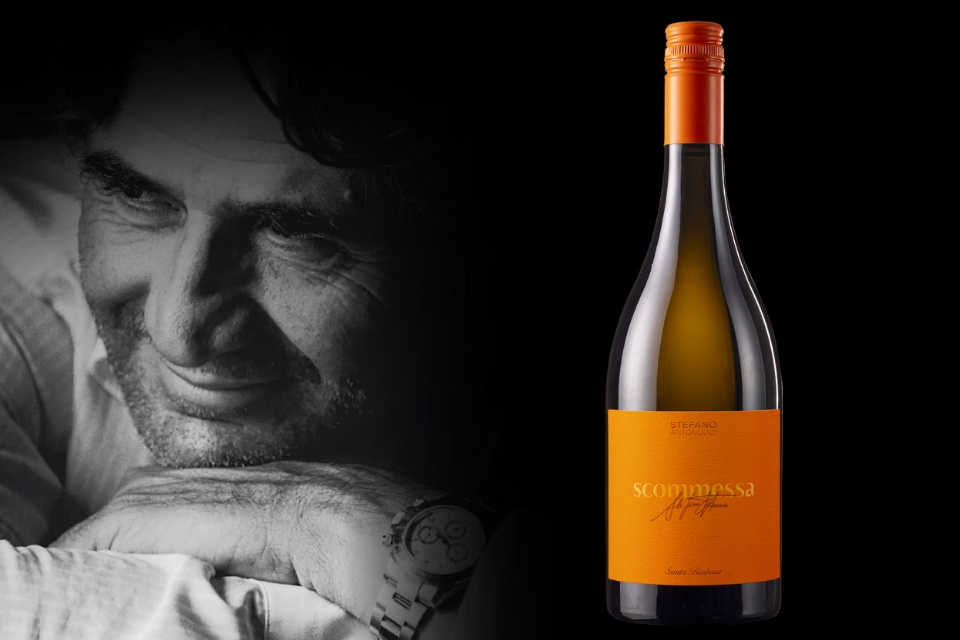
Scommessa is the name of the new Marche Igt 2025 from Santa Barbara obtained from Verdicchio grapes through sequential inoculation of Lachancea thermotolerans and Saccharomyces cerevisiae. An innovative winemaking approach that exploits the first yeast’s ability to produce lactic acid during alcoholic fermentation. The result is a wine in which “induced” freshness becomes an oenological response to the progressive loss of acidity in grapes due to climate change.
Behind the orange label designed by Stefano Antonucci lies a very current issue. Rising temperatures and faster grape ripening can result in musts richer in sugars, more alcoholic wines, and lower acidity levels. With consequences not only on the taste profile but also on chemical and microbiological stability. Santa Barbara – already Central Italy Winery for the Winemag 2025 Guide – addresses the problem starting from fermentation.
LACHANCEA THERMOTOLERANS, THE YEAST THAT PRODUCES ACIDITY
Lachancea thermotolerans is a non-Saccharomyces yeast naturally present in the grape’s microbial flora. Its distinctive feature lies in its ability to convert part of the fermentable sugars, especially glucose and fructose, into L-lactic acid rather than ethanol.
The process occurs thanks to the activity of the lactate dehydrogenase enzyme. This is why we speak of “bioacidification“: acidity is not corrected afterwards through the addition of organic acids but is produced biologically during the early stages of fermentation.
However, the acidifying capacity varies significantly among different strains of Lachancea thermotolerans. Some produce limited amounts of lactic acid, while others can reach much higher levels. According to data released by Lallemand for the strain marketed under the name Laktia, production can range from 2 to 9 grams per liter, depending on must characteristics and winemaking conditions.
Laffort in turn highlights how the metabolic activity of the most acidifying strains generally increases at temperatures above 20 degrees and in the absence of Saccharomyces cerevisiae. Temperature, must composition, and the interval between the two inoculations therefore allow the winemaker to modulate the result.
WHY SEQUENTIAL INOCULATION IS NEEDED
Lachancea thermotolerans is mainly used in the early stages of the process. After 24, 48, or 72 hours, Saccharomyces cerevisiae is inoculated, the yeast responsible for completing alcoholic fermentation.
The longer the period left to Lachancea before the entry of Saccharomyces, the greater the production of lactic acid can be. Sequential inoculation therefore allows control of acidification without entrusting the entire fermentation to a microorganism that, alone, might not complete it properly. This is the same protocol adopted for Scommessa by Santa Barbara.
An experiment conducted on rosé musts of Syrah and Cinsaut, the subject of a thesis from the University of Padua, confirmed the effects of the procedure. In wines obtained with three different strains of Lachancea thermotolerans, an increase in total acidity, a decrease in pH, a greater amount of glycerol, and a reduction in alcohol content were detected.
Organoleptic analyses also revealed variations in the presence of certain esters and acetates. Ethyl lactate, although present in greater quantities, remained below the perception threshold. An important finding: bioacidification does not necessarily equate to the appearance of recognizable lactic sensations in the wine.
EFFECTS ON THE WINE
The decrease in pH can contribute to microbiological stability during aging, increasing the active fraction of sulfur dioxide. In red wines, it can also promote color stabilization and aging potential.
When lactic acid production exceeds approximately 3-4 grams per liter, the activity of Lachancea thermotolerans can also hinder lactic acid bacteria and inhibit malolactic fermentation. This is an effect to be evaluated based on the wine type and oenological objective.
The conversion of part of the sugars into lactic acid finally subtracts material from ethanol production. This results in a possible, generally modest reduction in alcohol content. An interesting element in warm areas and vintages, where sugar maturity and loss of acidity often tend to proceed together.
STEFANO ANTONUCCI’S SCOMMESSA ON VERDICCHIO
In the glass, Scommessa presents a straw yellow color with greenish reflections. The olfactory profile opens with a beautiful floral component, fresh. There are also citrus notes, light tropical nuances, and Mediterranean scrub herbs. On the palate, the meaning of this project: the acidity is very pronounced and delivers a sip for true lovers of “taut and vertical” wines. Technical terms often used in the industry for profiles that only approach that of the Marche Igt Scommessa 2025.
Perhaps there’s a slight lack of balance, but Stefano Antonucci’s effort deserves absolute attention. Also because the use of Lachancea thermotolerans is not presented as a simple expedient to correct a low-acid must. It becomes part of the wine’s very identity and its taste construction. A path that takes on particular significance when applied to Verdicchio. A variety known for its pronounced acidity and propensity for long aging, but far from exempt from the effects of climate change.