IN BREVE
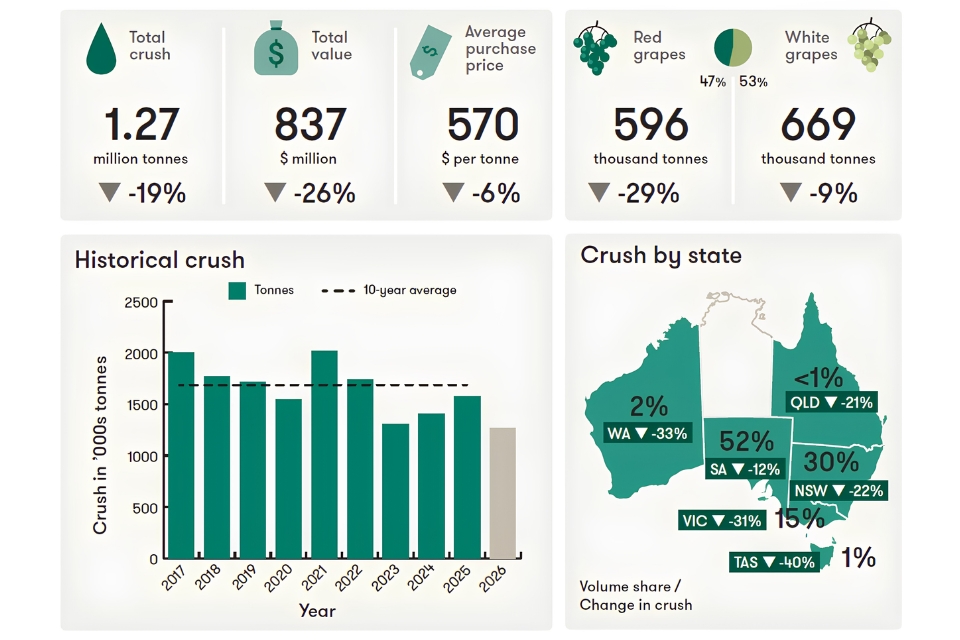
- The 2026 vintage in Australia stands at 1.27 million tonnes, the lowest since 2000, with a 19% decrease compared to 2025.
- Red grapes take the biggest hit, with a 29% decrease from the previous year, while white grapes drop by only 9%.
- Adverse weather conditions and production cuts contributed to the decline, yet failed to support grape prices.
- Demand for red wine is declining globally, negatively impacting Australian wine sales.
- The sector may need to consider further vineyard downsizing to rebalance supply and demand.
The 2026 vintage in Australia reached 1.27 million tonnes of grapes, the lowest quantity recorded since 2000. However, the drop in supply was not enough to support grape prices, which are still penalized by the weakness of global wine demand, especially for reds.
This is according to Wine Australia’s National Vintage Report 2026. The national harvest decreased by approximately 300,000 tonnes, or 19% compared to 2025, and was 25% lower than the ten-year average of 1.69 million tonnes. According to Wine Australia, this contraction is equivalent to about 33 million fewer nine-liter cases of wine.
FOUR VINTAGES BELOW AVERAGE
The result was influenced by difficult seasonal conditions, including flooding that affected some inland wine-growing areas. The main factor, however, is believed to be the planned reduction in production in response to changing consumption patterns.
«There have now been four consecutive vintages below the long-term average», observes Peter Bailey, Wine Australia’s Manager of Market Insights. This succession indicates «a structural rebalancing» of the grape quantities required by wineries to meet international demand.
The decline in the harvest affected Australia’s various states and major wine-growing regions relatively uniformly, from the warmer inland areas to the cool and temperate regions.
RED GRAPES DOWN BY 29%
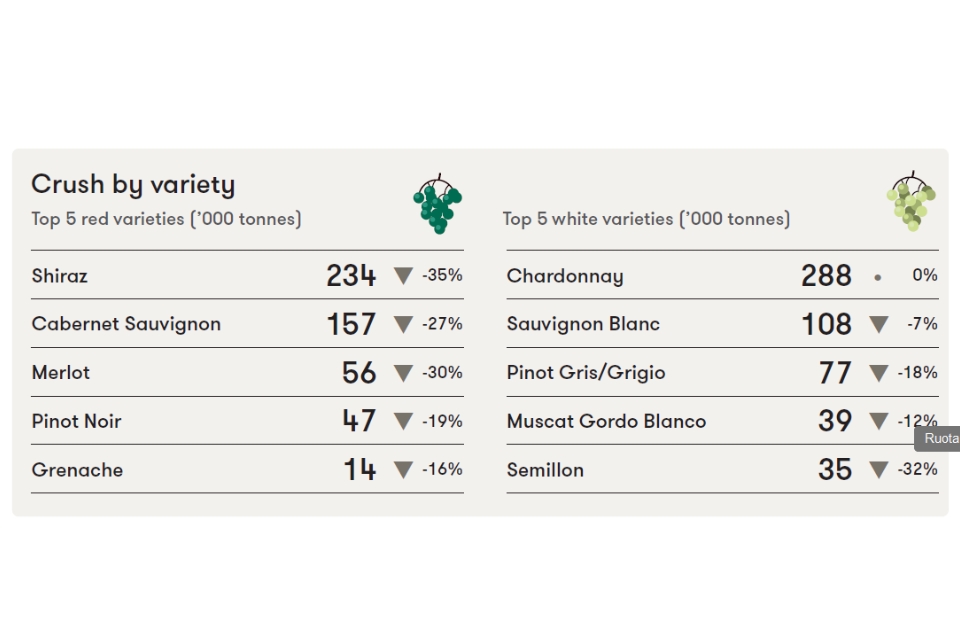
Once again, red varieties are paying the highest price for the crisis. Of the 306,334 tonnes lost compared to the previous vintage, approximately 80% consists of red grapes. The harvest of red varieties decreased by 243,560 tonnes, a 29% year-on-year contraction. This is also the lowest quantity since 2000.
The reduction in white grapes was more contained, falling by 62,774 tonnes, or 9%. Their share of the total harvest thus rose by six percentage points, reaching 53%. This is only the second time in the last twelve years that white grapes have represented the majority of the Australian vintage.


THE MARKET REWARDS WHITE WINES
The production shift reflects the evolution of international consumption. According to IWSR data cited by Wine Australia, since 2017, red wine has recorded a global decline twice as large as that of white wine.
The global market for reds has reportedly lost nearly 450 million cases compared to 2017 levels. This dynamic has more sharply reduced the demand for Australian red grapes, while white varieties have shown greater resilience.
General market conditions are nevertheless affecting all wine-growing areas. Over the last five years, the total harvest from cool and temperate regions has progressively approached that of the Riverland, South Australia’s main inland region.
GRAPE PRICES STILL FALLING
Despite the sharp reduction in the harvest, the average value of grapes purchased by wineries fell to 570 Australian dollars per tonne, 6% less than in 2025. The reduction affected both red and white grapes, in inland regions as well as in cool and temperate areas. In the latter, the average value for both categories decreased by 3%.
In the warmer inland areas, red grapes lost 1%, while whites recorded a 12% decline. “There has been no improvement in prices, demonstrating that demand remains very weak,” Bailey emphasizes. The lack of a recovery for reds, despite the significant production cut, is noted as particularly concerning. Added to this now is the decline in white grape prices.
AUSTRALIAN VINEYARDS TOWARDS NEW DOWNSIZING
Australian wine sales on the domestic and export markets currently amount to about one billion liters, equivalent to a demand for approximately 1.4 million tonnes of grapes. According to Wine Australia, this volume could be produced with fewer than 100,000 hectares of vineyards, an area equal to about two-thirds of the current estimated production base.
The sector may therefore be called upon to evaluate further vineyard downsizing to rebalance supply and demand. However, there remains a risk of over-correction due to the lack of complete data on uprooted areas and new plantings.
More precise indications should come with the completion of the National Vineyard Register, the tool designed to census Australia’s viticultural assets and support future production decisions. The National Vintage Report 2026 is based on a voluntary survey conducted between April and May among 667 businesses. The data collected represents, according to Wine Australia, about 87% of the entire national wine grape production.