IN BREVE
- The 2025 harvest in Trentino produced over 1.1 million quintals of grapes, with an 11% increase compared to 2024.
- Climate change negatively affected grape health, leading to widespread rot during harvest.
- Projects like IRRITRE assist in monitoring irrigation needs, essential in a year with extreme weather conditions.
- Red varieties achieved satisfactory results despite an early harvest schedule, thanks to good cellar management.
- Highlighted the positive effects of the season on Chardonnay, with balance between sugars, acidity, and good sensory expression.
The 2025 harvest in the province of Trento closed with over 1.1 million quintals of grapes and an 11% increase compared to 2024. A production result in line with the average of the last decade, despite complex climatic conditions that affected grape health and required quick decisions in the vineyard.
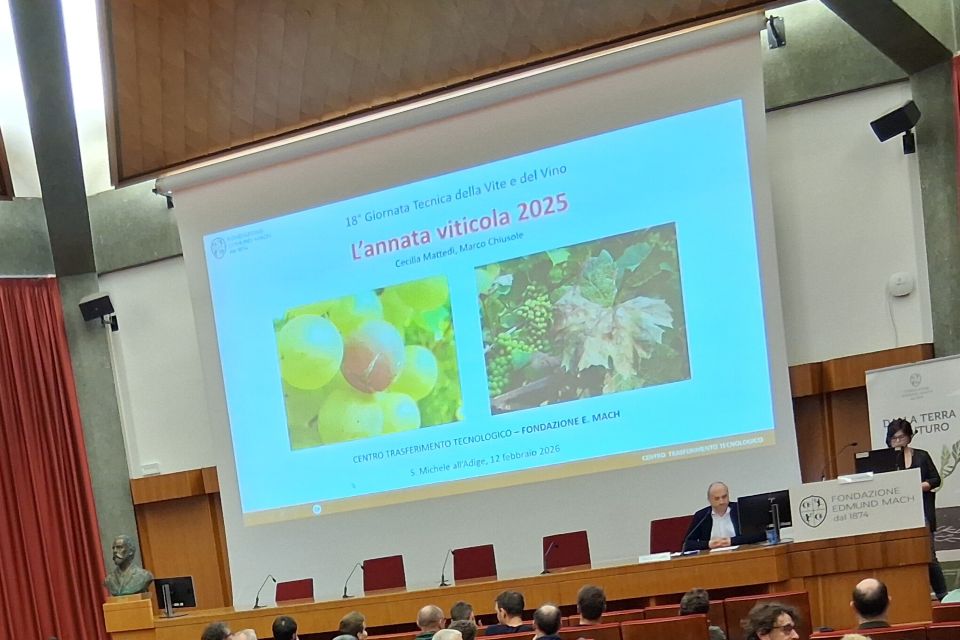
The wine-growing season’s assessment was presented at the Edmund Mach Foundation (FEM), during the 18th Technical Day of Vine and Wine. The meeting also focused on an increasingly relevant topic: managing grape integrity and health during ripening, in relation to the effects of climate change.
According to data from the Consorzio Vini del Trentino, production reached 1,131,393 quintals, marking a recovery compared to 2024, a year of low production.
WEATHER PATTERNS AND IMPACT ON VINES
2025 was characterized by weather conditions opposite to the previous year. A hot, dry June was followed by an exceptionally cold and rainy period. During harvest, heavy rainfall and above-average temperatures favored the spread of rot, forcing in several cases an early and concentrated harvest within just a few suitable days.
Conditions also affected irrigation needs, requiring monitoring based on the integration of forecast models and direct measurements. In this context, the IRRITRE project was launched, promoted and funded by the Autonomous Province of Trento to monitor irrigation volumes in local consortia.
The season will be remembered for the significant spread of bunch rot. Downy mildew pressure was moderate in most areas, with no significant powdery mildew infections. Phytoplasmosis monitoring indicates a stable situation compared to 2024, with an average incidence of 0.4%, as well as Scaphoideus titanus captures. However, flavescence dorée outbreaks were identified in neglected or poorly managed vineyards.
TEROLDEGO AND CLIMATE CHANGE
During the meeting, moderated by Alberto Gelmetti, field experiences with Teroldego were discussed, presented by Roberto Lucin (FEM) and Paolo Molinari (Cavit). Rising average temperatures have caused an advance in the phenological phases of this medium-late ripening variety over the past fifteen years.
In recent vintages, the phenological advance combined with heavy rainfall and high temperatures in the pre-harvest phase has favored grape health problems, related to skin breakdown and the onset of rot and botrytis. In 2025 the phenomenon was particularly severe and widespread, requiring early and accelerated harvests, especially for medium-late varieties. To contain these issues, defense strategies were tested with substances aimed at improving bunch resistance to rot.
ANTI-BOTRYTIS AGENTS AND BIOLOGICALS COMPARED
Christian Roschatt, from the Laimburg Research Center, presented comparative trials between synthetic anti-botrytis agents and products based on naturally derived active substances on Chardonnay. The trials, conducted in recent years, evaluated the effectiveness of different products. Analyses were performed on synthetic anti-botrytis agents to determine residues on grapes. The abundant rainfall between August and September 2025 caused severe botrytis attacks even in Alto Adige vineyards, confirming the centrality of plant protection in vintages characterized by high climatic pressure.
PLANT PROTECTION PRODUCTS AND WATER PROTECTION
Plant protection treatments were also addressed. Daniel Bondesan (FEM Technology Transfer Center) emphasized the importance of proper sprayer cleaning and choosing suitable locations for washing. He illustrated alternatives to field washing and innovative distribution practices being studied at FEM.
The Consorzio Trentino di Bonifica, with Michele Bernabè, presented the experiences of Lavis and Mezzocorona in building collective facilities for sprayer washing. Post-treatment phases, such as equipment loading and washing, represent one of the main sources of potential point-source water pollution.
GRAPE QUALITY AND WINEMAKING PROSPECTS
From a winemaking perspective, according to Mario Malacarne and Federico Bruni of the FEM Technology Transfer Center, the vintage can be evaluated positively for Chardonnay. Both sparkling base and still wine. The grapes showed balance between sugar content, acidity, and pH, with good sensory expression in the wines.
Aromatic and semi-aromatic white varieties, as well as Pinot Grigio, were more affected by the weather patterns of the second half of August. Red varieties, despite an early harvest schedule, thanks to technical cellar management produced fresh and fruity wines.
Opening the proceedings, Maurizio Bottura, deputy director general of FEM, noted: “This is the second event in a program consisting of five technical days during which the Technology Transfer Center technicians, together with external speakers invited for the occasion, share with operators the knowledge and experiences gained over the past year of activity.” Bottura also thanked the UMST Agriculture and the Agriculture Service of the Autonomous Province of Trento for funding the program dedicated to flavescence dorée.