In wine, power continues to hold a competitive advantage: it makes itself known immediately. Concentration, fruit ripeness, oak, volume and persistence impress from the very first sip. A context in which elegance paradoxically demands more attention. And in which drinkability still risks being mistaken for simplicity.
Among the perfect storms of the international wine world, the time seems to have arrived for the least obvious one. The most harmonious, dynamic wines capable of inviting the next sip could become the most precious labels in wineries’ ranges. Not because they follow a trend. But because producing “lightness” without inconsistency is far more difficult than it seems, in the face of climate change.
THE PREJUDICE OF THE IMPORTANT WINE
For decades, many wineries have built their internal hierarchy according to a rather elementary equation: more extraction, more aging, more alcohol and more oak meant greater prestige. The flagship wine had to show itself different from the others. Above all through volume. It was also the simplest model to communicate.
A severe selection of grapes, thirty months in barrique and a heavy bottle offered immediate arguments to support a high price. Far more complicated to explain why an apparently light wine should cost so much, devoid of special effects and perhaps already enjoyable a few months after bottling. But drinkability does not necessarily coincide with immediacy. And elegance is not a polite version of weakness.
LIGHTNESS IS HEAVY WORK
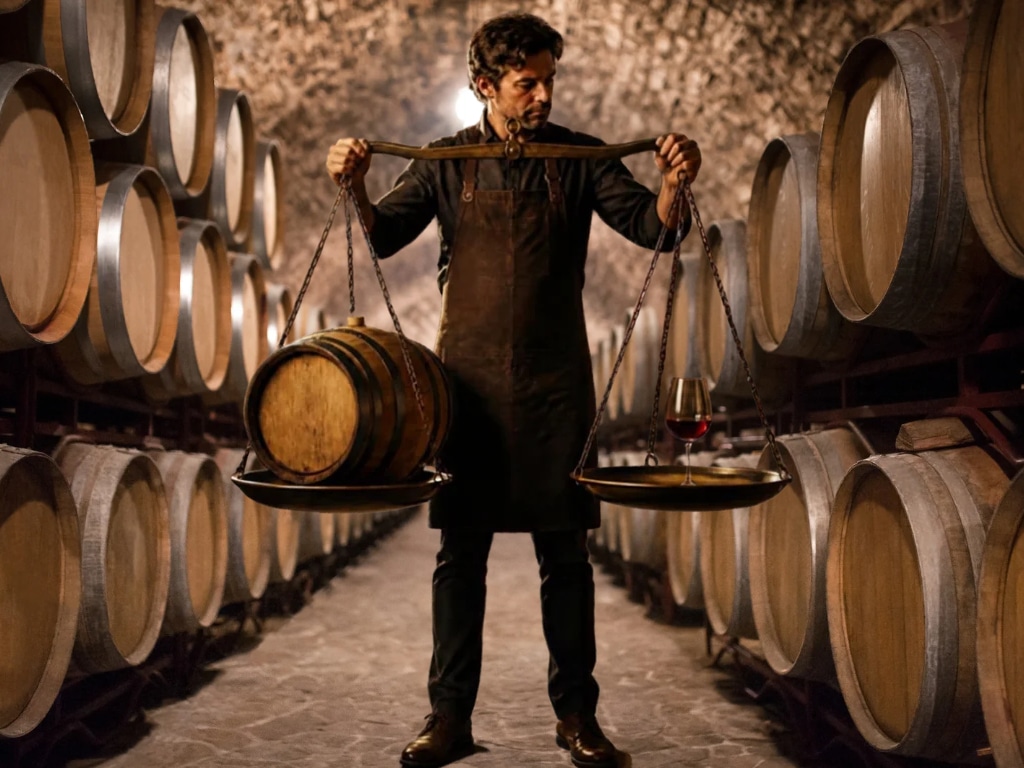
Obtaining a concentrated wine is increasingly less difficult these days. Obtaining a deep wine, without making its weight perceptible, can become the true challenge of modern viticulturists today. It requires balance in the vineyard, precision at harvest, measured extractions, ripe tannins. Intact acidity. And a use of aging that leaves no invasive imprint.
True elegance does not subtract complexity: it makes it natural. It is what allows a wine to be intense without being muscular. Persistent, without becoming exhausting. Gastronomic, without needing to occupy the entire table with its own “ego”.
Even drinkability should be read as a technical value. A great wine is not one that forces you to stop after half a glass to reflect on its importance. It can also be one that finishes too quickly. Leaving, however, a clear, territorial and recognizable trace.
THE PROBLEM OF SCORING
Here criticism comes into play. Comparative tastings, especially when they include many samples, tend to reward what emerges quickly. A powerful wine raises its voice. An elegant one waits for the taster to lower their own.
Not all wine critics seem equipped yet to distinguish finesse from thinness, freshness from immaturity, restraint from lack of character. It is far simpler to assign a high score to what shows much, immediately and clearly. More difficult to recognize the value of what possesses depth without displaying it.
This does not mean transforming any pale red or sharp white into a “contemporary” masterpiece. The rhetoric of drinkability can become as convenient as that of concentration. A diluted wine remains diluted. An imbalance does not become elegance simply because today it weighs less in the glass.
A NEW IDEA OF PRESTIGE IN WINE
The task of criticism is not to justify a winery’s price list. But neither is it to continue using parameters that end up systematically penalizing the more “subtle” wines. A 96-point label does not necessarily have to have more matter than a 90-point one. It should possess more precision, identity, balance and capacity to move.
If wineries begin to place elegant wines at the top of their ranges, critics too will have to make a cultural leap. They will have to learn to evaluate not only how much a wine offers, but how it manages to offer it.
Are we ready? Only partly. Too much criticism continues to confuse importance with imposingness. But the future could belong to wines that do not need to show their muscles to be remembered. And that, precisely while they seem to flow effortlessly, reveal how much it cost to produce. That lightness.