IN BRIEF
- Ferrari Maximum Blanc de Blancs wins the world title in magnum format, while the 75 cl only obtains silver at CSWWC 2026.
- The company’s communication regarding the magnum victory is unclear and risks creating confusion among the winery’s newsletter readers.
- The CSWWC excludes Deluxe Champagnes from world titles to prevent expensive wines from dominating the competition. Hands up if you knew that.
- Champagne & Sparkling Wine World Championships 2026 aims to “reduce the reputational risk of participants,” protecting the wineries that invest in the competition. Another element that is not always clear to those reading the results.
- Wineries like Tenuta Mazzolino (Oltrepò Pavese) clearly communicated the format and category of their awards.
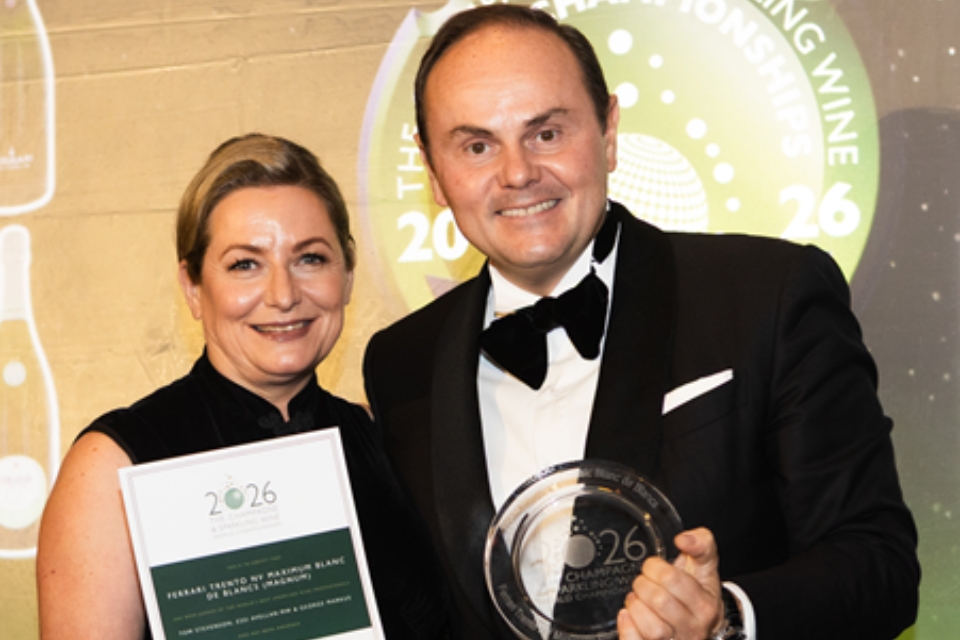
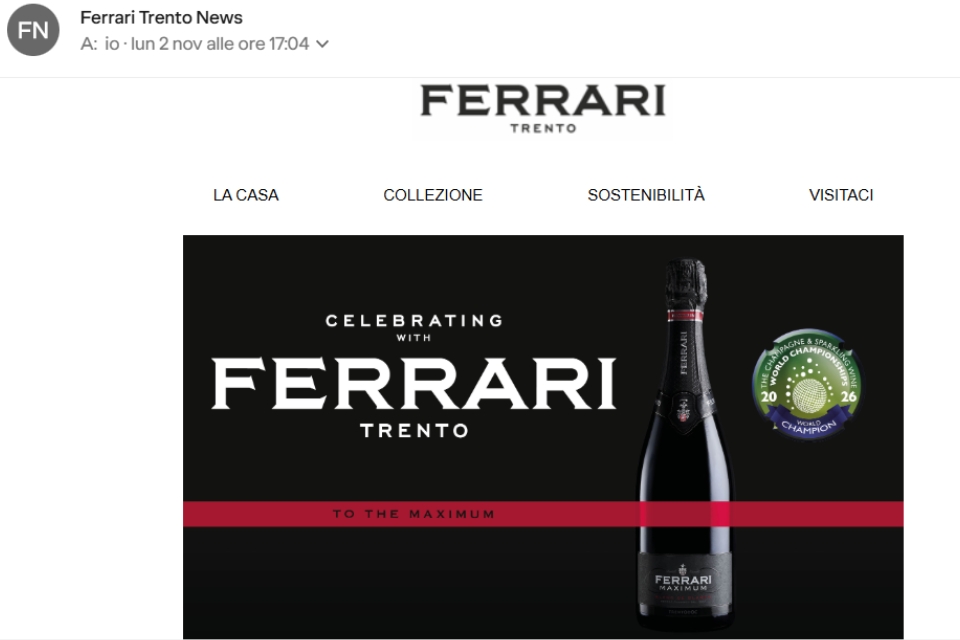
The magnum conquers the world title. The 75 cl receives silver. In the newsletter celebrating Ferrari Maximum Blanc de Blancs, released by the Lunelli family winery on November 2, the awarded format disappears from the subject line, the title, and the main text dedicated to the recognition. The results of the Champagne & Sparkling Wine World Championships 2026 (CSWWC), however, clearly distinguish between the two champions. And this is no small detail.
| Format | Official result |
|---|---|
| Magnum, 150 cl | Gold, Blanc de Blancs world champion, best Italian sparkling wine, best Trentodoc |
| 75 cl | Silver |
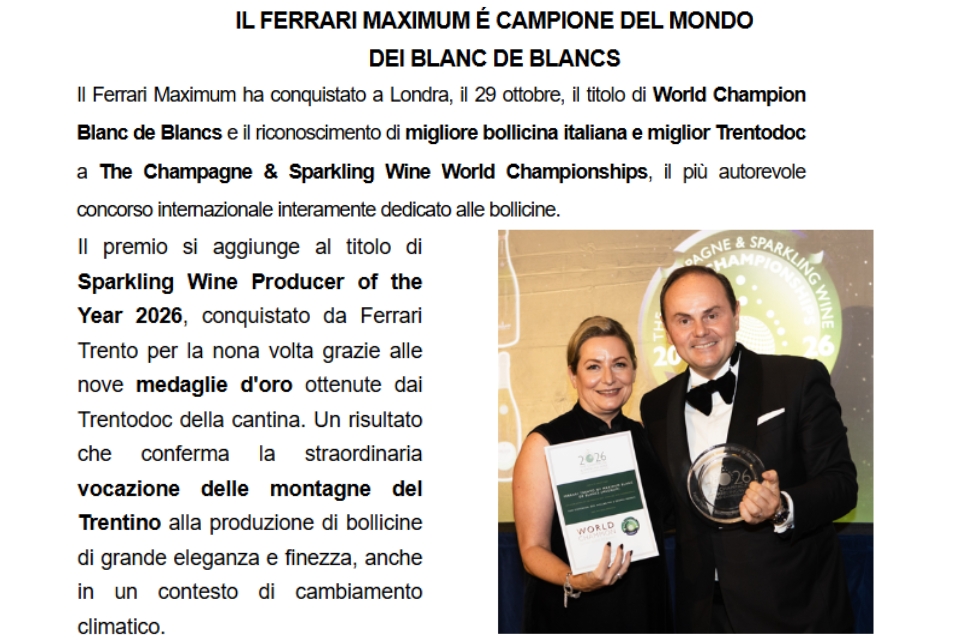
The three titles belong to the champion in magnum. The smaller bottle participated in the same edition, obtaining a different rating. In the communication sent to newsletter subscribers, the word “Magnum” is only distinguishable by enlarging the photographed diploma (how many did so? Few or none). On the Ferrari website, however, the news from October 30 correctly specifies the format.
The discrepancy therefore concerns the clarity of the messages spread by the company to its newsletter subscribers. The communication may lead the reader to extend the recognition to the cuvée, regardless of the bottle capacity. Even the product depicted in the graphics can be misleading: the volume is illegible and, indeed, the silhouette alone might lead one to identify it as a 75 cl rather than a magnum.
THE “CHAMPIONS LEAGUE” OF CHAMPAGNES, WITH THE TOP SEEDS ELSEWHERE
The format is only one of the necessary clarifications. The world title also requires knowing who can compete for it. The CSWWC excludes Deluxe Champagnes, equivalent to cuvées de prestige, from the standard world titles by style. The stated reason is to prevent very expensive wines from dominating these awards. They remain eligible for the absolute recognition race. Champagne & Sparkling Wine World Championships
The football comparison comes naturally: a Champions League of sparkling wines in which some of the most prestigious teams are diverted to another bracket, to make room for competitors. As if PSG, Real Madrid, Barcelona, and Manchester City played in a league of their own, while cups with world-renowned names and resonance were awarded to teams deliberately declared “inferior.” A detail that the public should know more clearly to correctly interpret the value of a CSWWC recognition.
Commercial prestige, of course, offers only an analogy with top seeds: qualitative superiority remains to be proven in the glass. In 2026, Dom Ruinart Blanc de Blancs 2013 takes the absolute title, while Ferrari wins the Blanc de Blancs title. The result reflects different paths. It would therefore be improper to deduce from the category title a superiority over all Champagnes attributable to the same style.


MAZZOLINO AND THE WEIGHT OF RECOGNITIONS
For Tenuta Mazzolino, Blanc de Noirs world champion with the 2021 vintage, the awarded sample is indeed in 75 cl. The winery’s official communication, unlike what happened with Ferrari Trento Doc, identifies the vintage and category. This title, however, also belongs to the system that excludes Deluxe Champagnes from standard world comparisons by style. It must therefore be read within that perimeter, without transforming it into a certification of superiority over every Blanc de Noirs produced in the world.
Another element concerns the accumulation of awards. The same wine receives the world title and three territorial recognitions: best sparkling wine of Oltrepò Pavese, best vintage Blanc de Noirs Brut of the area, and best organic sparkling wine of Oltrepò.
THE CONFIDENTIALITY THAT PROTECTS BRANDS
The CSWWC openly explains why it only publishes golds and silvers: reducing reputational risk can encourage the participation of major producers. For Deluxe Champagnes, the protection increases: only gold is published. A silver, which can be publicly used by other sparkling wines, remains confidential for a prestige cuvée. Curious, isn’t it?
The producer thus obtains a communicable success. Or they maintain anonymity, guaranteed by the competition itself. The consumer, on the other hand, misses part of the comparison: the absence of a wine can mean a lack of entry, or a performance insufficient to be announced.
Selectivity also deserves some calculation. Out of a thousand declared samples, in 2026, 156 golds and 237 silvers are awarded: 39.3% of entrants. Another 322 wines, according to the organizers, would have deserved a hypothetical bronze. Including them would bring the total to 71.5%.
The site criticizes other competitions precisely for the high percentage of winners obtained by including bronzes and mentions. Why, then, bother communicating the share of potential bronzes? Thresholds and participants may differ, so percentages prevent automatic comparisons. However, they show how much the choice to make only certain levels of judgment public weighs.
PRODUCER OF THE YEAR AND NUMBER OF ENTRIES
Ferrari wins the title of Sparkling Wine Producer of the Year with nine golds. The official criterion is the highest absolute number of gold medals. The award values a range capable of expressing numerous excellent champions. Therefore, it is directly conditioned by the breadth of participation: the more cuvées, vintages, and formats are entered, the greater the opportunities to accumulate results.
The standard 2026 fee is £169 per wine, reduced to £149 for early bird entries. Four bottles per sample must be sent, even for large formats; discounts are provided for multiple and cumulative entries. Financial and product availability thus enters into the possibilities of competing with an extensive range.
The promotional value of those brands makes control over their use decisive: what indications must accompany them in newsletters, catalogs, and on bottles? And what checks ensure that format, vintage, and category remain recognizable even after the award ceremony?