IN BREVE
- A Montefalco 2026 confirms the shift in approach to Sagrantino, with only 12 samples of the new 2022 vintage available.
- Trebbiano Spoletino emerges as the star wine, with consistently high quality and growing popularity compared to Sagrantino.
- Producers are moving toward more ready and accessible wines, with a tendency to promote a more “ready” style of Sagrantino.
- Montefalco Rosso wines show a pursuit of immediacy and drinkability, though with variable results.
- In the background of the event, also the dual identity of Trebbiano Spoletino, which can be either Doc Spoleto or Montefalco Doc Bianco.
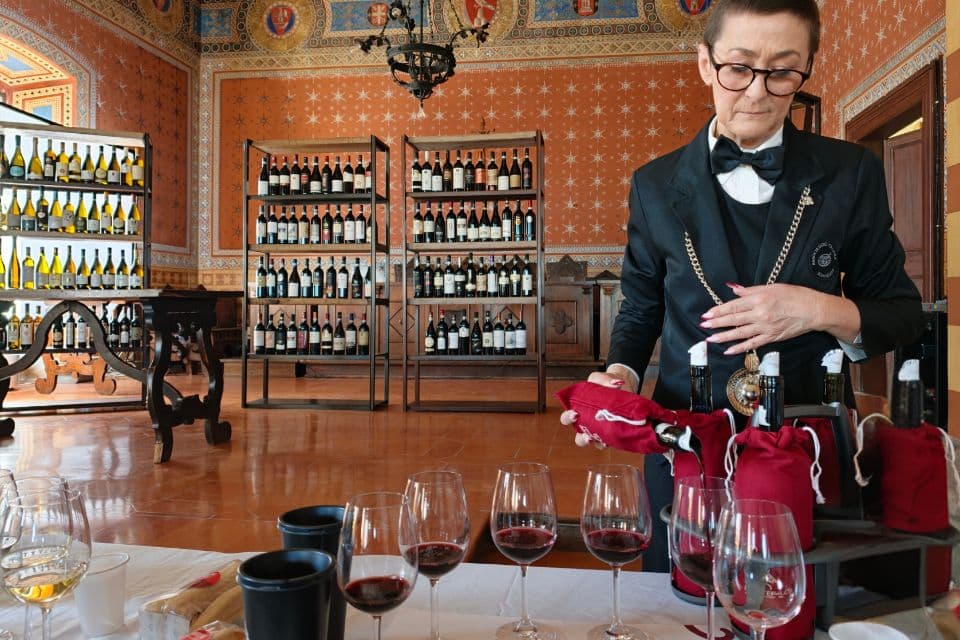
Less and less Sagrantino di Montefalco and more and more Trebbiano Spoletino and Montefalco Rosso. With the shift from “Anteprima Sagrantino” to “A Montefalco“, the Consortium of Umbria’s renowned wine seems to have changed its skin, but above all its color. So much so that one wonders whether the new name of the event, launched in 2024, isn’t already outdated. Only 12 samples of the 2022 vintage of Sagrantino di Montefalco Docg were made available for technical tasting in the hall of the Municipality of Montefalco, with service by Ais Umbria sommeliers. Among these, no fewer than 3 from a single producer: Arnaldo Caprai.
Too few to continue speaking of Sagrantino’s centrality in the most important annual event for the Consortium led by Paolo Bartoloni. Who prefers to have the new vintage tasted (and evaluated) by an “external commission,” rather than by the entire press invited to the territory, who are left—to put it bluntly—with “the crumbs.” The reasons would be various. And the conditional is necessary, because the versions are multiple.
SAGRANTINO DI MONTEFALCO, PREVIEW SAMPLES PLUMMET
They range from harsh criticism of some samples not yet “ready,” in editions when among the Sagrantinos presented there were also “barrel trials”, to the desire to present only wines already capable of telling the vintage well. Up to the introduction, now for a couple of editions, of the rule requiring at least one year of bottle aging for wines presentable to the press in the technical tasting room.
Justifications that alone are not enough to explain such a small number of samples of the new vintage, given a substantial number of producers (65 members of the Consortium) and—not least—journalists and operators who attended “A Montefalco” 2026, from April 26 to 28. Weighing heavily, in the eyes of many observers, is also the absence of wines from major names in the territory such as Tabarrini, Pardi, and Fattoria Colleallodole – Milziade Antano, to name just three (significant ones).
“A MONTEFALCO” ROSSO: MORE AND MORE SPACE FOR SAGRANTINO’S FALLBACK DOC
Beneath the superficiality of numbers, always interpretable at the reader’s discretion, there are the facts. Sagrantino di Montefalco, a wine undergoing a profound revolution that is leading producers to release more “ready” wines, without the need for decades of waiting—especially regarding tannins—is not experiencing its most glorious period in the domestic and international market. By the way: no mention, with official figures in hand, of the denomination’s performance during the Consortium’s presentations.
All the more reason, evidently, to focus communication on the “fallback denomination”: Rosso di Montefalco, “ready” sooner and increasingly attractive in terms of quality-price ratio. But what has consolidated, since the first year of the metamorphosis from “Anteprima Sagrantino” to “A Montefalco,” is above all the role of the territory’s great rising star: the white Trebbiano Spoletino. Which has ended up accompanying—and overshadowing, in some ways—even the quintessential Umbrian white wine: Grechetto.
THE TREBBIANO SPOLETINO PARADOX: TWO DENOMINATIONS FOR THE RISING STAR
On this front too, however, some perplexity emerges. The Montefalco and Spoleto area finds itself in the paradoxical situation of promoting two different wines obtainable 100% from Trebbiano Spoletino grapes: Doc Spoleto Trebbiano Spoletino and Montefalco Bianco. With the expansion of the Doc Spoleto production zone to the Montefalco area, 5 municipalities overlap with the Montefalco Bianco area, out of a total of 9 distinct municipalities.
In essence, in these five municipalities the same wine can be labeled as “Trebbiano Spoletino Doc Spoleto” or “Montefalco Doc Bianco.” But Montefalco Bianco can be produced with a minimum of 50% and a maximum of 100% Spoletino, while Doc Spoleto requires pure Spoletino (minimum 85%, according to EU laws). A dispersion of energy—in communication terms—that also risks confusing consumers about the true profile of Trebbiano Spoletino. A denomination that, with the expansion of the zone, aims to double production to reach the mark.

TREBBIANO SPOLETINO, THE WHITE WINE SHIFTING MONTEFALCO’S BALANCE
While awaiting publication of all scores, the clearest picture from the technical tasting room at the Municipality of Montefalco comes from Trebbiano Spoletino. Not only for the number of samples, but for the average quality that emerged from the tasting. In the Spoleto Trebbiano Spoletino Doc category, the 19 wines tasted show an average of 90.6 points, with several labels consistently above 92.
It’s the most dynamic segment among the whites present at “A Montefalco” 2026. The denomination appears mature now, though still traversed by different styles: taut and savory wines, fuller and more golden interpretations, versions with maceration hints (a novelty recently regulated by the Consortium), more gastronomic trials, and some samples marked by slight oxidative drifts.
The most interesting finding is Trebbiano Spoletino’s ability to sustain different winemaking approaches without losing recognizability. In the best tastings, yellow citrus, peach, apricot, chamomile, aromatic herbs, fennel, anise, bergamot, and a salinity that gives depth to the drink emerge. Some wines work on verticality, others on substance.
Still others introduce wood, maceration, or greater fruit ripeness. When balance succeeds, the result is among the most convincing of the entire tasting. Scacciadiavoli 2024 and Perticaia “Del Posto” 2023 reach 94 points; Bocale 2024, Perticaia 2024, Valdangius “Campo de Pico” 2024, Antonelli “Vignatonda” 2023, and Valdangius “Filium” 2023 stand at 93.
GRECHETTO DI MONTEFALCO, MORE COMPRESSED IDENTITY
Montefalco Grechetto Doc confirms the grape’s historic role, but in direct comparison appears less incisive than Trebbiano Spoletino. The 6 samples tasted range between 86 and 90 points, with an average of 88.3. The profile is more contained, less expansive. Notes of exotic fruit, ripe fruit, salinity, and a phenolic component that in some cases approaches a tannic sensation recur. The denomination shows good consistency, but less momentum.
The most convincing sample is Montefalco Grechetto “Montacchiello” 2022 from Tenuta di Saragano, rated 90 points: a wine still present, played on the softness of the fruit, with fresh and savory structure. Also good are Scacciadiavoli 2025, Terre de la Custodia “Aurem” 2024, and Colle Ciocco “Clarignano” 2023, all at 89 points. Overall, however, Grechetto seems today more an identity memory than the true qualitative engine of the Montefalco white segment.
MONTEFALCO BIANCO DOC, BETWEEN TREBBIANO SPOLETINO AND SOFTER INTERPRETATIONS
Montefalco Bianco Doc occupies an intermediate position. The 6 samples tasted register an average of 89.2 points. The varietal base is often dominated by Trebbiano Spoletino, sometimes pure, sometimes in blend with Chardonnay, Viognier, or other varieties. The result is a less defined category compared to Spoleto Trebbiano Spoletino Doc, but not without interest.
In the best cases, the category finds balance between salinity, ripe fruit, and greater roundness. Terre de la Custodia “Plentis” 2022, with 91 points, shows this direction well: the salinity of Trebbiano Spoletino is softened and made more international by the presence of Chardonnay.
Tenuta Bellafonte “Sperella” 2025 and Tenuta Alzatura “Aria di Casa” 2023 stop at 90 points, with different registers: more soaring and forward-looking the first, softer and closer to a Burgundian idea the second. The category works when it doesn’t become generic. Where the fruit loses purity or oxidative notes appear, the profile weakens rapidly.
SPOLETO TREBBIANO SPOLETINO SPUMANTE AND SUPERIORE, NUMBERS STILL TOO LIMITED
More difficult to trace a solid profile for Spoleto Trebbiano Spoletino Spumante Doc and for Spoleto Trebbiano Spoletino Superiore Doc. The samples are few: 3 in the first case, 2 in the second. The Spumante shows an average of 88.7 points, with Antonelli 2021 at 91 points as the most convincing tasting. The direction seems interesting, especially when the “bubble” enhances the grape’s salinity and verticality.
It remains, however, an area still under construction, with room for work on the finesse of the perlage and aromatic definition. Trebbiano Spoletino Superiore Doc, with only 2 samples, does not allow definitive evaluations. Le Cimate “Riserva del Cavalier Bartoloni” 2022 reaches 90 points, showing a more oily and gastronomic interpretation.
Colle Uncinano 2022 stops at 88. The category would need greater presence in tasting to understand whether the “Superiore” designation truly translates into greater complexity or remains, at least for now, a poorly represented niche.
MONTEFALCO ROSSO DOC, THE FALLBACK DENOMINATION IS ALREADY THE PRESENT
Montefalco Rosso Doc is the category that best tells the story of the territory’s pursuit of immediacy. The 25 samples tasted have an average of 88.9 points, with peaks at 91. It’s not the denomination of absolute peaks. But it’s the one in which the attempt to build more accessible wines, centered on drinkability, fruit, and less muscular management of the tannic component is most clearly read.
Sangiovese remains the cornerstone of the category, with Sagrantino often used in contained percentages and with Merlot, Canaiolo, Colorino, or Barbera completing the picture. The best Montefalco Rosso wines work on cherry, strawberry, blackberry, aromatic herbs, wild fennel, Mediterranean scrub, and freshness.
Moretti Omero 2023 and Colle Ciocco 2021 reach 91 points. Following at 90 are Arnaldo Caprai “Vigna Flaminia Maremmana” 2023, Goretti – Fattoria Le Mura Saracene 2023, Lungarotti “Tenuta Brancalupo” 2023, Scacciadiavoli 2023, Tenuta Alzatura 2023, Montioni 2022, Romanelli “Capo de Casa” 2022, Fongoli 2021, and Tenuta di Saragano 2021.
The category, however, remains uneven. Alongside fragrant, crisp, and already approachable wines, samples marked by cooked fruit, volatile acidity, dry tannins, green notes, or oxidative profiles appear. It’s a denomination useful to the market, perhaps even strategic, but not yet uniformly resolved.
MONTEFALCO ROSSO RISERVA DOC, MORE AMBITION BUT ALSO MORE RISKS
Montefalco Rosso Riserva Doc raises the bar, but not always with linear results. The 17 samples tasted have an average of 89.9 points, higher than that of Montefalco Rosso, but with a very wide range: from 84 to 95 points. The Riserva is the category in which production ambition emerges most forcefully, along with the risks of over-extraction, overly evident wood, or approaches still tied to an idea of power, close to that of traditional Sagrantino di Montefalco.
When it works, Montefalco Rosso Riserva is one of the most convincing categories of the tasting. Fongoli “Serpullo” 2022, rated 95 points, is the peak of the category: pure fruit, dynamic palate, salinity, and depth. Valdangius 2021 reaches 94, with tension, precision, and perspective. Antonelli 2022, Perticaia 2020, and Tenuta di Saragano 2018 stand at 93 points. Here the denomination demonstrates it can express complex, territorial, authentic, and contemporary wines.
The problem is the average consistency of style. Some samples show marked wood, not always integrated acidity, or overly aggressive tannins. The Riserva thus confirms a dual nature: it can be one of the territory’s best cards, but only when the pursuit of structure doesn’t stifle freshness, fruit, and drinkability.
MONTEFALCO SAGRANTINO DOCG, LESS CENTRAL BUT STILL THE QUALITATIVE PEAK
The paradox of “A Montefalco” 2026 is all here: Sagrantino loses numerical centrality, but remains the category with the highest average qualitative value among commercial reds. In the 42 samples present in the tasting room—from various vintages—the average is 91.4 points, with peaks up to 96. The data confirms that Sagrantino, when well interpreted, remains the territory’s deepest and most ambitious wine. But it also confirms how difficult it is to tame.
The tasting notes show a denomination in the midst of transition. The best samples no longer seek only concentration, alcohol, extraction, and waiting. They aim for more readable fruit, balsamic freshness, more precise wood management, less pronounced tannins, and greater drinkability. Arnaldo Caprai “25 Anni” 2021 reaches 96 points. At 95 are Fongoli “Fracanton” 2017, Perticaia 2019, Antonelli “Molino dell’Attone” 2020, and Colle Ciocco 2021. At 94 is Antonelli “Chiusa di Pannone” 2020.
The best Sagrantino today speaks of cherry, blackberry, blood orange, Mediterranean scrub, spices, balsamic notes, licorice, coffee, tobacco, and well-integrated tertiary aromas. In less successful cases, however, dry tannins, bitter closures, dusty wood, cooked fruit, oxidation, volatile acidity, or disjointed phenolic sensations emerge. The denomination remains powerful and identity-defining, but demands precision. It doesn’t forgive shortcuts or extreme simplifications.
SAGRANTINO 2022 PREVIEW, FEW SAMPLES BUT CLEAR SIGNALS
The 12 Sagrantino 2022 presented in preview have an average of 93 points. It’s a high figure, but must be read with caution: the number of samples is limited and the selection doesn’t represent the entire denomination. Precisely for this reason, rather than photographing the vintage as a whole, the tasting shows the direction chosen by part of the territory.
The main signal is the pursuit of a Sagrantino more readable already in youth. Antonelli 2022, rated 94 points, is described as a wine surprisingly focused on drinkability for a preview, with open fruit, fairly ready tannins, and less glyceric-alcoholic weight. Bocale 2022, at 96 points, stands out for ripe fruit, deliciousness, and tannins in the integration phase. Arnaldo Caprai confirms the weight of its range, with “25 Anni” 2022 at 95 points, “Collepiano” 2022 at 94, and “Valdimaggio” 2022 at 92.
The nature of the grape variety remains evident nonetheless. Even in the best samples the tannins are lively, dense, sometimes aggressive or drying. Some wines need time; others already seem oriented toward more immediate and contemporary enjoyment. Perhaps this is where Sagrantino’s future is at stake: not in renouncing its structure, but in the ability to make it more precise, less off-putting, and more consistent with today’s market.
And if a comparison with foreign wines can be made, it’s to be found in the work of Rhône producers, much more than those of Bordeaux or any other Italian region. In a well-arranged blind tasting, the best contemporary expressions of Sagrantino di Montefalco could “blend in” with the legendary Grenache, Syrah, and Mourvèdre of Châteauneuf-du-Pape. Even as single varietals, especially regarding Syrah.
SAGRANTINO PASSITO, A DIFFICULT CATEGORY TO REVIVE
Montefalco Sagrantino Passito Docg appears the most problematic category in the picture. The 8 commercial samples have an average of 88.5 points. The 3 preview 2022 samples rise to 92.3, but the number is too limited to speak of a reversal of trend. The category remains difficult, both technically and in terms of positioning.
In commercial passitos, dry tannins, grainy sensations, significant sweetness, and not always balanced profiles recur. Dionigi 2020, with 91 points, is the best result of the series, thanks to aromatic herbs and ripe fruit. Romanelli “Cocrè” 2019, Terre de la Custodia “Melanto” 2020, La Veneranda 2021, and Scacciadiavoli 2021 stop at 89. The sweetness of Sagrantino passito, if not supported by freshness and well-managed tannin, risks becoming difficult to balance.
More promising are the three Passito 2022 in preview. Antonelli 2022 reaches 95 points, with tannins in their place and convincing drinkability even at higher temperature. Valdangius “Angelina” 2022 shows balsamic notes, pennyroyal, and freshness, and a sweetness destined to integrate better. Terre di San Felice 2022 stops at 90. The category still makes sense only if it manages to avoid the monumental effect and recover balance, drinkability, and aromatic precision. A bit like the dry version, where the watchwords now seem to come down to two: precision and authenticity.